woodland wildflower
Goat's rue
Tephrosia virginiana
Also known as Virginia Tephrosia, Devil's Shoestring
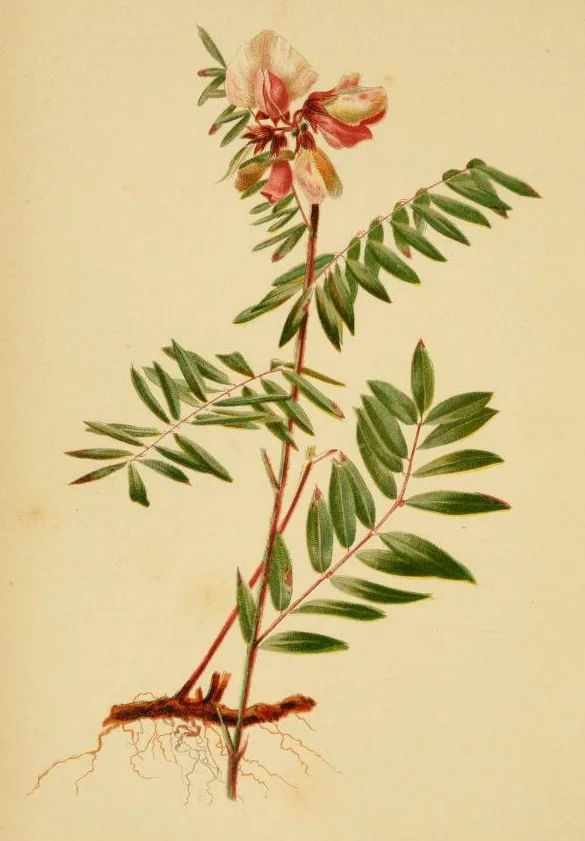 1 of 3
Native to much of the USA
Southern New Hampshire to West Virginia, southern Michigan and extreme southeastern Minnesota, south to Florida, Texas and Kansas
- Light Full sun to shade Sun tolerance
- Moisture Dry Moisture preference
- Zones 4–9 Cold to heat range
- Bloom Apr–Jul Flowering time
- Height up to 2 ft to 0.6 m
- Life cycle Perennial Annual to perennial
In the garden
A woodland wildflower for sun through shade and lean, dry soil. Its pink and yellow flowers peak in May. At up to 2 ft, it suits shade gardens and woodland edges. Hardy in USDA zones 4–9.
Growing conditions
Light
Full sun Partial shade Full shade
Moisture
Dry Moist Wet
Hardiness zones
Find your zone:
When it blooms
The Goat's rue's pink and yellow flowers bloom April to July, peaking in May. This late-spring display draws bees and beetles.
Goat's rue blooms pink & yellowFoliage
Pollinators & wildlife
- Bees Common Eastern Bumble Bee
also Brown-belted Bumble Bee, Flat-tailed Leafcutter Bee, broad-handed leafcutter bee +20 more
Southern Plains Bumble Bee, Eastern Miner Bee, Petulant Leafcutter Bee, Squash Longhorn-Cuckoo, Small-handed Leaf-cutter Bee, Megachile brevis, Spot-fronted Wool-carder Bee, Dwarf Cellophane-cuckoo Bee, Lasioglossum cinctipes, Osmia conjuncta, Black-tailed Long-horned Bee, Anthidium psoraleae, Yellow-spotted Cuckoo Nomad Bee, Nomada salicis, Coelioxys modesta, Melissodes dentiventris, Foveolate Sweat Bee, Anthidiellum notatum notatum, Megachile mucida, cranberry leafcutter bee - Beetles Mournful Long-horned Beetle also Althaeus hibisci, Mordella scutellaris, Euderces picipes
- Butterflies Pearl Crescent also Eastern Tailed-Blue, Horace's Duskywing
- Also visited by
- Flower flies: Anthrax palliata
- Moths: Jaguar Flower Moth
Butterflies that use this plant
Documented host and nectar records. Each links to a planting guide for that butterfly.
- Eastern tailed-bluenectar
- Pearl crescentnectar
Full plant details
Where it grows
- Habitat
- WoodlandThe wild plant community it grows in.
- Native range
- Much of the USAUnited States (33): AL, AR, CT, DC, DE, FL, GA, IA, IL, IN, KS, KY, LA, MA, MD, MI, MN, MO, MS, NC, NH, NJ, NY, OH, OK, PA, RI, SC, TN, TX, VA, WI, WV. Where it grows wild on its own, by state and province.
- Native distribution
- Southern New Hampshire to West Virginia, southern Michigan and extreme southeastern Minnesota, south to Florida, Texas and KansasThe same native range, usually more exact than the state list, and often noting where it has spread beyond it.
Growing conditions
- Light
- Full sun to shadeHow much sun it takes, from full sun to full shade.
- Moisture
- DryThe soil dampness it prefers, from dry to wet.
- Hardiness zones
- USDA 4–9 · Canadian 5–7The cold-to-heat climate range it survives.
- Soil
- Sandy soilsThe soils it grows in naturally.
- Soil texture
- Light to heavy (sandy to clay)The soil grade it prefers, from sand to clay.
- Soil pH
- Mildly acid to mildly alkalineThe acidity to alkalinity it tolerates (7 is neutral).
- Soil quality
- Low (tolerates poor soil)How rich a soil it needs. Many natives prefer lean soil and flop in rich beds.
Growth & form
- Height
- up to 2 ft (to 0.6 m)Typical mature height.
- Life cycle
- PerennialWhether it lives a single season (annual), two (biennial), or returns for years (perennial).
Flowers, foliage & fruit
- Type
- WildflowerWhat kind of plant it is.
- Bloom
- Apr–JulWhen it flowers.
- Flower color
- Pink, YellowThe bloom color, or colors.
- Fruit/Seeds
- ripens May–SepThe seed or fruit it sets after flowering.
- Toxicity
- Poisonous if eatenWhether any part is poisonous to people or pets.