woodland wildflower
Goatsbeard
Aruncus dioicus
Also known as Bride's Feathers, Goat's Beard
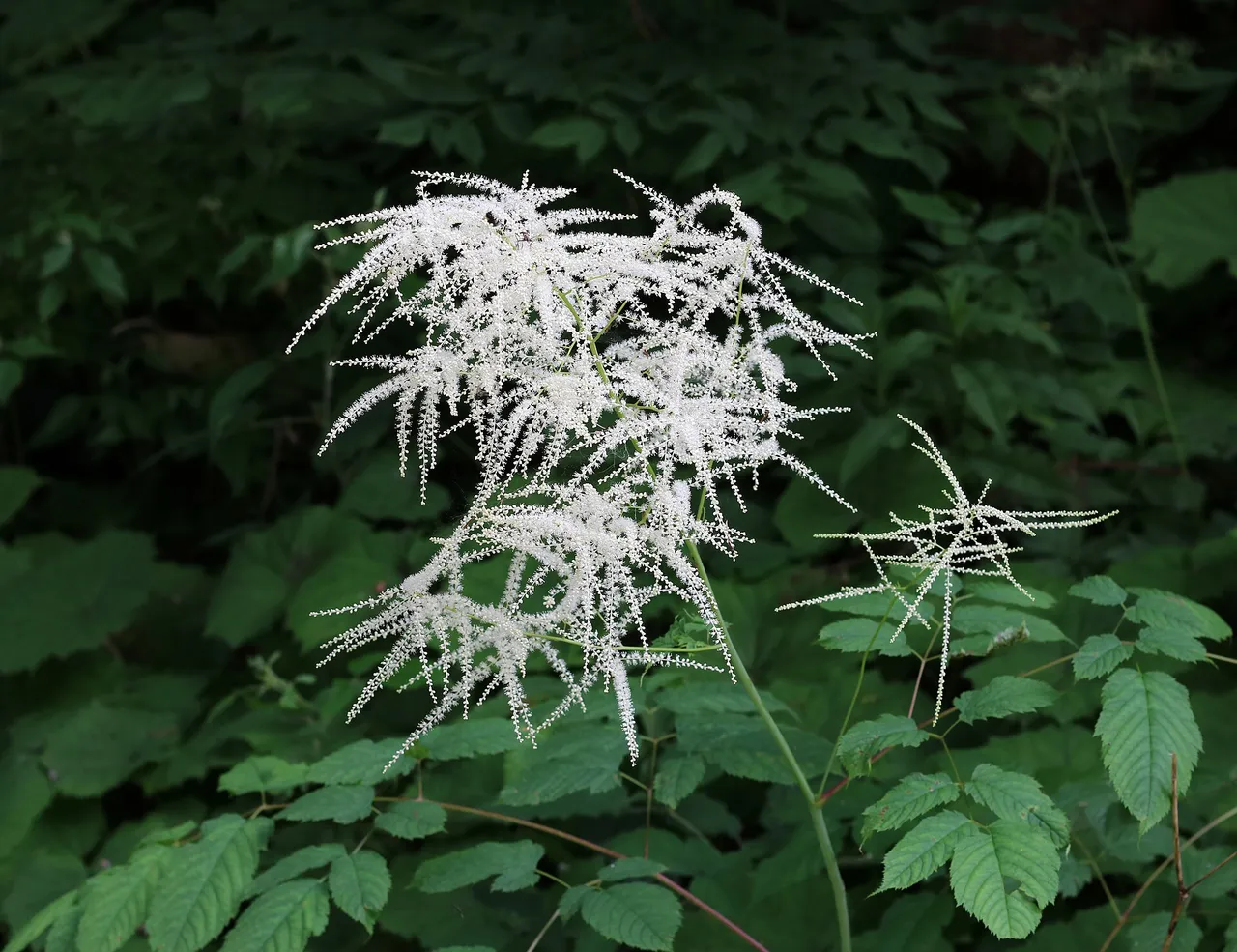
Native to much of the USA
Pennsylvania and Iowa, south to North Carolina, Alabama, and Arkansas
- Light Full sun to shade Sun tolerance
- Moisture Moist to wet Moisture preference
- Zones 3–9 Cold to heat range
- Bloom May–Jun Flowering time
- Height up to 6 ft to 1.8 m
- Life cycle Perennial Annual to perennial
In the garden
A woodland wildflower for sun through shade and consistently moist to wet soil. At up to 6 ft, it needs room in shade gardens and woodland edges. Hardy in USDA zones 3–9.
Growing conditions
Light
Full sun Partial shade Full shade
Moisture
Dry Moist Wet
Hardiness zones
Find your zone:
Pollinators & wildlife
- Bees Common Eastern Bumble Bee
also Western Honey Bee, Pure Green Sweat bee, Fuzzy-Horned Bumble Bee +96 more
Orange-legged Furrow Bee, Agapostemon texanus, Golden Sweat Bee, Modest Masked Bee, Spurred Ceratina, Sitka Bumble Bee, Hawthorn Mining Bee, Silky Striped Sweat Bee, Bristle Sweat Bee, Slender-faced Masked Bee, Rugose-chested Sweat Bee, Cresson's Mining Bee, Articulated Nomad, Punctate Masked Bee, Cherry Mining Bee, Nude Mining Bee, Annulate Masked Bee, Ceratina dupla, Hylaeus affinis, Long-lipped Miner, Hairy masked Bee, Meadow Parsnip Miner Bee, Experienced Sweat Bee, Thistle Longhorn-Cuckoo, Lasioglossum cinctipes, Fragile Miner Bee, Little Masked Bee, Common Masked Bee, Fox's Sweat Bee, Nomada affabilis, Andrena personata, Buff-tailed Bumble Bee, Nomada bifasciata, Black Masked Bee, Large Masked Bee, Golden Furrow Bee, Andrena mendica, Tetragona dissecta, Coelioxys alternata, Lasioglossum sabulosum, Lasioglossum podolicum, Hylaeus glacialis, Hylaeus pfankuchi, Snowy Masked Bee, Hylaeus moricei, Andrena afrensis, Hylaeus pilosulus, Lasioglossum aeratum, Hylaeus tyrolensis, Hylaeus euryscapus, Hylaeus alpinus, Lasioglossum subfasciatum, Hylaeus duckei, Hylaeus paulus, Hylaeus sinuatus, Hylaeus taeniolatus, Hylaeus styriacus, Lasioglossum interruptum, Hylaeus gibbus, Narrowed Masked Bee, White-lipped Yellow-face Bee, Hylaeus kahri, Hylaeus difformis, Lasioglossum majus, Small Shiny Furrow Bee, Dotted Masked Bee, Hylaeus bifasciatus, Reed Yellow-face Bee, Horned Masked Bee, Lasioglossum lucidulum, Hylaeus crassanus, Lasioglossum glabriusculum, Chalk Yellow-face Bee, Lasioglossum marginatum, Halictus leucaheneus, White-jawed Yellow-face Bee, Lasioglossum tricinctum, Hylaeus imparilis, Fringed Furrow Bee, Lasioglossum intermedium, Osmia mustelina, Short-horned Yellow-face Bee, Gredler's Masked Bee, Onion Yellow-face Bee, Variegated Masked Bee, Lasioglossum lineare, Forest Masked Bee, Hylaeus globula, Japanese Small Carpenter, Cuneate Nomad Bee, Lasioglossum tegulare, Sanicle Masked Bee, Hylaeus illinoisensis, Robertson's Miner Bee, Plated Miner Bee, Leavitt's Armored-Resin bee - Beetles Asian Lady Beetle
also Spotted Cucumber Beetle, Margined Leatherwing Beetle, Fourteen-spotted Lady Beetle +38 more
Yellow Velvet Beetle, Strangalepta Flower Longhorn Beetle, Lined Longhorn Beetle, Round-necked Longhorn Beetle, Slender Flower Longhorn Beetle, Euderces pini, Pubescent Tumbling Flower Beetle, Trachysida mutabilis, Mournful Long-horned Beetle, Agrilaxia flavimana, Ornated Tumbling Flower Beetle, Althaeus hibisci, Typocerus badius, Disonycha limbicollis, Spotted Longhorn Beetle, Mordellistena aspersa, Pseudotolida lutea, Propylaea quatuordecimpunctata, Brachyleptura vagans, Strangalia acuminata, Eastern Rhopalophora, Etorofus subhamatus, Valgus canaliculatus, Euderces picipes, Broom Seed Beetle, Idiostrangalia contracta, Parastrangalis nymphula, Callimoxys sanguinicollis, Mordellistena biplagiata, Bimaculate Longhorn Beetle, Downy Long-horned Beetle, Grammoptera exigua, Metacmaeops vittata, Tumbling Ragdoll, Leptalia macilenta, Mordellochroa abdominalis, Molorchus umbellatarum, Evodinus monticola vancouveri - Flower flies Margined Calligrapher
also Common Drone Fly, Transverse-banded Flower Fly, Oblique Streaktail +9 more
Thick-legged Hover Fly, Eurasian Drone Fly, Black-shouldered Drone Fly, Common Flower Fly, Yellow-shouldered Blacklet, Marmalade Hover Fly, Scar-horned Blacklet, Black-horned Pufftail, Short-haired Wrinklehead - Also visited by
- Moths:
Virginia Ctenucha Moth, Eight-spotted Forester Moth +7 more
Black-bordered Lemon Moth, Delicate Cycnia Moth, White-striped Black, Brown Bark Carpet Moth, Common Spring Moth, Bluish Spring Moth, Eufidonia notataria - Butterflies:
Red-banded Hairstreak, Banded Hairstreak +2 more
Striped Hairstreak, Cyaniris neglecta - Wasps: Fraternal Potter Wasp, Four-toothed Mason Wasp
- Moths:
Butterflies that use this plant
Documented host and nectar records. Each links to a planting guide for that butterfly.
- Banded hairstreaknectar
- Red-banded hairstreaknectar
- Summer azurenectar
Full plant details
Where it grows
- Habitat
- WoodlandThe wild plant community it grows in.
- Native range
- Much of the USAUnited States (23): AL, AR, DC, GA, IA, IL, IN, KY, MD, MI, MO, MS, NC, NJ, OH, OK, OR, PA, SC, TN, VA, WI, WV. Where it grows wild on its own, by state and province.
- Native distribution
- Pennsylvania and Iowa, south to North Carolina, Alabama, and ArkansasThe same native range, usually more exact than the state list, and often noting where it has spread beyond it.
Growing conditions
- Light
- Full sun to shadeHow much sun it takes, from full sun to full shade.
- Moisture
- Moist to wetThe soil dampness it prefers, from dry to wet.
- Hardiness zones
- USDA 3–9 · Canadian 1–9The cold-to-heat climate range it survives.
- Soil
- Average to acid, mesic to moist soilThe soils it grows in naturally.
- Soil texture
- Light to heavy (sandy to clay)The soil grade it prefers, from sand to clay.
- Soil pH
- Mildly acid to mildly alkalineThe acidity to alkalinity it tolerates (7 is neutral).
- Water use
- Medium to highHow thirsty it is, a rough guide to how often to water.
Growth & form
- Height
- up to 6 ft (to 1.8 m)Typical mature height.
- Spread
- ~10 ft (3 m)How wide one plant gets, a guide to spacing.
- Life cycle
- PerennialWhether it lives a single season (annual), two (biennial), or returns for years (perennial).
- Growth rate
- RapidA relative ranking versus other plants of the same type (USDA), not an absolute rate.
Flowers, foliage & fruit
- Type
- WildflowerWhat kind of plant it is.
- Bloom
- May–JunWhen it flowers.
- Flower color
- WhiteThe bloom color, or colors.
- Toxicity
- None knownWhether any part is poisonous to people or pets.