wetland shrub
He-huckleberry
Lyonia ligustrina
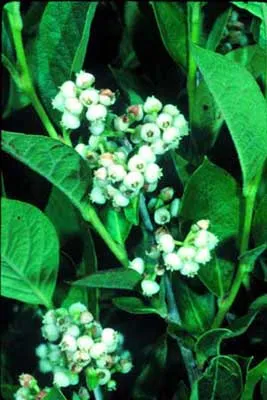
Native to much of the USA
Southeastern Maine to New York, Ohio, Kentucky and Arkansas, south to Florida and eastern Texas; more scattered in western part of its range
- Light Partial shade Sun tolerance
- Moisture Wet Moisture preference
- Zones 4–9 Cold to heat range
- Bloom Jun–Jun Flowering time
- Height up to 12 ft to 3.7 m
- Life cycle Perennial Annual to perennial
In the garden
A wetland shrub for partial shade and wet soil. At up to 12 ft, it needs room in rain gardens, pond edges, and damp low spots. Hardy in USDA zones 4–9.
Growing conditions
Light
Full sun Partial shade Full shade
Moisture
Dry Moist Wet
Hardiness zones
Find your zone:
Pollinators & wildlife
- Bees Common Eastern Bumble Bee
also Western Honey Bee, Two-spotted Bumble Bee, Perplexing Bumble Bee +8 more
Half-black Bumble Bee, Orange-tipped Wood-digger, Dark-winged Sweat Bee, Melitta melittoides, Kalmia Miner Bee, Perdita novaeangliae, Colletes productus, Xylocopa virginica virginica - Butterflies Silver-spotted Skipper
also Aphrodite Fritillary, Striped Hairstreak, Oak Hairstreak +1 more
Edwards' Hairstreak - Flower flies Eurasian Drone Fly
- Also visited by
- Wasps: Four-toothed Mason Wasp
Butterflies that use this plant
Documented host and nectar records. Each links to a planting guide for that butterfly.
- Aphrodite fritillarynectar
- Edwards' hairstreaknectar
- Silver-spotted skippernectar
Full plant details
Where it grows
- Habitat
- WetlandThe wild plant community it grows in.
- Native range
- Much of the USAUnited States (27): AL, AR, CT, DC, DE, FL, GA, KY, LA, MA, MD, ME, MS, NC, NH, NJ, NY, OH, OK, PA, RI, SC, TN, TX, VA, VT, WV. Where it grows wild on its own, by state and province.
- Native distribution
- Southeastern Maine to New York, Ohio, Kentucky and Arkansas, south to Florida and eastern Texas; more scattered in western part of its rangeThe same native range, usually more exact than the state list, and often noting where it has spread beyond it.
Growing conditions
- Light
- Partial shadeHow much sun it takes, from full sun to full shade.
- Moisture
- WetThe soil dampness it prefers, from dry to wet.
- Hardiness zones
- USDA 4–9 · Canadian 5–7The cold-to-heat climate range it survives.
- Soil
- Wet, poorly drained, acid soilsThe soils it grows in naturally.
- Soil pH
- 5.0–6.5The acidity to alkalinity it tolerates (7 is neutral).
- Soil quality
- LowHow rich a soil it needs. Many natives prefer lean soil and flop in rich beds.
Growth & form
- Height
- up to 12 ft (to 3.7 m)Typical mature height.
- Life cycle
- PerennialWhether it lives a single season (annual), two (biennial), or returns for years (perennial).
- Root depth
- 12+ in (30+ cm)How far the roots reach, a guide to drought resilience and transplanting.
Flowers, foliage & fruit
- Type
- ShrubWhat kind of plant it is.
- Bloom
- Jun–JunWhen it flowers.
- Flower color
- WhiteThe bloom color, or colors.
- Toxicity
- None knownWhether any part is poisonous to people or pets.
Propagation & seed
- Cold stratification
- Not requiredWhether seed needs a cold, moist spell before it will germinate.
- Propagation
- CuttingsHow to start new plants.
- Seed spread rate
- ModerateHow readily it self-sows. Slow or none means well-behaved, not a spreader.
- Seedling vigor
- MediumHow strongly young seedlings establish.