woodland wildflower
Rue anemone
Thalictrum thalictroides
Also known as Rue-anemone
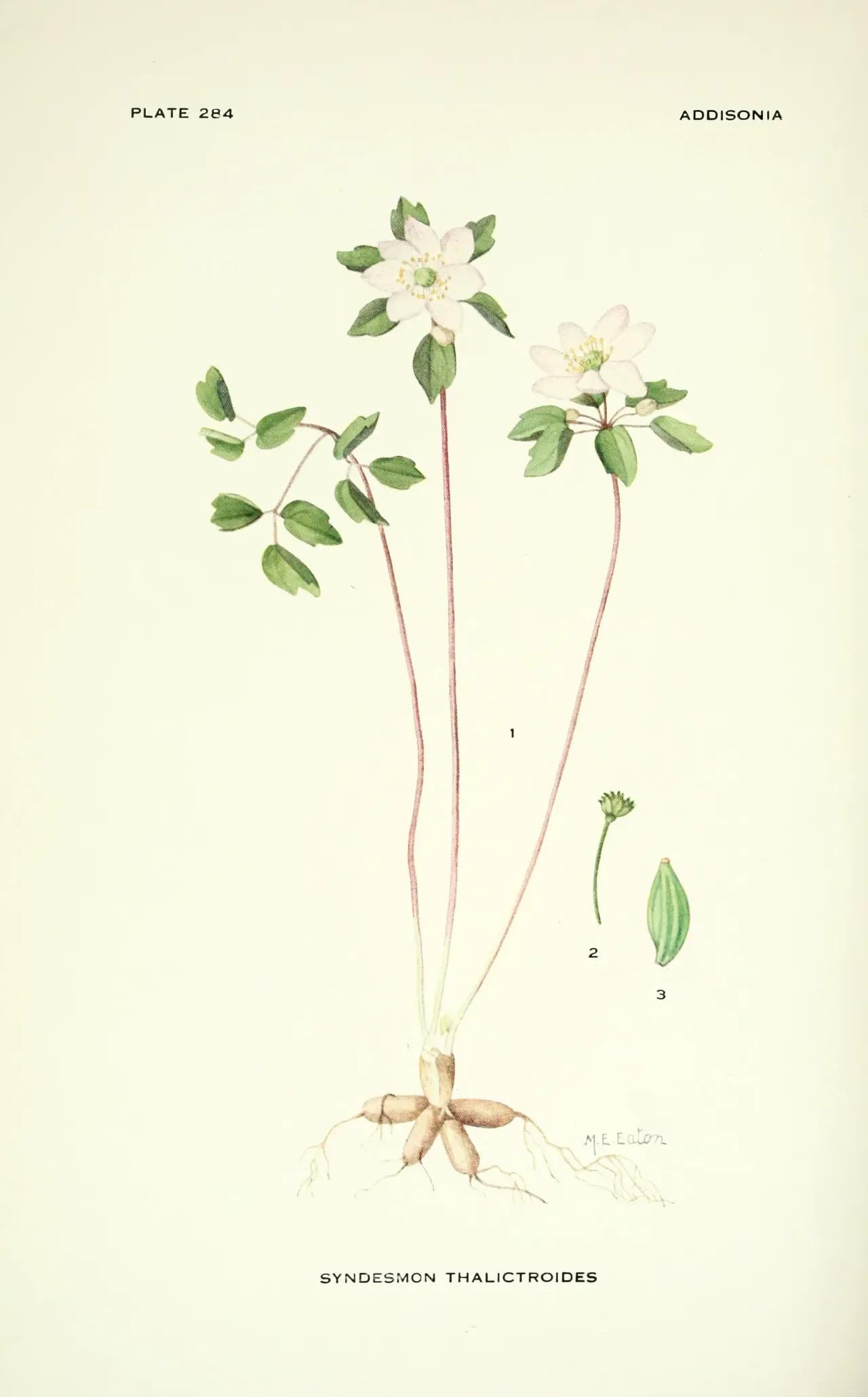 1 of 2
Native to much of the USA and southern Canada
Southwestern Maine to Minnesota, south to northwestern Florida, Mississippi, Arkansas and Oklahoma
- Light Partial shade Sun tolerance
- Moisture Moist Moisture preference
- Zones 4–8 Cold to heat range
- Bloom Mar–May Flowering time
- Height up to 1 ft to 0.3 m
- Life cycle Perennial Annual to perennial
In the garden
A woodland wildflower for partial shade and evenly moist soil. Its white and pink flowers peak in April. At up to 1 ft, it tucks into shade gardens and woodland edges. Hardy in USDA zones 4–8.
Growing conditions
Light
Full sun Partial shade Full shade
Moisture
Dry Moist Wet
Hardiness zones
Find your zone:
When it blooms
The Rue anemone's white and pink flowers bloom March to May, peaking in April. This spring display draws bees and flower flies.
Rue anemone blooms white & pinkFoliage
Pollinators & wildlife
- Bees Pure Green Sweat bee
also Western Honey Bee, Colletes inaequalis, Orange-legged Furrow Bee +22 more
Agapostemon texanus, Golden Sweat Bee, Spurred Ceratina, Carlin's Mining Bee, Bristle Sweat Bee, Rugose-chested Sweat Bee, Cresson's Mining Bee, Anthophora walshii, Ceratina dupla, Spot-fronted Wool-carder Bee, Imitator Miner Bee, Experienced Sweat Bee, Osmia pumila, Thistle Longhorn-Cuckoo, Nelumbo Masked Bee, Osmia conjuncta, Birkmann's Sweat Bee, Andrena personata, Lasioglossum abanci, Macoupin County sweat bee, Spring Beauty Miner, Pseudopanurgus labrosus - Flower flies Long-tailed Aphideater
also Greater Bee Fly, Black-shouldered Drone Fly, Eastern Forest Sedgesitter +2 more
Eastern Catkin Fly, Sphaerophoria cylindricus - Butterflies Falcate Orangetip also West Virginia White
- Also visited by
- Beetles: Double-lined Longhorn Beetle, Acmaeodera tubulus
Full plant details
Where it grows
- Habitat
- WoodlandThe wild plant community it grows in.
- Native range
- Much of the USA and southern CanadaUnited States (33): AL, AR, CT, DC, DE, FL, GA, IA, IL, IN, KS, KY, MA, MD, ME, MI, MN, MO, MS, NC, NH, NJ, NY, OH, OK, PA, RI, SC, TN, VA, VT, WI, WV. Canada (1): ON. Where it grows wild on its own, by state and province.
- Native distribution
- Southwestern Maine to Minnesota, south to northwestern Florida, Mississippi, Arkansas and OklahomaThe same native range, usually more exact than the state list, and often noting where it has spread beyond it.
Growing conditions
- Light
- Partial shadeHow much sun it takes, from full sun to full shade.
- Moisture
- MoistThe soil dampness it prefers, from dry to wet.
- Hardiness zones
- USDA 4–8 · Canadian 5–7The cold-to-heat climate range it survives.
- Soil
- Humus-rich, sometimes dry, soilsThe soils it grows in naturally.
Growth & form
- Height
- up to 1 ft (to 0.3 m)Typical mature height.
- Life cycle
- PerennialWhether it lives a single season (annual), two (biennial), or returns for years (perennial).
Flowers, foliage & fruit
- Type
- WildflowerWhat kind of plant it is.
- Bloom
- Mar–MayWhen it flowers.
- Flower color
- White, PinkThe bloom color, or colors.
- Fruit/Seeds
- ripens Apr–MayThe seed or fruit it sets after flowering.
- Toxicity
- Poisonous if eatenWhether any part is poisonous to people or pets.