woodland wildflower
Carolina crane's-bill
Geranium carolinianum
Also known as Carolina Geranium, Wild Geranium, Carolina Cranesbill
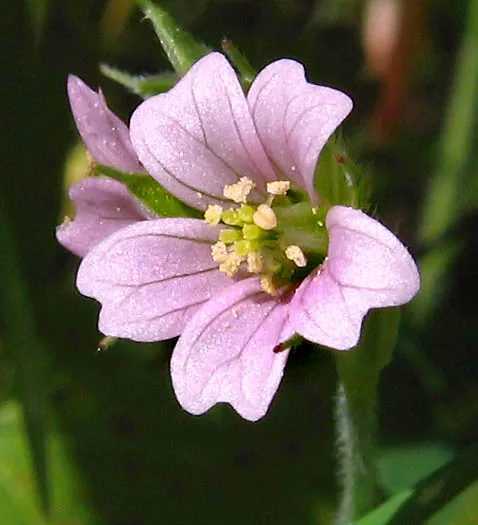 1 of 3
Native to most of the USA and southern Canada
Scattered from New England to Wisconsin and British Columbia, southern across the US to Florida and then south to central Mexico
- Light Partial shade Sun tolerance
- Moisture Moisture preference
- Zones 4–10 Cold to heat range
- Bloom Mar–Jul Flowering time
- Height up to 2 ft to 0.6 m
- Life cycle Annual or biennial Annual to perennial
In the garden
A woodland wildflower for partial shade. At up to 2 ft, it suits shade gardens and woodland edges. Hardy in USDA zones 4–10.
Growing conditions
Light
Full sun Partial shade Full shade
Moisture
Dry Moist Wet
Hardiness zones
Find your zone:
Pollinators & wildlife
- Bees Golden Sweat Bee
also Silky Striped Sweat Bee, Bristle Sweat Bee, Rugose-chested Sweat Bee +14 more
Cranesbill Miner, Hylaeus affinis, Osmia conjuncta, Goatsbeard Miner Bee, Sixteen-spotted Cuckoo Carder Bee, white-winged sweat bee, Asian Honey Bee, Florida Masked Bee, Coelioxys alternata, Hoplitis pilosifrons, Lasioglossum tegulare, Pseudopanurgus parvus, Tetragona dissecta, Nason's Mining Bee - Butterflies Common Buckeye
also Viceroy, Reakirt's Blue, Thecla edwardsi +2 more
Papilio cresphontes, Elkalyce argiades - Flower flies Margined Calligrapher also The Merodon equestris Group, American Snout Fly, Eastern Orange-tailed Leafwalker
- Also visited by
- Wasps: Metric Paper Wasp, Fraternal Potter Wasp
- Beetles: Downy Long-horned Beetle, Onthophagus pennsylvanicus
Butterflies that use this plant
Documented host and nectar records. Each links to a planting guide for that butterfly.
- American snoutnectar
- Common buckeyenectar
- Edwards' hairstreaknectar
- Giant swallowtailnectar
- Reakirt's bluenectar
- Viceroynectar
Full plant details
Where it grows
- Habitat
- WoodlandThe wild plant community it grows in.
- Native range
- Most of the USA and southern CanadaUnited States (48): AL, AR, AZ, CA, CT, DC, DE, FL, GA, IA, ID, IL, IN, KS, KY, LA, MA, MD, ME, MI, MN, MO, MS, MT, NC, ND, NE, NH, NJ, NM, NV, NY, OH, OK, OR, PA, RI, SC, SD, TN, TX, UT, VA, VT, WA, WI, WV, WY. Canada (4): AB, BC, ON, SK. Where it grows wild on its own, by state and province.
- Native distribution
- Scattered from New England to Wisconsin and British Columbia, southern across the US to Florida and then south to central MexicoThe same native range, usually more exact than the state list, and often noting where it has spread beyond it.
Growing conditions
- Light
- Partial shadeHow much sun it takes, from full sun to full shade.
- Hardiness zones
- USDA 4–10 · Canadian 4–7The cold-to-heat climate range it survives.
- Soil
- Gravelly to clay soilsThe soils it grows in naturally.
Growth & form
- Height
- up to 2 ft (to 0.6 m)Typical mature height.
- Life cycle
- Annual or biennialWhether it lives a single season (annual), two (biennial), or returns for years (perennial).
Flowers, foliage & fruit
- Type
- WildflowerWhat kind of plant it is.
- Bloom
- Mar–JulWhen it flowers.
- Flower color
- White, PinkThe bloom color, or colors.
- Fruit/Seeds
- Schizocarp (beaked)The seed or fruit it sets after flowering.
- Toxicity
- None knownWhether any part is poisonous to people or pets.