woodland shrub
Coralberry
Symphoricarpos orbiculatus
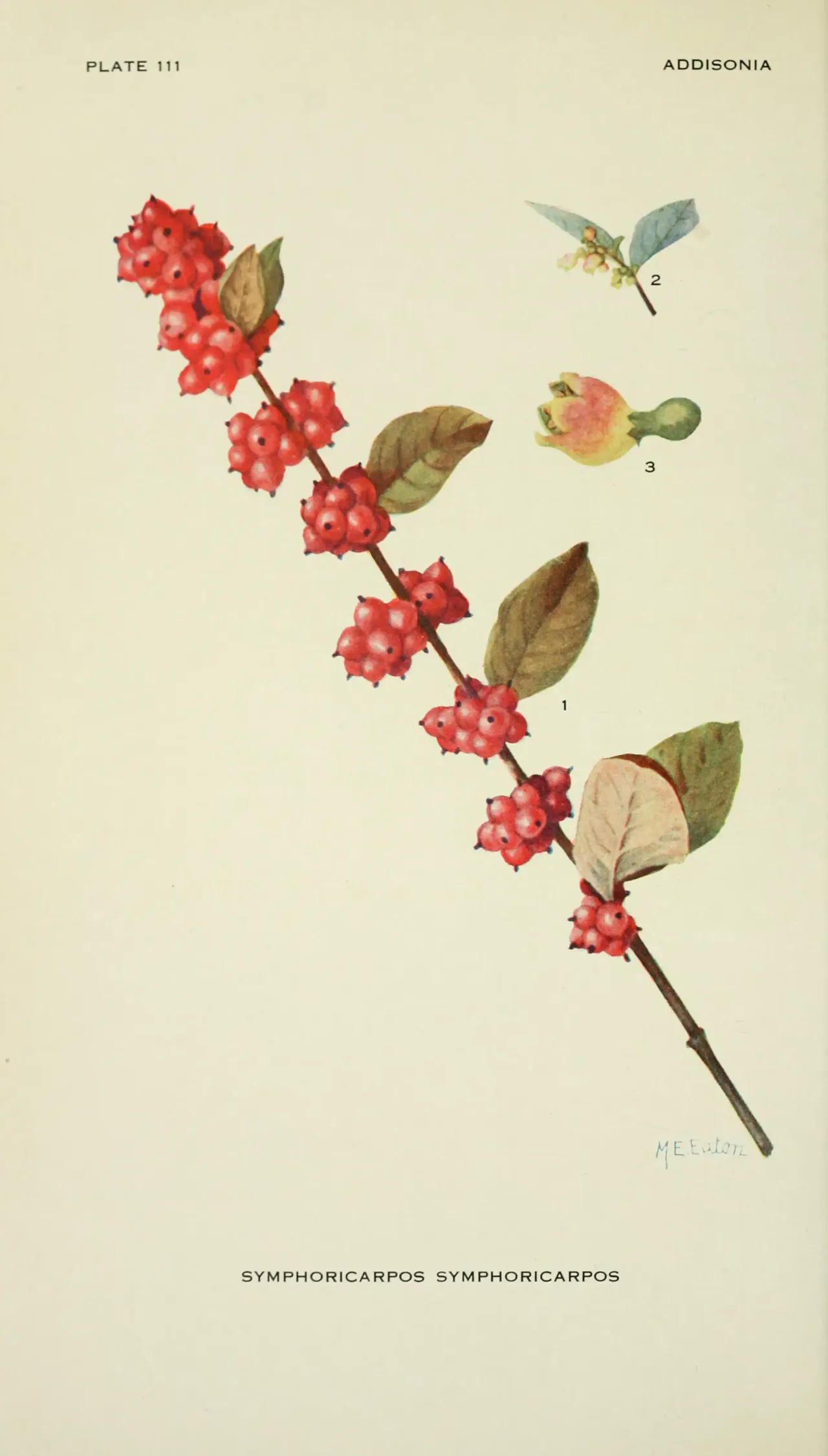 1 of 2
Native to much of the USA
Eastern US from New York south to eastern Texas, west to South Dakota and Colorado.
- Light Part shade to shade Sun tolerance
- Moisture Dry to moist Moisture preference
- Zones 5–9 Cold to heat range
- Bloom Jun–Nov Flowering time
- Height up to 6 ft to 1.8 m
- Life cycle Perennial Annual to perennial
In the garden
A woodland shrub for part to full shade and dry to moist soil. Its white and green flowers peak in August. At up to 6 ft, it needs room in shade gardens and woodland edges. Hardy in USDA zones 5–9.
Growing conditions
Light
Full sun Partial shade Full shade
Moisture
Dry Moist Wet
Hardiness zones
Find your zone:
When it blooms
The Coralberry's white and green flowers bloom June to November, peaking in August. This late-summer display draws bees and flower flies.
Coralberry blooms white & greenFoliage
Pollinators & wildlife
- Bees Common Eastern Bumble Bee
also Western Honey Bee, Brown-belted Bumble Bee, American Bumble Bee +54 more
Yellow-faced Bumble Bee, Ligated Furrow Bee, Pure Green Sweat bee, Bombus fervidus, Red-belted Bumble Bee, Two-spotted Longhorn Bee, Fuzzy-Horned Bumble Bee, Two-form Bumble Bee, Half-black Bumble Bee, Orange-legged Furrow Bee, Yellow-fronted Bumble Bee, Tripartite Sweat Bee, Flat-tailed Leafcutter Bee, Golden Sweat Bee, Great Basin Bumble Bee, Modest Masked Bee, Van Dyke's Bumble Bee, Silky Striped Sweat Bee, Bristle Sweat Bee, Rugose-chested Sweat Bee, Parallel-striped Sweat Bee, Say's Cuckoo Leafcutter Bee, Hylaeus affinis, Cresson's Sweat Bee, Cyclops Blood Bee, Colletes nudus, Experienced Sweat Bee, Lasioglossum cinctipes, Triepeolus cressonii, Fox's Sweat Bee, Athabasca Sweat Bee, Goatsbeard Miner Bee, Osmia bruneri, Obscure Sweat Bee, Box-headed Furrow Bee, Monk Longhorn, Andrena cheyennorum, Lasioglossum pleurospeculum, Lasioglossum euboeense, Lasioglossum laeve, Pseudopanurgus albitarsis, Lasioglossum subfasciatum, Great Banded Furrow Bee, Coelioxys brevis, Sphecodes antennariae, Lasioglossum coreopsis, Sphecodes dichrous, Augochlora feronia, Augochlora nominata, Forbes's Sweat Bee, Lasioglossum tegulare, Augochlorella persimilis, Zephyr Sweat Bee, Bellflower Resin Bee - Flower flies Margined Calligrapher
also Common Drone Fly, Transverse-banded Flower Fly, Thick-legged Hover Fly +10 more
Virginia Giant Hover Fly, Eastern Hornet Fly, Mexican Cactus Fly, Band-winged Bee Fly, Wavy Mucksucker, Yellow-thighed Thick-leg Fly, Black-haired Psyllid-killer, Mallota cimbiciformis, Tropidia quadrata, Parhelophilus laetus - Butterflies Red Admiral
also Pearl Crescent, Silver-spotted Skipper, Viceroy +6 more
Gray Buckeye, Common Alpine, Speyeria edwardsii, Occidryas editha, Cynthia cardui, Holly Blue - Also visited by
- Wasps:
Bald-faced Hornet, Fraternal Potter Wasp +3 more
Four-toothed Mason Wasp, Boll's Potter Wasp, Yellow-legged Hornet - Moths:
Green Cloverworm Moth, Large Lace-border Moth +5 more
Snowberry Clearwing, Tulip-tree Beauty, Tersa Sphinx, Heterophleps triguttaria, Wedgling Moth - Beetles:
Pubescent Tumbling Flower Beetle, Texas Military Leaf Beetle +3 more
Notated Lady Beetle, Tumbling Ragdoll, Lord Leaf Beetle - Birds: Brown-headed Cowbird
- Wasps:
Butterflies that use this plant
Documented host and nectar records. Each links to a planting guide for that butterfly.
- Common buckeyenectar
- Edwards' hairstreaknectar
- Pearl crescentnectar
- Red admiralnectar
- Silver-spotted skippernectar
- Viceroynectar
Full plant details
Where it grows
- Habitat
- WoodlandThe wild plant community it grows in.
- Native range
- Much of the USAUnited States (29): AL, AR, DC, DE, FL, GA, IA, IL, IN, KS, KY, LA, MD, MI, MN, MO, MS, NC, NE, OH, OK, PA, SC, SD, TN, TX, VA, WI, WV. Where it grows wild on its own, by state and province.
- Native distribution
- Eastern US from New York south to eastern Texas, west to South Dakota and Colorado.The same native range, usually more exact than the state list, and often noting where it has spread beyond it.
Growing conditions
- Light
- Part shade to shadeHow much sun it takes, from full sun to full shade.
- Moisture
- Dry to moistThe soil dampness it prefers, from dry to wet.
- Hardiness zones
- USDA 5–9 · Canadian 6–7The cold-to-heat climate range it survives.
- Soil
- Well-drained sand, loam, or clayThe soils it grows in naturally.
- Soil texture
- Light to heavy (sandy to clay)The soil grade it prefers, from sand to clay.
- Soil pH
- 5.5–7.5The acidity to alkalinity it tolerates (7 is neutral).
- Soil quality
- MediumHow rich a soil it needs. Many natives prefer lean soil and flop in rich beds.
- Water use
- Low to mediumHow thirsty it is, a rough guide to how often to water.
- Salinity tolerance
- LowHow well it copes with salty soil, near roads or the coast.
- Lime (CaCO₃) tolerance
- LowHow well it copes with chalky, lime-rich soil.
Growth & form
- Height
- up to 6 ft (to 1.8 m)Typical mature height.
- Spread
- ~7 ft (2 m)How wide one plant gets, a guide to spacing.
- Life cycle
- PerennialWhether it lives a single season (annual), two (biennial), or returns for years (perennial).
- Growth rate
- ModerateA relative ranking versus other plants of the same type (USDA), not an absolute rate.
- Shape
- ErectIts overall silhouette.
- Root depth
- 18+ in (46+ cm)How far the roots reach, a guide to drought resilience and transplanting.
Flowers, foliage & fruit
- Type
- ShrubWhat kind of plant it is.
- Bloom
- Jun–NovWhen it flowers.
- Flower color
- White, GreenThe bloom color, or colors.
- Fruit/Seeds
- ripens Jan–DecThe seed or fruit it sets after flowering.
- Toxicity
- None knownWhether any part is poisonous to people or pets.
Propagation & seed
- Cold stratification
- Required (cold, moist)Whether seed needs a cold, moist spell before it will germinate.
- Propagation
- Bare root, container, seedHow to start new plants.
- Seed
- ~0.1 million seeds per poundNotes on the seed and how to sow it.
- Seed spread rate
- SlowHow readily it self-sows. Slow or none means well-behaved, not a spreader.
- Seedling vigor
- MediumHow strongly young seedlings establish.
- Vegetative spread
- ModerateWhether it creeps outward or stays put in a clump.