woodland wildflower
Field goldenrod
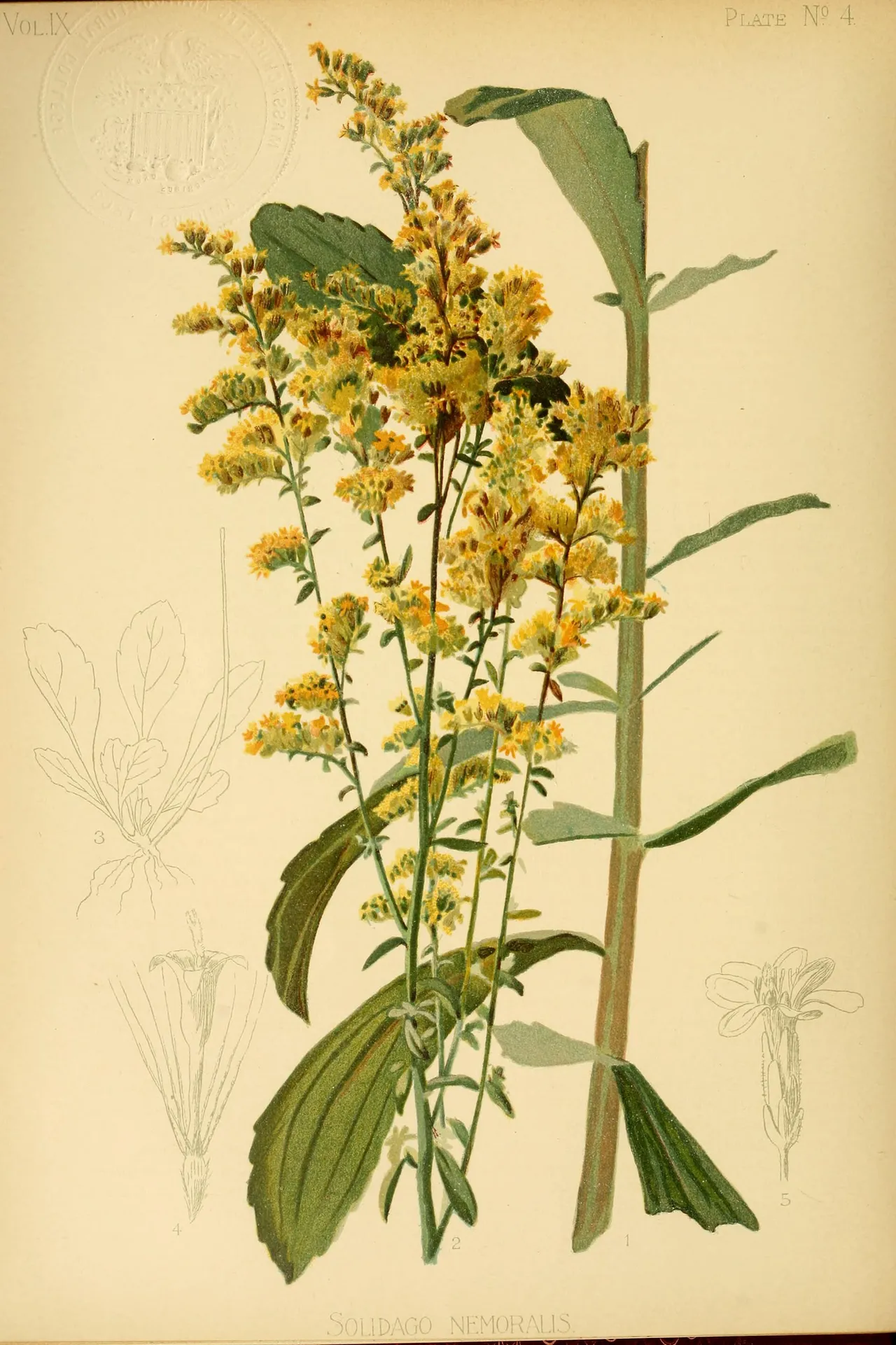
Solidago nemoralis
Also known as Prairie Goldenrod, Gray Goldenrod, Oldfield Goldenrod, Grayleaf Goldenrod, Gray-leaved Goldenrod, Dyersweed Goldenrod, Dwarf Goldenrod
 1 of 2
Native to most of the USA and Canada
Across southern Canada south through much of the US east of the Rockies to Durango in northern Mexico
- Light Full sun to shade Sun tolerance
- Moisture Dry Moisture preference
- Zones 3–9 Cold to heat range
- Bloom Aug–Oct Flowering time
- Height up to 3 ft to 0.9 m
- Life cycle Perennial Annual to perennial
In the garden
A woodland wildflower for sun through shade and lean, dry soil. Its yellow flowers peak in September. At up to 3 ft, it suits shade gardens and woodland edges. It spreads readily, so give it room or a contained spot. Hardy in USDA zones 3–9.
Growing conditions
Hardiness zones
When it blooms
The Field goldenrod's yellow flowers bloom August to October, peaking in September. This early-fall display draws bees and butterflies.
Field goldenrod blooms yellowFoliage
Pollinators & wildlife
- Bees Common Eastern Bumble Bee
also Western Honey Bee, American Bumble Bee, Ligated Furrow Bee +43 more
Tricolored Bumble Bee, Bicolored Striped Sweat Bee, Red-belted Bumble Bee, Two-form Bumble Bee, Black-and-gold Bumble Bee, Half-black Bumble Bee, Oblong Woolcarder Bee, Confusing Furrow Bee, Spurred Ceratina, Hairy-banded Mining Bee, Cloudy-winged Mining Bee, Louisiana Painted-Dark bee, Rugose-chested Sweat Bee, Parallel-striped Sweat Bee, Aster Mining Bee, Colletes simulans, Say's Cuckoo Leafcutter Bee, Notch-backed Cellophane-cuckoo Bee, Eastern Spine-shouldered Cellophane Bee, Megachile brevis, Ceratina dupla, Augochloropsis humeralis, Swenk's Fairy Bee, Goldenrod Cellophane Bee, Experienced Sweat Bee, Lasioglossum cinctipes, Triepeolus cressonii, Illinois Sweat Bee, Colletes eulophi, Lasioglossum platyparius, Tifton Nomad Bee, Eight-spotted Fairy Bee, Drury's Long-horned Bee, White-banded Sweat Bee, Andrena miserabilis, Colletes compactus, Colletes americanus, Short-horned Yellow-face Bee, Pseudopanurgus compositarum, Augochlorella persimilis, Pseudopanurgus andrenoides, Leavitt's Armored-Resin bee, Lasioglossum semicaeruleum - Butterflies Common Buckeye
also Gray Hairstreak, American Lady, Orange Sulphur +10 more
Eastern Tailed-Blue, Common Checkered-Skipper and Allies, Clouded Sulphur, Common Ringlet, Dainty Sulphur, American Copper, American Branded Skipper, Panoquina ocola, Little Yellow, Anosia plexippus - Flower flies Margined Calligrapher
also Eastern Calligrapher, Common Drone Fly, Transverse-banded Flower Fly +11 more
Long-tailed Aphideater, Thick-legged Hover Fly, Eurasian Drone Fly, Tufted Globetail, Eastern Hornet Fly, Common Loopwing Aphideater, Systropus macer, Sericomyia militaris, Short-haired Wrinklehead, Eupeodes nielseni, Sphaerophoria cylindricus - Also visited by
- Moths:
Soybean Looper Moth, Arcigera Flower Moth +10 more
Variable Reddish and California Pyrausta Moths, Brown Pinion, Boston and Median-banded Darts and Allies, Northern Flower Moth, Venerable Dart, Hawaiian Beet Webworm Moth, Acontia candefacta, Ornate Bella Moth, Utetheisa bella, Cotton Bollworm Moth - Beetles:
Goldenrod Soldier Beetle, Locust Borer +7 more
Striped Cucumber Beetle, Parenthesis Lady Beetle, ragweed leaf beetle, Diabrotica longicornis, Onthophagus pennsylvanicus, Notated Lady Beetle, Chauliognathus pennsylvanicus - Wasps:
Eastern Yellowjacket, Fraternal Potter Wasp +6 more
Four-toothed Mason Wasp, Ancistrocerus catskill, European tube wasp, Euodynerus castigatus, Parancistrocerus vagus, Ancistrocerus campestris
- Moths:
Butterflies that use this plant
Documented host and nectar records. Each links to a planting guide for that butterfly.
- American coppernectar
- American ladynectar
- Clouded sulphurnectar
- Common buckeyenectar
- Common ringletnectar
- Dainty sulphurnectar
- Eastern tailed-bluenectar
- Gray hairstreaknectar
- Little yellownectar
- Orange sulphurnectar
Full plant details
Where it grows
- Habitat
- WoodlandThe wild plant community it grows in.
- Native range
- Most of the USA and CanadaUnited States (42): AL, AR, CO, CT, DC, DE, FL, GA, IA, IL, IN, KS, KY, LA, MA, MD, ME, MI, MN, MO, MS, MT, NC, ND, NE, NH, NJ, NM, NY, OH, OK, PA, RI, SC, SD, TN, TX, VA, VT, WI, WV, WY. Canada (9): AB, BC, MB, NB, NS, ON, PE, QC, SK. Where it grows wild on its own, by state and province.
- Native distribution
- Across southern Canada south through much of the US east of the Rockies to Durango in northern MexicoThe same native range, usually more exact than the state list, and often noting where it has spread beyond it.
Growing conditions
- Light
- Full sun to shadeHow much sun it takes, from full sun to full shade.
- Moisture
- DryThe soil dampness it prefers, from dry to wet.
- Hardiness zones
- USDA 3–9 · Canadian 2–7The cold-to-heat climate range it survives.
- Soil
- Sandy, rocky soils. Sandy, Sandy Loam, Medium Loam, Clay Loam, Clay, Caliche typeThe soils it grows in naturally.
- Soil texture
- Light to heavy (sandy to clay)The soil grade it prefers, from sand to clay.
- Soil pH
- 6.5–7.5The acidity to alkalinity it tolerates (7 is neutral).
- Soil quality
- LowHow rich a soil it needs. Many natives prefer lean soil and flop in rich beds.
- Water use
- MediumHow thirsty it is, a rough guide to how often to water.
- Salinity tolerance
- NoneHow well it copes with salty soil, near roads or the coast.
- Lime (CaCO₃) tolerance
- MediumHow well it copes with chalky, lime-rich soil.
Growth & form
- Height
- up to 3 ft (to 0.9 m)Typical mature height.
- Life cycle
- PerennialWhether it lives a single season (annual), two (biennial), or returns for years (perennial).
- Growth rate
- RapidA relative ranking versus other plants of the same type (USDA), not an absolute rate.
- Shape
- DecumbentIts overall silhouette.
- Root depth
- 12+ in (30+ cm)How far the roots reach, a guide to drought resilience and transplanting.
Flowers, foliage & fruit
- Type
- WildflowerWhat kind of plant it is.
- Bloom
- Aug–OctWhen it flowers.
- Flower color
- YellowThe bloom color, or colors.
- Fruit/Seeds
- Achene; ripens Sep–NovThe seed or fruit it sets after flowering.
- Toxicity
- None knownWhether any part is poisonous to people or pets.
Propagation & seed
- Cold stratification
- Not requiredWhether seed needs a cold, moist spell before it will germinate.
- Propagation
- Container, cuttings, seedHow to start new plants.
- Seed
- ~1 million seeds per poundNotes on the seed and how to sow it.
- Seed spread rate
- RapidHow readily it self-sows. Slow or none means well-behaved, not a spreader.
- Seedling vigor
- HighHow strongly young seedlings establish.
- Vegetative spread
- RapidWhether it creeps outward or stays put in a clump.