prairie wildflower
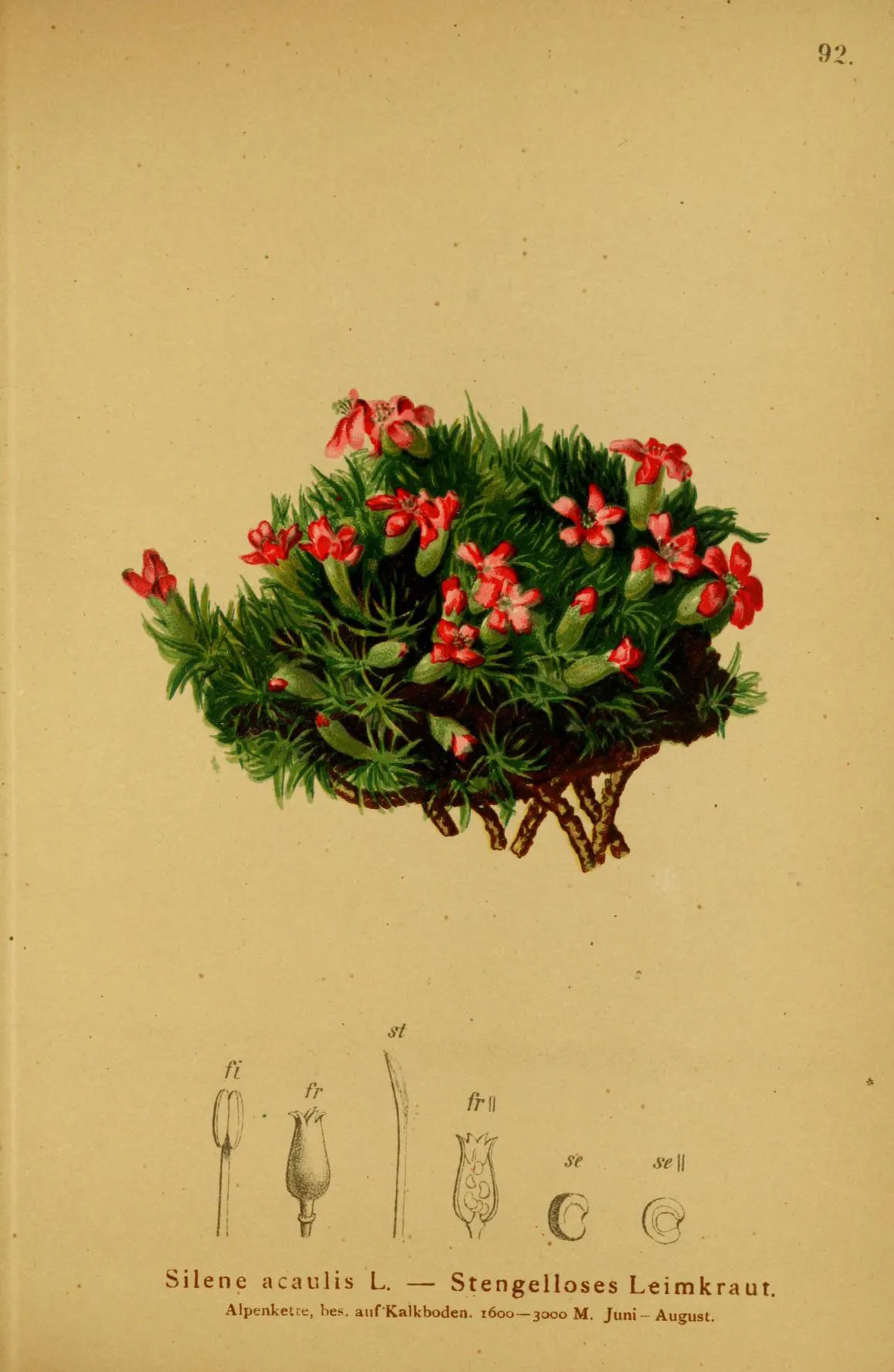
Moss Campion
Silene acaulis
Also known as Cushion Pink
 1 of 2
Native to the Southwest, the Rockies, and the Pacific Coast and southern Canada
Circumpolar (var. exscapa), southern in northern America to Oregon, Idaho, northern Montana and New Hampshire; extending southern in the Rockies to New Mexico and Arizona as var. subacaulescens
- Light Full sun Sun tolerance
- Moisture Moisture preference
- Zones 1–8 Cold to heat range
- Bloom Jun–Aug Flowering time
- Height up to 6 in to 15 cm
- Life cycle Perennial Annual to perennial
In the garden
A prairie wildflower for full sun. At up to 6 in, it tucks into meadows and sunny borders. Hardy in USDA zones 1–8.
Growing conditions
Light
Full sun Partial shade Full shade
Moisture
Dry Moist Wet
Hardiness zones
Find your zone:
Pollinators & wildlife
- Butterflies Painted Lady
also Northern Grizzled Skipper, Hecla Sulphur, Astarte Fritillary +14 more
Dewy Ringlet, Clossiana chariclea, Arctic Blue, Green-veined White, Common Brimstone, Small Tortoiseshell, Clossiana improba, Occidryas anicia eurytion, Plebejus glandon, European Peacock Butterfly, Magdalena Alpine, Hypodryas cynthia, Occidryas editha, Chlosyne palla whitneyi - Bees Fuzzy-Horned Bumble Bee
also Forest Bumble Bee, Golden-belted Bumble Bee, Heath Bumble Bee +11 more
Red Mason Bee, Buff-tailed Bumble Bee, Red-tailed Bumble Bee, Lasioglossum sabulosum, Deceptive Bumble Bee, Small Shiny Furrow Bee, Bombus wurflenii, Mountain Bumble Bee, Broken-belted Bumble Bee, Bombus hyperboreus, Garden Bumble Bee - Flower flies Holarctic Bristleside
also Bombylius cinerascens, Bombylius medius, Lundbeck's Sedgesitter +1 more
Pearly Sedgesitter - Also visited by
- Moths:
Dwarf Willow Looper, Spruce Carpet +4 more
Sympistis zetterstedtii, Sympistis lapponica, Alpine Arches, Coenotephria salicata - Beetles: Asian Lady Beetle
- Moths:
Butterflies that use this plant
Documented host and nectar records. Each links to a planting guide for that butterfly.
- Common ringletnectar
- Painted ladynectar
- Silver-bordered fritillarynectar
Full plant details
Where it grows
- Habitat
- PrairieThe wild plant community it grows in.
- Native range
- The Southwest, the Rockies, and the Pacific Coast and southern CanadaUnited States (13): AK, AZ, CO, ID, ME, MT, NH, NM, NV, OR, UT, WA, WY. Canada (1): NS. Where it grows wild on its own, by state and province.
- Native distribution
- Circumpolar (var. exscapa), southern in northern America to Oregon, Idaho, northern Montana and New Hampshire; extending southern in the Rockies to New Mexico and Arizona as var. subacaulescensThe same native range, usually more exact than the state list, and often noting where it has spread beyond it.
Growing conditions
- Light
- Full sunHow much sun it takes, from full sun to full shade.
- Hardiness zones
- USDA 1–8 · Canadian 0–8The cold-to-heat climate range it survives.
- Soil
- Rich, scree soilThe soils it grows in naturally.
- Soil texture
- Light to medium (sandy to loamy)The soil grade it prefers, from sand to clay.
- Soil pH
- Mildly acid to mildly alkalineThe acidity to alkalinity it tolerates (7 is neutral).
Growth & form
- Height
- up to 6 in (to 15 cm)Typical mature height.
- Spread
- ~1 ft (0.2 m)How wide one plant gets, a guide to spacing.
- Life cycle
- PerennialWhether it lives a single season (annual), two (biennial), or returns for years (perennial).
Flowers, foliage & fruit
- Type
- WildflowerWhat kind of plant it is.
- Bloom
- Jun–AugWhen it flowers.
- Flower color
- Pink, PurpleThe bloom color, or colors.
- Toxicity
- None knownWhether any part is poisonous to people or pets.