prairie wildflower
Nodding onion
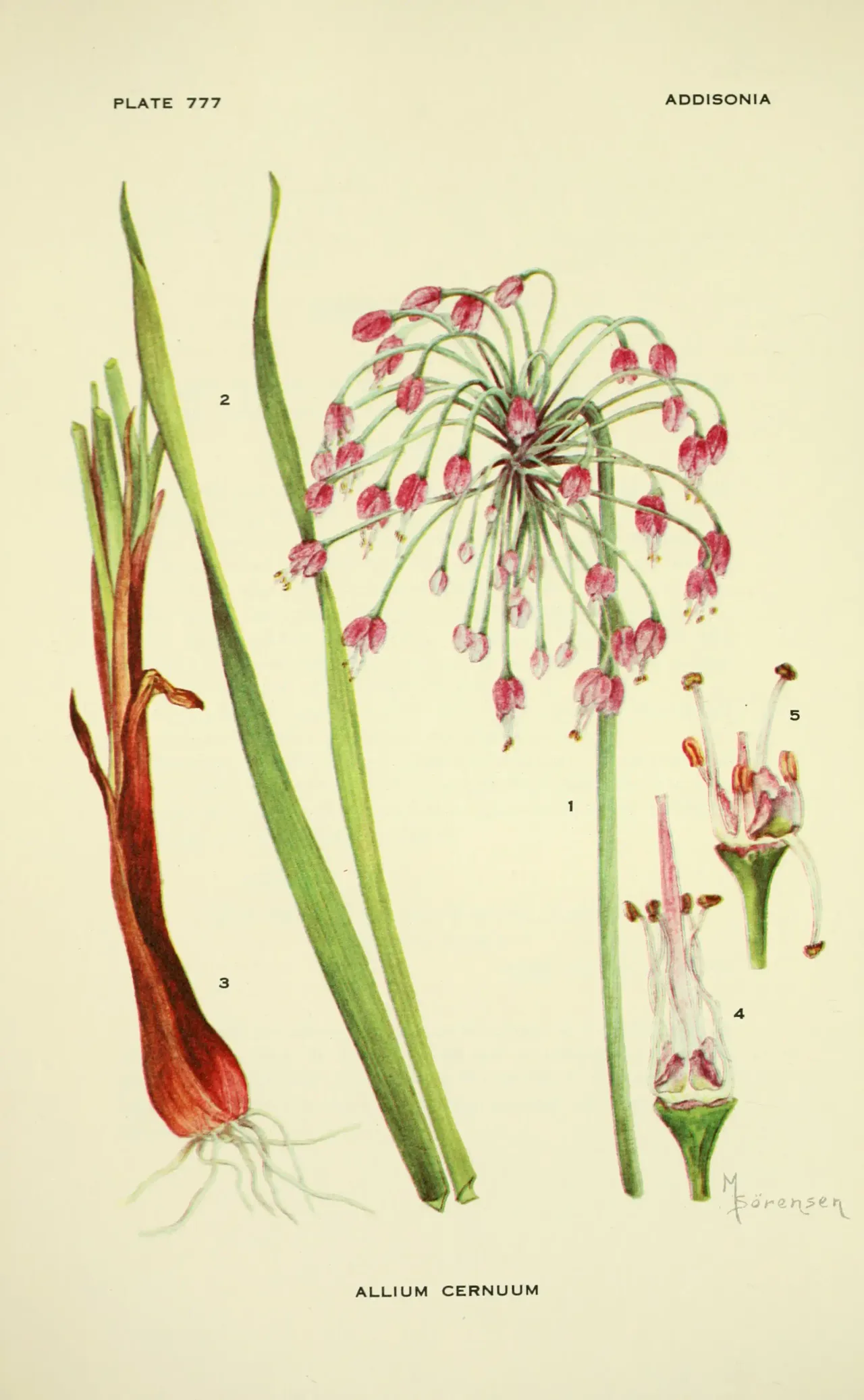
Allium cernuum
 1 of 4
Native to much of the USA and southern Canada
New York to British Columbia, south to mountains and cooler regions from Georgia to Arizona and south into northern Mexico
- Light Full sun Sun tolerance
- Moisture Moist Moisture preference
- Zones 2–9 Cold to heat range
- Bloom Jun–Aug Flowering time
- Height up to 2 ft to 0.6 m
- Life cycle Perennial Annual to perennial
In the garden
A prairie wildflower for full sun and evenly moist soil. Its white and pink flowers peak in July. At up to 2 ft, it suits meadows and sunny borders. Hardy in USDA zones 2–9.
Growing conditions
Light
Full sun Partial shade Full shade
Moisture
Dry Moist Wet
Hardiness zones
Find your zone:
When it blooms
The Nodding onion's white and pink flowers bloom June to August, peaking in July. This midsummer display draws bees and butterflies.
Nodding onion blooms white & pinkFoliage
Pollinators & wildlife
- Bees Common Eastern Bumble Bee
also Western Honey Bee, Eastern Carpenter Bee, Brown-belted Bumble Bee +51 more
American Bumble Bee, Yellow-faced Bumble Bee, Black-tailed Bumble Bee, Bombus fervidus, Red-belted Bumble Bee, Hunt's Bumble Bee, Two-spotted Longhorn Bee, Fuzzy-Horned Bumble Bee, Two-form Bumble Bee, Half-black Bumble Bee, Orange-legged Furrow Bee, Yellow-fronted Bumble Bee, Vancouver Bumble Bee, Great Basin Bumble Bee, Rusty-patched Bumble Bee, Confusing Furrow Bee, Orange-tipped Wood-digger, Western Bumble Bee, Ceratina acantha, frigid bumble bee, Golden-tailed Leafcutter Bee, Patchwork Leafcutter Bee, Viereck's Sweat Bee, Anthophora ursina, Cresson's Sweat Bee, Carinate Armored-Resin bee, Kincaid's Cellophane Bee, Anthidium mormonum, Truncate Small-Mason, Occidental Sweat Bee, Heriades cressoni, Anthidium utahense, Heriades variolosa, Silver-fronted Small-Mason, Nevada Sweat Bee, Athabasca Sweat Bee, Glittering Cellophane Bee, Cactus Mason Bee, Megachile lapponica, Marin County Sweat Bee, white-winged sweat bee, Osmia juxta, Osmia tristella, Osmia pusilla, Lasioglossum aff.nevadense, Lasioglossum aff.caducum, Lasioglossum sp.F28, Hoplitis fulgida fulgida, Classy Sweat Bee, Osmia dolerosa, Bombus vancouverensis vancouverensis - Butterflies Monarch
also Pearl Crescent, Common Buckeye, Silver-spotted Skipper +8 more
Eastern Tailed-Blue, Common Checkered-Skipper and Allies, Horace's Duskywing, Dainty Sulphur, Tawny-edged Skipper, Melissa Blue, Rocky Mountain Parnassian, Elkalyce amyntula valeriae - Flower flies Eastern Calligrapher
also Oblique Streaktail, Large-tailed Aphideater, Tufted Globetail +6 more
Common Loopwing Aphideater, Broad-banded Aphideater, Snow's Aphideater, Hemipenthes sinuosus, Eriozona erratica, Ocyptamus costatus - Also visited by
- Beetles: Goldenrod Soldier Beetle, Black Diabrotica
- Wasps: Four-toothed Mason Wasp, Parancistrocerus fulvipes
- Moths: Corn Earworm Moth
- Hummingbirds: Ruby-throated Hummingbird
Butterflies that use this plant
Documented host and nectar records. Each links to a planting guide for that butterfly.
- Common buckeyenectar
- Dainty sulphurnectar
- Eastern tailed-bluenectar
- Melissa bluenectar
- Monarch butterflynectar
- Pearl crescentnectar
- Silver-spotted skippernectar
Full plant details
Where it grows
- Habitat
- PrairieThe wild plant community it grows in.
- Native range
- Much of the USA and southern CanadaUnited States (35): AL, AR, AZ, CO, DC, GA, IA, ID, IL, IN, KY, MD, MI, MN, MO, MS, MT, NC, NE, NJ, NM, NY, OH, OR, PA, SC, SD, TN, TX, UT, VA, WA, WI, WV, WY. Canada (4): AB, BC, ON, SK. Where it grows wild on its own, by state and province.
- Native distribution
- New York to British Columbia, south to mountains and cooler regions from Georgia to Arizona and south into northern MexicoThe same native range, usually more exact than the state list, and often noting where it has spread beyond it.
Growing conditions
- Light
- Full sunHow much sun it takes, from full sun to full shade.
- Moisture
- MoistThe soil dampness it prefers, from dry to wet.
- Hardiness zones
- USDA 2–9 · Canadian 1–9The cold-to-heat climate range it survives.
- Soil
- Humus-rich, neutral to alkaline soilsThe soils it grows in naturally.
- Soil texture
- Light to heavy (sandy to clay)The soil grade it prefers, from sand to clay.
- Soil pH
- Mildly acid to mildly alkalineThe acidity to alkalinity it tolerates (7 is neutral).
- Lime (CaCO₃) tolerance
- HighHow well it copes with chalky, lime-rich soil.
Growth & form
- Height
- up to 2 ft (to 0.6 m)Typical mature height.
- Spread
- ~1 ft (0.3 m)How wide one plant gets, a guide to spacing.
- Life cycle
- PerennialWhether it lives a single season (annual), two (biennial), or returns for years (perennial).
- Growth rate
- RapidA relative ranking versus other plants of the same type (USDA), not an absolute rate.
Flowers, foliage & fruit
- Type
- WildflowerWhat kind of plant it is.
- Bloom
- Jun–AugWhen it flowers.
- Flower color
- White, PinkThe bloom color, or colors.
- Fruit/Seeds
- ripens Jul–SepThe seed or fruit it sets after flowering.
- Toxicity
- Poisonous if eatenWhether any part is poisonous to people or pets.