wetland shrub
Sheep laurel
Kalmia angustifolia
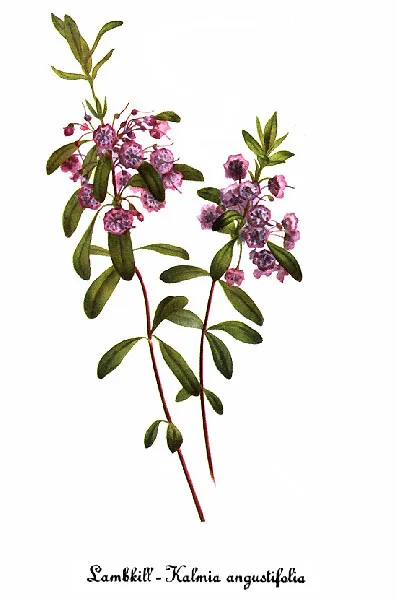 1 of 3
Native to the Northeast and southern Canada
Labrador to Ontario, southern, primarily through eastern portion of eastern states, to Georgia; also northern Michigan
- Light Partial shade Sun tolerance
- Moisture Wet Moisture preference
- Zones 2–7 Cold to heat range
- Bloom Jun–Jul Flowering time
- Height up to 5 ft to 1.5 m
- Life cycle Perennial Annual to perennial
In the garden
A wetland shrub for partial shade and wet soil. At up to 5 ft, it needs room in rain gardens, pond edges, and damp low spots. Hardy in USDA zones 2–7.
Growing conditions
Light
Full sun Partial shade Full shade
Moisture
Dry Moist Wet
Hardiness zones
Find your zone:
Pollinators & wildlife
- Bees Common Eastern Bumble Bee
also Eastern Carpenter Bee, Brown-belted Bumble Bee, Two-spotted Bumble Bee +24 more
Tricolored Bumble Bee, Yellow-banded Bumble Bee, Wilke's Mining Bee, Yellowish Cuckoo Bumble bee, Neighborly Mining Bee, Sanderson's Bumble Bee, Bradley's Mining Bee, Allegheny Mining Bee, Dark-footed Yellow Loosestrife Bee, Snowy Mining Bee, Melitta melittoides, Kalmia Miner Bee, Toothed Miner Bee, Inornate cellophane-cuckoo bee, Buff-tailed Bumble Bee, Milwaukee Mining Bee, Osmia laticeps, Mountain Mason Bee, Colletes bradleyi, Colletes productus, Leavitt's Armored-Resin bee, Blueberry Digger Bee, twig mason bee, Nason's Mining Bee - Butterflies Pearl Crescent
also Dun Skipper, Atlantis Fritillary, American Silver-bordered Fritillary +10 more
Arctic Fritillary, Harris's Checkerspot, Pink-edged Sulphur, Karner Blue, Crowberry Blue, Bog Copper, Incisalia irioides, Incisalia niphon, Limenitis arthemis arthemis, Mitoura hesseli - Flower flies Narrow-headed Marsh Fly
also Thick-legged Hover Fly, Black-shouldered Drone Fly, Oblique-banded Pond Fly +4 more
Dusky Bog Fly, Bombylius incanus, Yellow-spotted Pond Fly, Platycheirus rosarum - Also visited by
- Moths:
Hummingbird Clearwing, White Slant-line +4 more
Slender Clearwing, Mousy Angle, Sundew Cutworm Moth, Epelis truncataria - Beetles: Altica kalmiae
- Moths:
Butterflies that use this plant
Documented host and nectar records. Each links to a planting guide for that butterfly.
- Eastern pine elfinnectar
- Pearl crescentnectar
- Red-spotted purplenectar
- Silver-bordered fritillarynectar
Full plant details
Where it grows
- Habitat
- WetlandThe wild plant community it grows in.
- Native range
- The Northeast and southern CanadaUnited States (15): CT, DC, DE, MA, MD, ME, MI, NH, NJ, NY, PA, RI, VA, VT, WV. Canada (3): NB, NS, PE. Where it grows wild on its own, by state and province.
- Native distribution
- Labrador to Ontario, southern, primarily through eastern portion of eastern states, to Georgia; also northern MichiganThe same native range, usually more exact than the state list, and often noting where it has spread beyond it.
Growing conditions
- Light
- Partial shadeHow much sun it takes, from full sun to full shade.
- Moisture
- WetThe soil dampness it prefers, from dry to wet.
- Hardiness zones
- USDA 2–7 · Canadian 0–7The cold-to-heat climate range it survives.
- Soil
- Wet/organic to dry/sterile soilsThe soils it grows in naturally.
- Soil texture
- Light to heavy (sandy to clay)The soil grade it prefers, from sand to clay.
- Soil pH
- AcidicThe acidity to alkalinity it tolerates (7 is neutral).
Growth & form
- Height
- up to 5 ft (to 1.5 m)Typical mature height.
- Spread
- ~5 ft (1.5 m)How wide one plant gets, a guide to spacing.
- Life cycle
- PerennialWhether it lives a single season (annual), two (biennial), or returns for years (perennial).
Flowers, foliage & fruit
- Type
- ShrubWhat kind of plant it is.
- Bloom
- Jun–JulWhen it flowers.
- Flower color
- Red, PurpleThe bloom color, or colors.
- Toxicity
- Poisonous if eatenWhether any part is poisonous to people or pets.