woodland vine
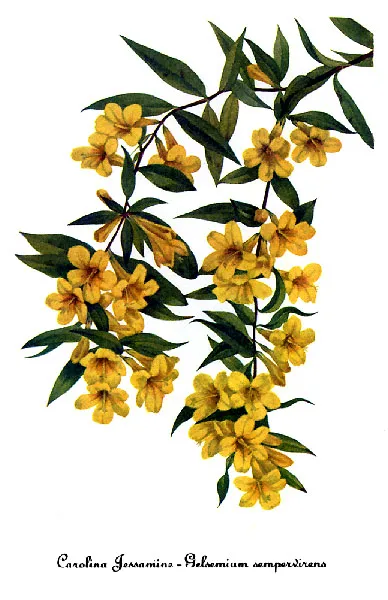
Yellow jessamine
Gelsemium sempervirens
Also known as Carolina Jessamine, Evening Trumpetflower, Poor Man's Rope
 1 of 2
Native to the Southeast
SoutheasternVA to Florida, west to Arkansas and east Texas, south to Guatemala, Zones 7 to 8. In Texas, limited in the wild to forested east Texas.
- Light Full sun to part shade Sun tolerance
- Moisture Moist Moisture preference
- Zones 7–10 Cold to heat range
- Bloom Jan–Apr Flowering time
- Height up to 20 ft to 6.1 m
- Life cycle Perennial Annual to perennial
In the garden
A woodland vine for full sun to part shade and evenly moist soil. Its yellow flowers peak in March. At up to 20 ft, it needs room in shade gardens and woodland edges. Hardy in USDA zones 7–10.
Growing conditions
Light
Full sun Partial shade Full shade
Moisture
Dry Moist Wet
Hardiness zones
Find your zone:
When it blooms
The Yellow jessamine's yellow flowers bloom January to April, peaking in March. This early-spring display draws bees and butterflies.
Yellow jessamine blooms yellowFoliage
Pollinators & wildlife
- Bees Common Eastern Bumble Bee
also Western Honey Bee, Eastern Carpenter Bee, Brown-belted Bumble Bee +4 more
Two-spotted Bumble Bee, Crotch's Bumble Bee, Blueberry Digger Bee, South Florida Eastern Carpenter Bee - Butterflies Eastern Tiger Swallowtail also Cloudless Sulphur, Two-tailed Swallowtail
- Moths Hummingbird Clearwing also Nessus Sphinx
Butterflies that use this plant
Documented host and nectar records. Each links to a planting guide for that butterfly.
- Cloudless sulphurnectar
- Eastern tiger swallowtailnectar
Full plant details
Where it grows
- Habitat
- WoodlandThe wild plant community it grows in.
- Native range
- The SoutheastUnited States (11): AL, AR, FL, GA, LA, MS, NC, SC, TN, TX, VA. Where it grows wild on its own, by state and province.
- Native distribution
- SoutheasternVA to Florida, west to Arkansas and east Texas, south to Guatemala, Zones 7 to 8. In Texas, limited in the wild to forested east Texas.The same native range, usually more exact than the state list, and often noting where it has spread beyond it.
Growing conditions
- Light
- Full sun to part shadeHow much sun it takes, from full sun to full shade.
- Moisture
- MoistThe soil dampness it prefers, from dry to wet.
- Hardiness zones
- USDA 7–10The cold-to-heat climate range it survives.
- Soil
- Moist, well-drained, humus-rich soil. pH adaptable. Sandy, Sandy Loam, Medium Loam, Clay Loam, ClayThe soils it grows in naturally.
- Soil texture
- Light to heavy (sandy to clay)The soil grade it prefers, from sand to clay.
- Soil pH
- Mildly acid to mildly alkalineThe acidity to alkalinity it tolerates (7 is neutral).
- Water use
- MediumHow thirsty it is, a rough guide to how often to water.
Growth & form
- Height
- up to 20 ft (to 6.1 m)Typical mature height.
- Life cycle
- PerennialWhether it lives a single season (annual), two (biennial), or returns for years (perennial).
- Growth rate
- RapidA relative ranking versus other plants of the same type (USDA), not an absolute rate.
Flowers, foliage & fruit
- Type
- VineWhat kind of plant it is.
- Bloom
- Jan–AprWhen it flowers.
- Flower color
- YellowThe bloom color, or colors.
- Fruit/Seeds
- ripens Jan–DecThe seed or fruit it sets after flowering.
- Toxicity
- Poisonous if eatenWhether any part is poisonous to people or pets.