woodland wildflower
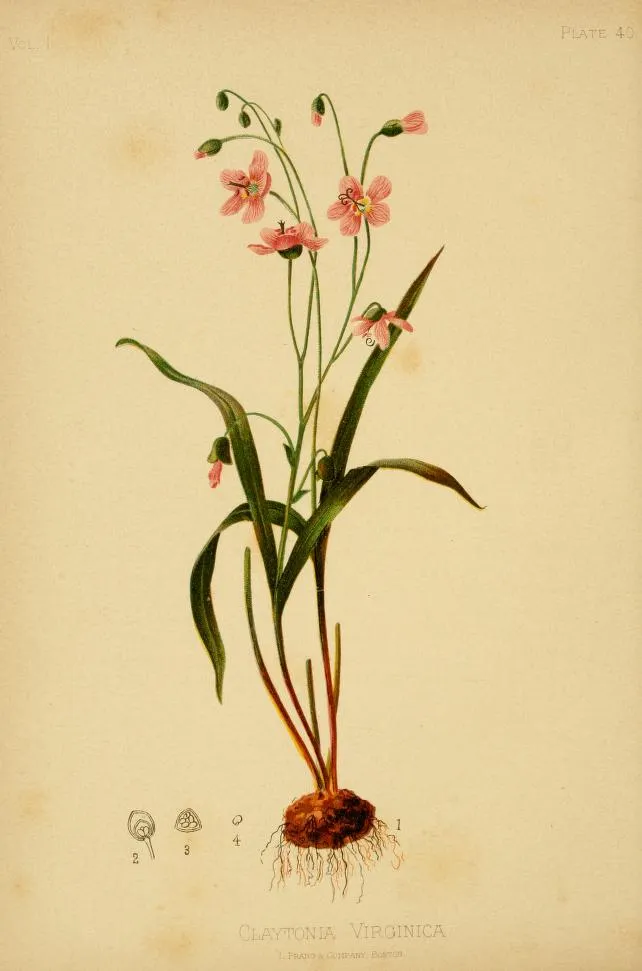
Virginia Springbeauty
Claytonia virginica
Also known as Springbeauty
 1 of 2
Native to much of the USA and southern Canada
Nova Scotia to Georgia, west to Minnesota, southeastern Nebraska, eastern Kansas and eastern Texas
- Light Partial shade Sun tolerance
- Moisture Moist Moisture preference
- Zones 4–9 Cold to heat range
- Bloom Mar–May Flowering time
- Height up to 16 in to 41 cm
- Life cycle Perennial Annual to perennial
In the garden
A woodland wildflower for partial shade and evenly moist soil. Its white and pink flowers peak in April. At up to 16 in, it tucks into shade gardens and woodland edges. Hardy in USDA zones 4–9.
Growing conditions
Light
Full sun Partial shade Full shade
Moisture
Dry Moist Wet
Hardiness zones
Find your zone:
When it blooms
The Virginia Springbeauty's white and pink flowers bloom March to May, peaking in April. This spring display draws bees and flower flies.
Virginia Springbeauty blooms white & pinkFoliage
Pollinators & wildlife
- Bees Common Eastern Bumble Bee
also Western Honey Bee, Eastern Carpenter Bee, Brown-belted Bumble Bee +105 more
Two-spotted Bumble Bee, American Bumble Bee, Ligated Furrow Bee, Tricolored Bumble Bee, Bicolored Striped Sweat Bee, Pure Green Sweat bee, Fuzzy-Horned Bumble Bee, Black-and-gold Bumble Bee, Half-black Bumble Bee, Colletes inaequalis, Orange-legged Furrow Bee, Agapostemon texanus, Brown-winged Striped Sweat Bee, Golden Sweat Bee, Confusing Furrow Bee, Spurred Ceratina, Blue Orchard Bee, Horn-faced Mason Bee, Nomada luteola, Carlin's Mining Bee, Neighborly Mining Bee, Black-and-yellow Nomad Bee, Silky Striped Sweat Bee, Spotted Nomad Bee, Frigid Mining Bee, Ceratina acantha, Bristle Sweat Bee, Rugose-chested Sweat Bee, Cresson's Mining Bee, Barbara's Mining Bee, Deep-blue Sweat Bee, Imbricate Cuckoo Nomad Bee, Cherry Mining Bee, Red-tailed Mining Bee, Orange-legged Miner Bee, Ceratina dupla, Cresson's Sweat Bee, Tridentate Miner, Imitator Miner Bee, Experienced Sweat Bee, Osmia pumila, Mustard Miner Bee, Lasioglossum cinctipes, Obliterated Nomad, Maine Blueberry Bee, Osmia conjuncta, Perplexed Miner Bee, Illinois Sweat Bee, Friendless Sweat Bee, Forbes' Mining Bee, Cresson's Nomad Bee, Toothed Miner Bee, Olympia Sweat Bee, Fox's Sweat Bee, Pygmy Nomad, Nomada affabilis, Birkmann's Sweat Bee, Goatsbeard Miner Bee, Andrena personata, Black-haired Miner Bee, Willow Flower Miner Bee, Ceanothus Miner Bee, Obscure Sweat Bee, Nomada sulphurata, White-sided Mason Bee, Osmia albiventris, Nomada perplexa, Nason's Mining Bee, Spring Beauty Miner, Lasioglossum abanci, Xylocopa virginica virginica, Andrena miserabilis, Dwarf-dandelion Mining Bee, Nimble Ceratina, Forbes's Sweat Bee, Pseudopanurgus labrosus, Rugose Mining Bee, Andrena ziziaeformis, Denticulate Nomad, Quebec Sweat Bee, Dunning's Miner, Depressed Nomad, Nomada (Nomada) sp. 1, Nomada (Nomada) sp. 2, Lasioglossum coriaceum, Halictus pectoralis, Augochlorella persimilis, Halictus cressonii, Augochloropsis fulgida, Ceratina tejonensis, Andrena illini, Andrena sayi, Cuneate Nomad Bee, Trout-lily Mining Bee, Eucera belfragei, Nomada sayi, Nomada parva, Macoupin County sweat bee, Nomada perplexans, Sphecodes dichrous, Augochlora nominata, Tetragona dissecta, Zephyr Sweat Bee, Truncate Sweat Bee, Augochlorella striata - Flower flies Margined Calligrapher
also Eastern Calligrapher, Oblique Streaktail, Long-tailed Aphideater +21 more
Narrow-headed Marsh Fly, Thick-legged Hover Fly, Greater Bee Fly, Black-shouldered Drone Fly, Yellow-shouldered Drone Fly, Variable Duskyface Fly, Western Calligrapher, Common Loopwing Aphideater, American Snout Fly, Thin-lined Calligrapher, Volucella bombylans, Common Flower Fly, Hairy-eyed Flower Fly, Eastern Forest Sedgesitter, Carposcalis obscurum, Two-spotted Leafwalker, Sphaerophoria cylindricus, Eastern Catkin Fly, Eupeodes nielseni, Sun Fly, Paragus bicolor - Butterflies Red Admiral
also Pearl Crescent, American Lady, Eastern Tailed-Blue +11 more
Eastern Comma, Checkered White, Falcate Orangetip, Northern Marble, Holly Blue, Anosia plexippus, Henry's Elfin, West Virginia White, Juvenal's Duskywing, Celastrina ladon, Elkalyce comyntas - Also visited by
- Beetles:
Asian Lady Beetle, Spotted Pink Lady Beetle +5 more
Two-lined Leatherwing, Acmaeodera tubulus, Slender Flower Longhorn Beetle, Coleomegilla maculata lengi, Chlorophorus glaucus - Wasps: Metric Paper Wasp, Ancistrocerus capra
- Beetles:
Butterflies that use this plant
Documented host and nectar records. Each links to a planting guide for that butterfly.
- American ladynectar
- American snoutnectar
- Checkered whitenectar
- Eastern commanectar
- Eastern tailed-bluenectar
- Pearl crescentnectar
- Red admiralnectar
Full plant details
Where it grows
- Habitat
- WoodlandThe wild plant community it grows in.
- Native range
- Much of the USA and southern CanadaUnited States (33): AL, AR, CT, DC, DE, GA, IA, IL, IN, KS, KY, LA, MA, MD, MI, MN, MO, MS, NC, NE, NJ, NY, OH, OK, PA, RI, SC, TN, TX, VA, VT, WI, WV. Canada (3): NS, ON, QC. Where it grows wild on its own, by state and province.
- Native distribution
- Nova Scotia to Georgia, west to Minnesota, southeastern Nebraska, eastern Kansas and eastern TexasThe same native range, usually more exact than the state list, and often noting where it has spread beyond it.
Growing conditions
- Light
- Partial shadeHow much sun it takes, from full sun to full shade.
- Moisture
- MoistThe soil dampness it prefers, from dry to wet.
- Hardiness zones
- USDA 4–9 · Canadian 4–7The cold-to-heat climate range it survives.
- Soil
- Rich, moist soils. Prefers high humusThe soils it grows in naturally.
- Soil texture
- Light to medium (sandy to loamy)The soil grade it prefers, from sand to clay.
- Soil pH
- AcidicThe acidity to alkalinity it tolerates (7 is neutral).
Growth & form
- Height
- up to 16 in (to 41 cm)Typical mature height.
- Spread
- ~1 ft (0.2 m)How wide one plant gets, a guide to spacing.
- Life cycle
- PerennialWhether it lives a single season (annual), two (biennial), or returns for years (perennial).
- Growth rate
- ModerateA relative ranking versus other plants of the same type (USDA), not an absolute rate.
Flowers, foliage & fruit
- Type
- WildflowerWhat kind of plant it is.
- Bloom
- Mar–MayWhen it flowers.
- Flower color
- White, PinkThe bloom color, or colors.
- Fruit/Seeds
- ripens Apr–MayThe seed or fruit it sets after flowering.
- Toxicity
- None knownWhether any part is poisonous to people or pets.