prairie wildflower
Whorled Coreopsis
Coreopsis verticillata
Also known as Threadleaf Coreopsis, Whorled Tickseed
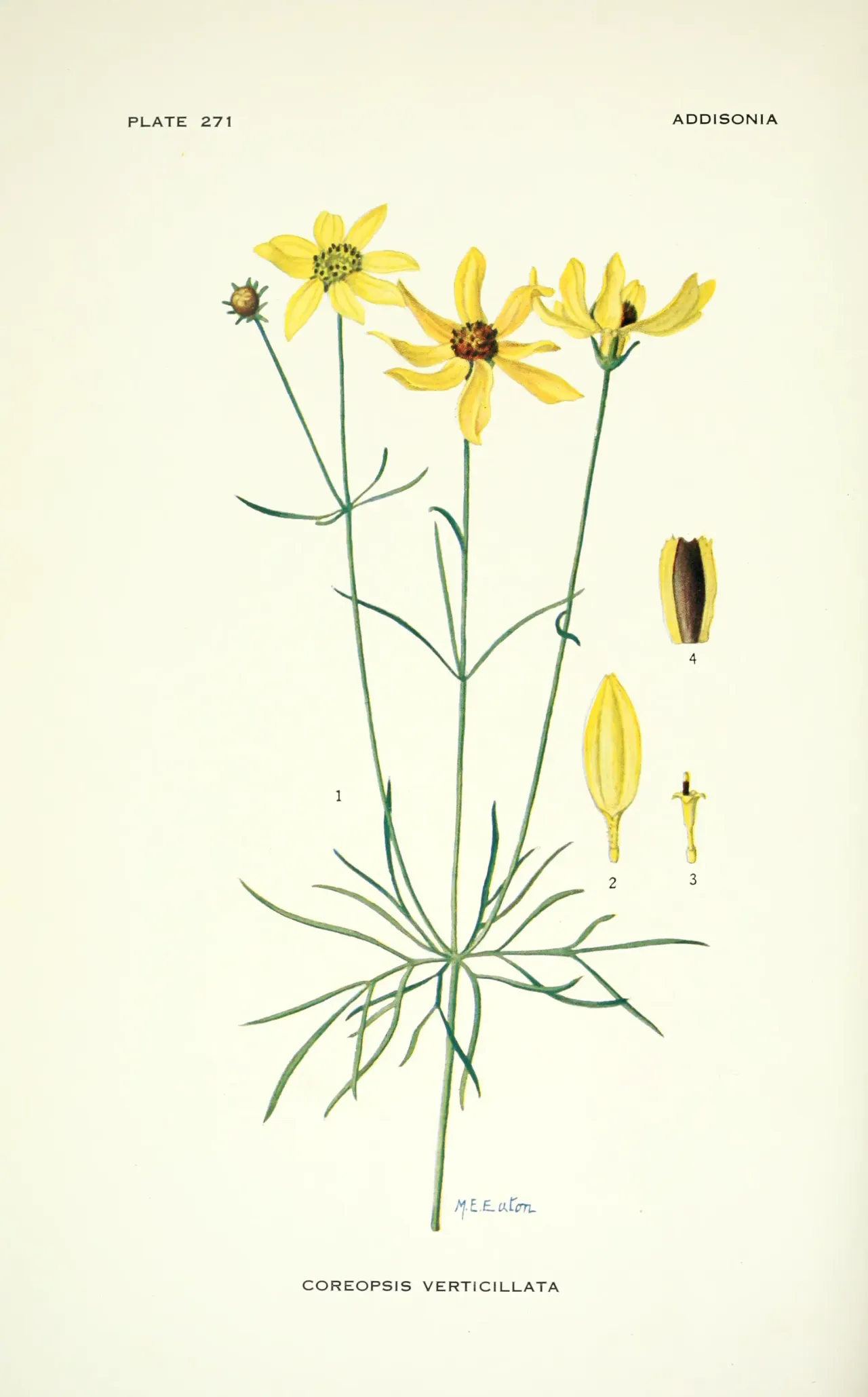 1 of 2
Native to the Southeast
Maryland to South Carolina, east to Kentucky and Tennessee
- Light Full sun to part shade Sun tolerance
- Moisture Dry Moisture preference
- Zones 3–8 Cold to heat range
- Bloom May–Sep Flowering time
- Height up to 3 ft to 0.9 m
- Life cycle Perennial Annual to perennial
In the garden
A prairie wildflower for full sun to part shade and lean, dry soil. Its yellow flowers peak in June. At up to 3 ft, it suits meadows and sunny borders. It shrugs off drought once established. Hardy in USDA zones 3–8.
Growing conditions
Light
Full sun Partial shade Full shade
Moisture
Dry Moist Wet
Hardiness zones
Find your zone:
When it blooms
The Whorled Coreopsis's yellow flowers bloom May to September, peaking in June. This early-summer display draws bees and butterflies.
Whorled Coreopsis blooms yellowFoliage
Pollinators & wildlife
- Bees Common Eastern Bumble Bee
also Western Honey Bee, Brown-belted Bumble Bee, Two-spotted Bumble Bee +27 more
Ligated Furrow Bee, Tricolored Bumble Bee, Bicolored Striped Sweat Bee, Pure Green Sweat bee, Bombus fervidus, Red-belted Bumble Bee, Perplexing Bumble Bee, Fuzzy-Horned Bumble Bee, Two-form Bumble Bee, Lemon Cuckoo Bumble Bee, Flat-tailed Leafcutter Bee, Oblong Woolcarder Bee, Confusing Furrow Bee, Spurred Ceratina, Alfalfa Leafcutter Bee, Wilke's Mining Bee, Pugnacious Leafcutter Bee, Louisiana Painted-Dark bee, Rugose-chested Sweat Bee, Patchwork Leafcutter Bee, Squash Longhorn-Cuckoo, European Small-Woolcarder, Melissodes subillatus, Ceratina dupla, Large-headed Armoured-Resin bee, Valiant Long-horned Bee, Megachile pugnata pugnata - Butterflies Monarch
also Red Admiral, Pearl Crescent, Common Buckeye +17 more
Fiery Skipper, Silver-spotted Skipper, American Lady, Eastern Tailed-Blue, Common Checkered-Skipper and Allies, Zabulon Skipper, Peck's Skipper, Dainty Sulphur, Least Skipper, Hobomok Skipper, Wild Indigo Duskywing, American Copper, Little Glassywing, Great Purple Hairstreak, Euptychia cymela, Silvery Checkerspot, Pyrgus communis - Flower flies Margined Calligrapher
also Eastern Calligrapher, Common Drone Fly, Transverse-banded Flower Fly +11 more
Long-tailed Aphideater, Eurasian Drone Fly, Black-shouldered Drone Fly, The Merodon equestris Group, Tufted Globetail, Thin-lined Calligrapher, Hunchbacked Bee Fly, Poecilanthrax tegminipennis, Orange-spined Drone Fly, Striped Bromeliad Fly, Bombylius comanche - Also visited by
- Moths:
Snowberry Clearwing, Yellow-collared Scape Moth +4 more
Squash Vine Borer, Pale-winged Crocidophora Moth, Maple Clearwing Moth, Celery Leaftier Moth - Beetles:
Seven-spotted Lady Beetle, Margined Leatherwing Beetle +3 more
Spotted Pink Lady Beetle, Oriental Beetle, Fourteen-spotted Lady Beetle - Wasps:
Bramble Mason Wasp, Euodynerus hidalgo boreoorientalis +2 more
Parancistrocerus leionotus, Euodynerus bidens
- Moths:
Butterflies that use this plant
Documented host and nectar records. Each links to a planting guide for that butterfly.
- American coppernectar
- American ladynectar
- Common buckeyenectar
- Dainty sulphurnectar
- Eastern tailed-bluenectar
- Fiery skippernectar
- Monarch butterflynectar
- Pearl crescentnectar
- Red admiralnectar
- Silver-spotted skippernectar
- Silvery checkerspotnectar
Full plant details
Where it grows
- Habitat
- PrairieThe wild plant community it grows in.
- Native range
- The SoutheastUnited States (10): AL, DC, GA, KY, MD, NC, SC, TN, VA, WV. Where it grows wild on its own, by state and province.
- Native distribution
- Maryland to South Carolina, east to Kentucky and TennesseeThe same native range, usually more exact than the state list, and often noting where it has spread beyond it.
Growing conditions
- Light
- Full sun to part shadeHow much sun it takes, from full sun to full shade.
- Moisture
- DryThe soil dampness it prefers, from dry to wet.
- Hardiness zones
- USDA 3–8 · Canadian 4–7The cold-to-heat climate range it survives.
- Soil
- Sandy, well-drained soilThe soils it grows in naturally.
- Soil texture
- Light to medium (sandy to loamy)The soil grade it prefers, from sand to clay.
- Soil pH
- Acid to neutralThe acidity to alkalinity it tolerates (7 is neutral).
- Soil quality
- Low (tolerates poor soil)How rich a soil it needs. Many natives prefer lean soil and flop in rich beds.
- Water use
- LowHow thirsty it is, a rough guide to how often to water.
- Drought tolerance
- HighRelative to plants of the same type and region, inferred from where it grows, not a days-without-water figure.
Growth & form
- Height
- up to 3 ft (to 0.9 m)Typical mature height.
- Spread
- ~3 ft (1 m)How wide one plant gets, a guide to spacing.
- Life cycle
- PerennialWhether it lives a single season (annual), two (biennial), or returns for years (perennial).
- Growth rate
- RapidA relative ranking versus other plants of the same type (USDA), not an absolute rate.
Flowers, foliage & fruit
- Type
- WildflowerWhat kind of plant it is.
- Bloom
- May–SepWhen it flowers.
- Flower color
- YellowThe bloom color, or colors.
- Fruit/Seeds
- Achene; ripens Jun–OctThe seed or fruit it sets after flowering.
- Toxicity
- None knownWhether any part is poisonous to people or pets.