woodland wildflower
Wild quinine
Parthenium integrifolium
Also known as American Fever-few
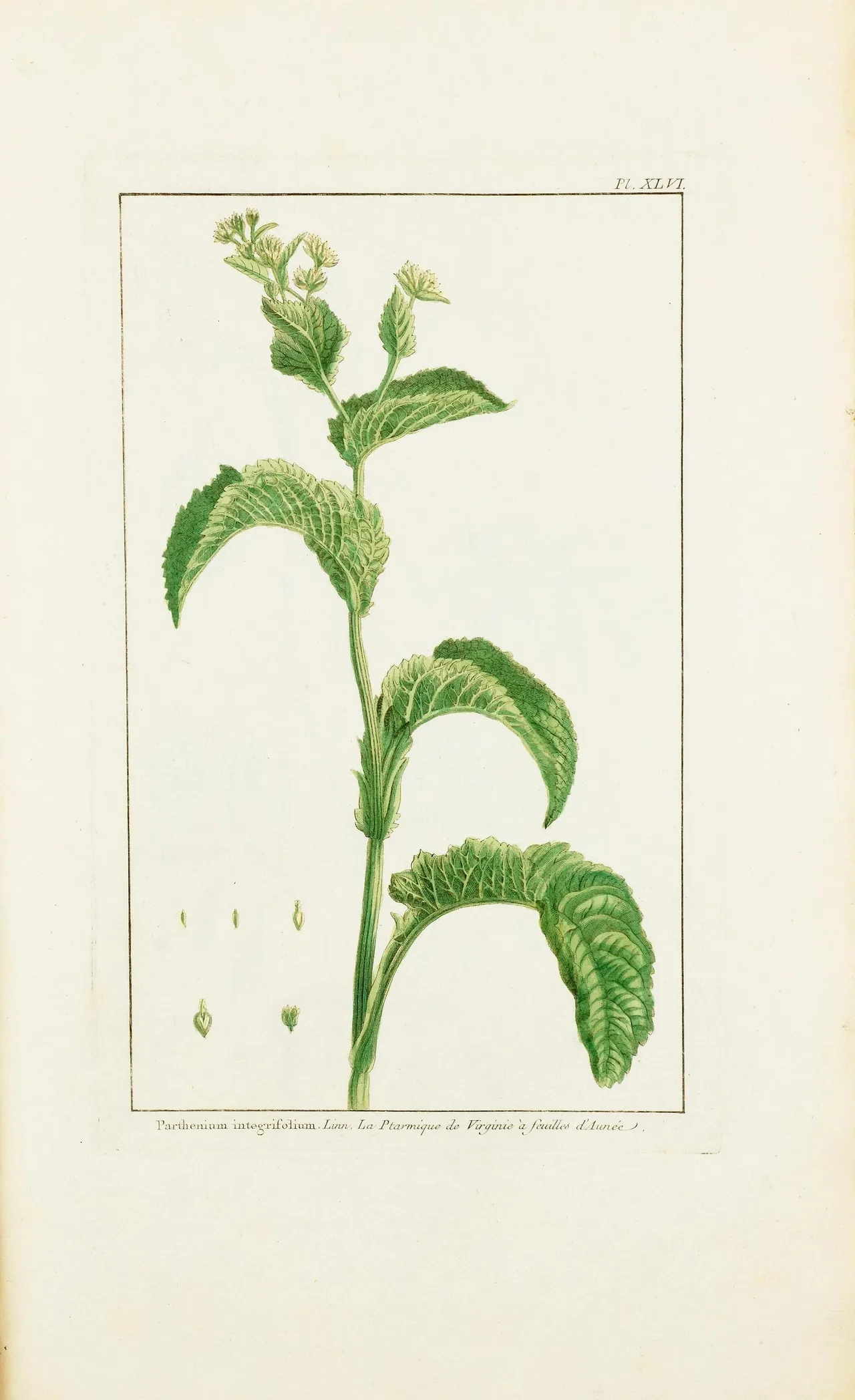 1 of 2
Native to much of the USA
Maryland to southeastern Minnesota, south to Georgia, Alabama and Arkansas
- Light Partial shade Sun tolerance
- Moisture Moisture preference
- Zones 4–8 Cold to heat range
- Bloom May–Sep Flowering time
- Height up to 3 ft to 0.9 m
- Life cycle Perennial Annual to perennial
In the garden
A woodland wildflower for partial shade. At up to 3 ft, it suits shade gardens and woodland edges. Hardy in USDA zones 4–8.
Growing conditions
Light
Full sun Partial shade Full shade
Moisture
Dry Moist Wet
Hardiness zones
Find your zone:
Pollinators & wildlife
- Bees Common Eastern Bumble Bee
also Western Honey Bee, Brown-belted Bumble Bee, Ligated Furrow Bee +22 more
Bicolored Striped Sweat Bee, Confusing Furrow Bee, Texas Leafcutter Bee, Cresson's Mining Bee, Silver-tailed Petalcutter, Calliopsis Cuckoo Nomad Bee, Ceratina dupla, Cresson's Masked Bee, Colletes nudus, Experienced Sweat Bee, Osmia conjuncta, Heriades variolosa, Nomada affabilis, Illinois Cuckoo Sweat Bee, minor cuckoo sweat bee, Leavitt's Armored-Resin bee, Lasioglossum sp.1, Sphecodes dichrous, Augochlorella persimilis, Leioproctus clypeatus, Augochlora feronia, Short-horned Yellow-face Bee - Beetles Goldenrod Soldier Beetle
also Margined Leatherwing Beetle, Banded Longhorn Beetle, Tomentous Soldier Beetle +15 more
Slender Flower Longhorn Beetle, Black Diabrotica, Eight-spotted Flower Longhorn Beetle, Red-winged Longhorn Beetle, Notch-tipped Flower Longhorn Beetle, Ten-spotted Spurleg, Stenocorus cylindricollis, Mordellistena comata, Glacial Lady Beetle, Tumbling Ragdoll, Valgus canaliculatus, Brachyleptura vagans, Chlorophorus glaucus, Wrinkled Soldier Beetle, Sumac Flea Beetle - Flower flies Margined Calligrapher
also Eastern Calligrapher, Thick-legged Hover Fly, Eurasian Drone Fly +7 more
Virginia Giant Hover Fly, Common Grass Skimmer, Tufted Globetail, Wavy Mucksucker, Toxophora amphitea, Eastern Orange-tailed Leafwalker, Sphaerophoria cylindricus - Also visited by
- Butterflies:
Eastern Tiger Swallowtail, Pearl Crescent +5 more
Viceroy, American Snout, Red-banded Hairstreak, Banded Hairstreak, Heodes hypophlaeas - Wasps:
Bald-faced Hornet, Fraternal Potter Wasp +6 more
Bramble Mason Wasp, Parasitic Aerial Yellowjacket, Parancistrocerus leionotus, Zethus spinipes, Hidalgo Mason Wasp, Ancistrocerus campestris - Moths:
Yellow-collared Scape Moth, Wavy-lined and Southern Emeralds +2 more
Ironweed Clearwing Moth, Isabella Tiger Moth
- Butterflies:
Butterflies that use this plant
Documented host and nectar records. Each links to a planting guide for that butterfly.
- American snoutnectar
- Banded hairstreaknectar
- Eastern tiger swallowtailnectar
- Pearl crescentnectar
- Red-banded hairstreaknectar
- Viceroynectar
Full plant details
Where it grows
- Habitat
- WoodlandThe wild plant community it grows in.
- Native range
- Much of the USAUnited States (23): AL, AR, GA, IA, IL, IN, KS, KY, LA, MD, MI, MN, MO, MS, NC, NY, OH, PA, SC, TN, VA, WI, WV. Where it grows wild on its own, by state and province.
- Native distribution
- Maryland to southeastern Minnesota, south to Georgia, Alabama and ArkansasThe same native range, usually more exact than the state list, and often noting where it has spread beyond it.
Growing conditions
- Light
- Partial shadeHow much sun it takes, from full sun to full shade.
- Hardiness zones
- USDA 4–8 · Canadian 5–7The cold-to-heat climate range it survives.
- Soil
- Well-drained soilsThe soils it grows in naturally.
- Soil texture
- Light to heavy (sandy to clay)The soil grade it prefers, from sand to clay.
- Soil pH
- Mildly acid to mildly alkalineThe acidity to alkalinity it tolerates (7 is neutral).
Growth & form
- Height
- up to 3 ft (to 0.9 m)Typical mature height.
- Life cycle
- PerennialWhether it lives a single season (annual), two (biennial), or returns for years (perennial).
Flowers, foliage & fruit
- Type
- WildflowerWhat kind of plant it is.
- Bloom
- May–SepWhen it flowers.
- Flower color
- WhiteThe bloom color, or colors.
- Toxicity
- None knownWhether any part is poisonous to people or pets.