woodland shrub
Coyote brush
Baccharis pilularis
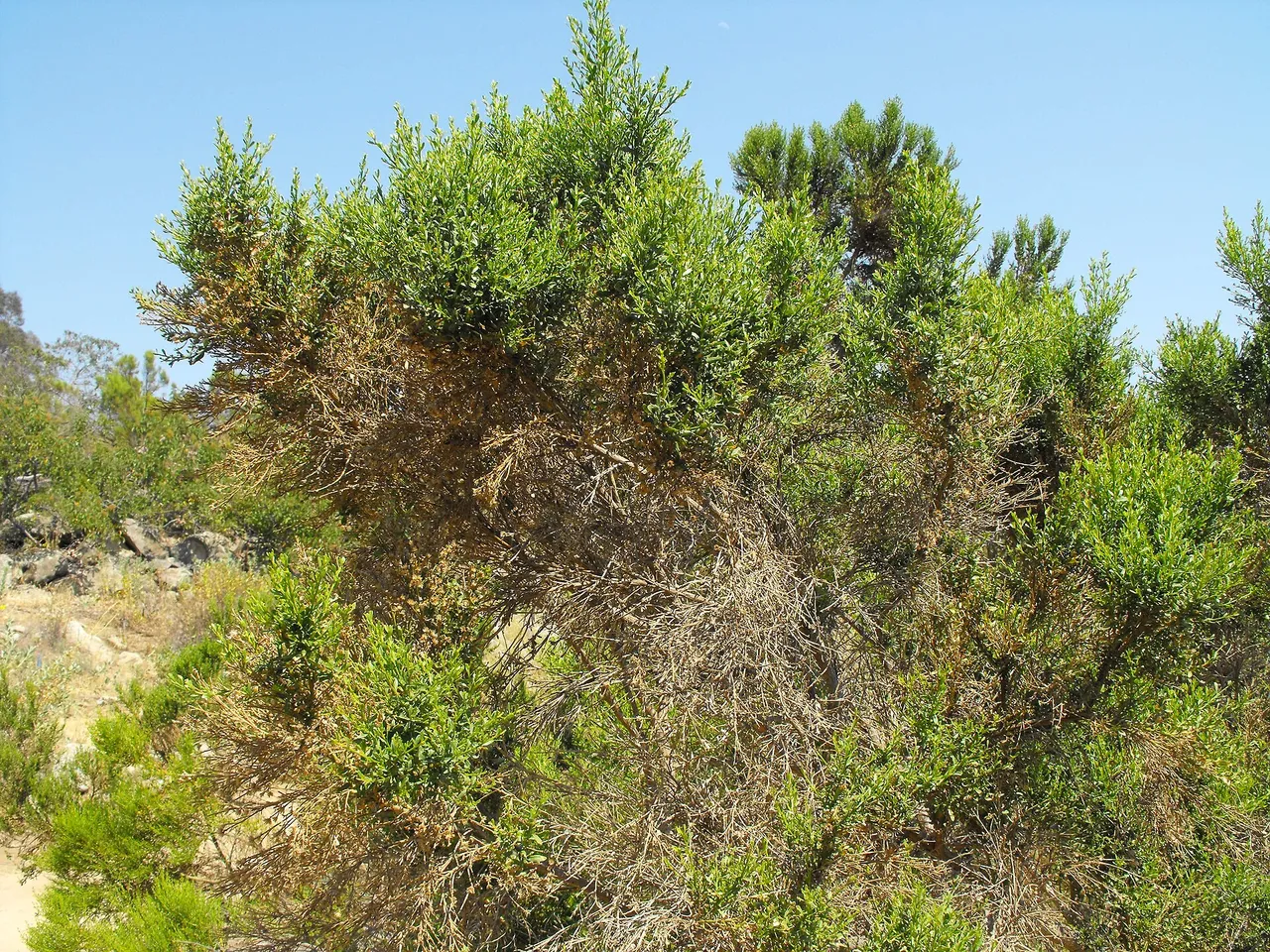
Native to California, New Mexico, and Oregon
Coastal areas from Baja California and southern California north to Tillamook county, Oregon, with inland populations in New Mexico and Chihuahua
- Light Full sun to part shade Sun tolerance
- Moisture Dry Moisture preference
- Zones n/a Cold to heat range
- Bloom Aug–Dec Flowering time
- Height up to 14 ft to 4.3 m
- Life cycle Perennial Annual to perennial
In the garden
A woodland shrub for full sun to part shade and lean, dry soil. Its white and yellow flowers peak in October. At up to 14 ft, it needs room in shade gardens and woodland edges. It shrugs off drought once established.
Growing conditions
Light
Full sun Partial shade Full shade
Moisture
Dry Moist Wet
When it blooms
The Coyote brush's white and yellow flowers bloom August to December, peaking in October. This fall display draws butterflies and flower flies.
Coyote brush blooms white & yellowFoliage
Pollinators & wildlife
- Butterflies Monarch
also Gulf Fritillary, Red Admiral, Pearl Crescent +30 more
Fiery Skipper, Painted Lady, Gray Hairstreak, American Lady, Orange Sulphur, Eastern Tailed-Blue, Common Checkered-Skipper and Allies, Common Ringlet, Gray Buckeye, Woodland Skipper, Variable Checkerspot, Lorquin's Admiral, Marine Blue, California Tortoiseshell, Acmon Blue, Western Pygmy-Blue, Umber Skipper, West Coast Lady, Great Purple Hairstreak, Mournful Duskywing, Purplish Copper, Strymon melinus pudica, Western Tailed-Blue, Coenonympha california california, Zerene eurydice, Dodge's Skipper, Limenitis bredowii californica, Atalopedes campestris, Apodemia mormo, Eresia aveyrona mylitta - Flower flies Margined Calligrapher
also Common Drone Fly, Oblique Streaktail, Narrow-headed Marsh Fly +22 more
Thick-legged Hover Fly, Eurasian Drone Fly, Yellow-shouldered Drone Fly, Black-margined Flower Fly, Variable Duskyface Fly, Common Grass Skimmer, Western Calligrapher, Tufted Globetail, Common Lagoon Fly, Black-footed Drone Fly, Exotic Streaktail, Broad-headed Marsh Fly, Golden Plushback, Poecilanthrax arethusa, Six-spotted Bromeliad Fly, Eurasian Smoothwing, Interrupted Hornet Fly, Copestylum violaceum, Stripe-eyed Lagoon Fly, Asemosyrphus polygrammus, Tropical Plushback, Single-banded Plushback - Bees Yellow-faced Bumble Bee
also Western Honey Bee, Ligated Furrow Bee, Black-tailed Bumble Bee +11 more
Two-form Bumble Bee, Tripartite Sweat Bee, Agapostemon texanus, Honey-tailed Striped Sweat Bee, Ceratina acantha, Cresson's Masked Bee, Hylaeus granulatus, Buckwheat Masked Bee, Mesilla Masked Bee, Peridot Sweat Bee, Valley Carpenter Bee - Also visited by
- Wasps:
Bald-faced Hornet, Western Yellowjacket +7 more
Golden Paper Wasp, Cross Potter Wasp, Parancistrocerus declivatus, California Yellowjacket, Polistes dorsalis californicus, American Yellowjacket, Vertical potter wasp - Beetles:
Asian Lady Beetle, Seven-spotted Lady Beetle +6 more
Convergent Lady Beetle, Spotted Cucumber Beetle, Spotless Lady Beetle, Coyote Brush Leaf Beetle, Western Polished Lady Beetle, Diabrotica undecimpunctata undecimpunctata - Moths:
Alfalfa Looper, Inornate Pyrausta Moth +2 more
Cisthene faustinula, Mottled Pyrausta Moth - Hummingbirds: Anna's Hummingbird, Allen's Hummingbird
- Birds: Say's Phoebe
- Wasps:
Butterflies that use this plant
Documented host and nectar records. Each links to a planting guide for that butterfly.
- Acmon bluenectar
- American ladynectar
- Common buckeyenectar
- Common ringletnectar
- Eastern tailed-bluenectar
- Fiery skippernectar
- Gray hairstreaknectar
- Gulf fritillarynectar
- Marine bluenectar
- Monarch butterflynectar
- Orange sulphurnectar
- Painted ladynectar
- Pearl crescentnectar
- Red admiralnectar
Full plant details
Where it grows
- Habitat
- WoodlandThe wild plant community it grows in.
- Native range
- California, New Mexico, and OregonUnited States (3): CA, NM, OR. Where it grows wild on its own, by state and province.
- Native distribution
- Coastal areas from Baja California and southern California north to Tillamook county, Oregon, with inland populations in New Mexico and ChihuahuaThe same native range, usually more exact than the state list, and often noting where it has spread beyond it.
Growing conditions
- Light
- Full sun to part shadeHow much sun it takes, from full sun to full shade.
- Moisture
- DryThe soil dampness it prefers, from dry to wet.
- Soil
- Dry sandy soilsThe soils it grows in naturally.
- Soil texture
- Light to heavy (sandy to clay)The soil grade it prefers, from sand to clay.
- Soil pH
- 6.0–8.5The acidity to alkalinity it tolerates (7 is neutral).
- Soil quality
- LowHow rich a soil it needs. Many natives prefer lean soil and flop in rich beds.
- Water use
- LowHow thirsty it is, a rough guide to how often to water.
- Drought tolerance
- HighRelative to plants of the same type and region, inferred from where it grows, not a days-without-water figure.
- Salinity tolerance
- LowHow well it copes with salty soil, near roads or the coast.
- Lime (CaCO₃) tolerance
- HighHow well it copes with chalky, lime-rich soil.
Growth & form
- Height
- up to 14 ft (to 4.3 m)Typical mature height.
- Life cycle
- PerennialWhether it lives a single season (annual), two (biennial), or returns for years (perennial).
- Growth rate
- ModerateA relative ranking versus other plants of the same type (USDA), not an absolute rate.
- Shape
- ProstrateIts overall silhouette.
- Root depth
- 20+ in (51+ cm)How far the roots reach, a guide to drought resilience and transplanting.
Flowers, foliage & fruit
- Type
- ShrubWhat kind of plant it is.
- Bloom
- Aug–DecWhen it flowers.
- Flower color
- White, YellowThe bloom color, or colors.
- Fruit/Seeds
- ripens Jan–DecThe seed or fruit it sets after flowering.
- Toxicity
- None knownWhether any part is poisonous to people or pets.
Propagation & seed
- Cold stratification
- Not requiredWhether seed needs a cold, moist spell before it will germinate.
- Propagation
- Bare root, container, cuttings, seedHow to start new plants.
- Seed
- ~8 million seeds per poundNotes on the seed and how to sow it.
- Seed spread rate
- SlowHow readily it self-sows. Slow or none means well-behaved, not a spreader.
- Seedling vigor
- MediumHow strongly young seedlings establish.
- Vegetative spread
- NoneWhether it creeps outward or stays put in a clump.