prairie wildflower
Flowering spurge
Euphorbia corollata
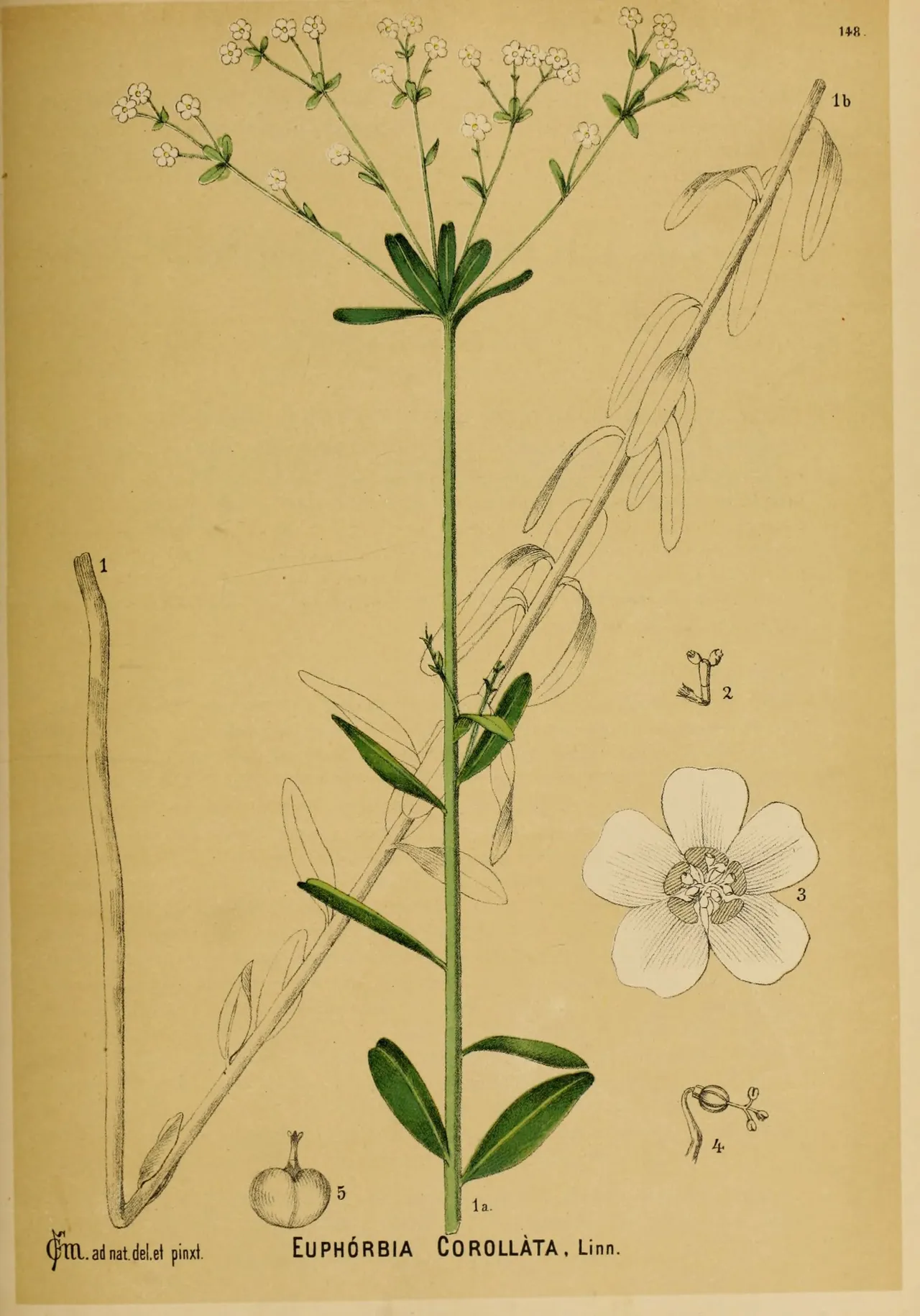
Native to much of the USA
New York to southeastern Minnesota and southeastern South Dakota, south to Florida, Texas, western Oklahoma and eastern Kansas
- Light Full sun Sun tolerance
- Moisture Dry Moisture preference
- Zones 4–9 Cold to heat range
- Bloom Jun–Oct Flowering time
- Height up to 3 ft to 0.9 m
- Life cycle Perennial Annual to perennial
In the garden
A prairie wildflower for full sun and lean, dry soil. At up to 3 ft, it suits meadows and sunny borders. It shrugs off drought once established. Hardy in USDA zones 4–9.
Growing conditions
Light
Full sun Partial shade Full shade
Moisture
Dry Moist Wet
Hardiness zones
Find your zone:
Pollinators & wildlife
- Flower flies Margined Calligrapher
also Eastern Calligrapher, Oblique Streaktail, Thick-legged Hover Fly +21 more
Eurasian Drone Fly, Common Grass Skimmer, Tufted Globetail, Yellow-legged Flower Fly, Chrysanthrax cypris, Band-winged Bee Fly, Wavy Mucksucker, Exoprosopa fasciata, Yellow-legged Bog Fly, Black-haired Psyllid-killer, Bombylius atriceps, Scar-horned Blacklet, grasshopper bee fly, Volucella vesiculosa, Epistrophe emarginata, Hemipenthes sinuosus, Maize Calligrapher, Paragus bicolor, Paragus tibialis, Sphaerophoria cylindricus, Villa alternata - Bees Ligated Furrow Bee
also Western Honey Bee, Pure Green Sweat bee, Black-and-gold Bumble Bee +12 more
Golden Sweat Bee, Spurred Ceratina, Bristle Sweat Bee, Punctate Masked Bee, Hylaeus affinis, Experienced Sweat Bee, white-winged sweat bee, Augochlorella persimilis, Yellow-spotted Cuckoo Nomad Bee, Anthophora aeneiventris, Sphecodes dichrous, Short-horned Yellow-face Bee - Butterflies Common Buckeye
also Silver-spotted Skipper, Eastern Tailed-Blue, Viceroy +7 more
Checkered White, Least Skipper, American Copper, Karner Blue, Thecla edwardsi, Protographium marcellus, Mitoura gryneus - Also visited by
- Wasps:
Fraternal Potter Wasp, Common Aerial Yellowjacket +6 more
Euodynerus foraminatus, Bramble Mason Wasp, Ancistrocerus catskill, Parancistrocerus pedestris, Mediterranean Potter Wasp, Ancistrocerus campestris - Beetles:
Goldenrod Soldier Beetle, Mordellistena comata +1 more
Chlorophorus glaucus
- Wasps:
Butterflies that use this plant
Documented host and nectar records. Each links to a planting guide for that butterfly.
- American coppernectar
- Checkered whitenectar
- Common buckeyenectar
- Eastern tailed-bluenectar
- Edwards' hairstreaknectar
- Juniper hairstreaknectar
- Silver-spotted skippernectar
- Viceroynectar
- Zebra swallowtailnectar
Full plant details
Where it grows
- Habitat
- PrairieThe wild plant community it grows in.
- Native range
- Much of the USAUnited States (33): AL, AR, CT, DC, DE, GA, IA, IL, IN, KS, KY, LA, MA, MD, MI, MN, MO, MS, NC, NE, NJ, NY, OH, OK, PA, RI, SC, SD, TN, TX, VA, WI, WV. Where it grows wild on its own, by state and province.
- Native distribution
- New York to southeastern Minnesota and southeastern South Dakota, south to Florida, Texas, western Oklahoma and eastern KansasThe same native range, usually more exact than the state list, and often noting where it has spread beyond it.
Growing conditions
- Light
- Full sunHow much sun it takes, from full sun to full shade.
- Moisture
- DryThe soil dampness it prefers, from dry to wet.
- Hardiness zones
- USDA 4–9 · Canadian 5–7The cold-to-heat climate range it survives.
- Soil
- Dry to mesic soilsThe soils it grows in naturally.
- Soil texture
- Light to medium (sandy to loamy)The soil grade it prefers, from sand to clay.
- Soil pH
- Mildly acid to mildly alkalineThe acidity to alkalinity it tolerates (7 is neutral).
- Drought tolerance
- HighRelative to plants of the same type and region, inferred from where it grows, not a days-without-water figure.
Growth & form
- Height
- up to 3 ft (to 0.9 m)Typical mature height.
- Life cycle
- PerennialWhether it lives a single season (annual), two (biennial), or returns for years (perennial).
Flowers, foliage & fruit
- Type
- WildflowerWhat kind of plant it is.
- Bloom
- Jun–OctWhen it flowers.
- Flower color
- WhiteThe bloom color, or colors.
- Toxicity
- Poisonous if eatenWhether any part is poisonous to people or pets.