prairie wildflower
Maximilian sunflower
Helianthus maximiliani
Also known as Max Sunflower
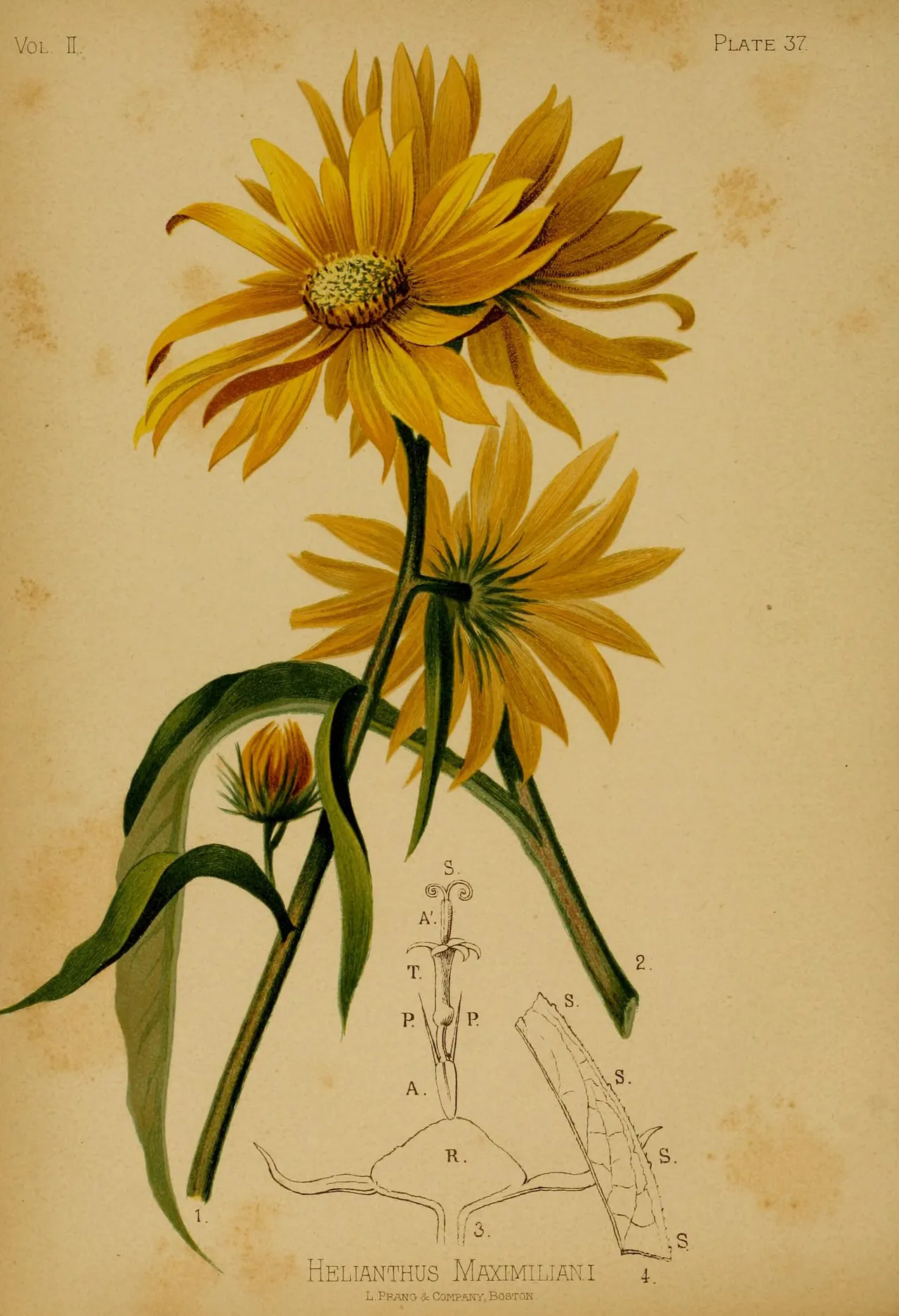 1 of 3
Native to the Great Plains and the Midwest and southern Canada
Minnesota to Saskatchewan, south to Missouri, Oklahoma and Texas; naturalized eastward and occasionally westward
- Light Full sun Sun tolerance
- Moisture Dry to moist Moisture preference
- Zones 3–10 Cold to heat range
- Bloom Jul–Nov Flowering time
- Height up to 10 ft to 3.0 m
- Life cycle Perennial Annual to perennial
In the garden
A prairie wildflower for full sun and dry to moist soil. Its yellow and brown flowers peak in September. At up to 10 ft, it needs room in meadows and sunny borders. Hardy in USDA zones 3–10.
Growing conditions
Light
Full sun Partial shade Full shade
Moisture
Dry Moist Wet
Hardiness zones
Find your zone:
When it blooms
The Maximilian sunflower's yellow and brown flowers bloom July to November, peaking in September. This early-fall display draws bees and butterflies.
Maximilian sunflower blooms yellow & brownFoliage
Pollinators & wildlife
- Bees Common Eastern Bumble Bee
also Western Honey Bee, Brown-belted Bumble Bee, American Bumble Bee +38 more
Yellow-faced Bumble Bee, Ligated Furrow Bee, Tricolored Bumble Bee, Bicolored Striped Sweat Bee, Red-belted Bumble Bee, Hunt's Bumble Bee, Half-black Bumble Bee, Vancouver Bumble Bee, Agapostemon texanus, Sculptured Resin Bee, Golden Sweat Bee, Confusing Furrow Bee, Oblique Longhorn Bee, Indiscriminate Cuckoo Bumble Bee, Dark-veined Longhorn Bee, broad-handed leafcutter bee, Southern Plains Bumble Bee, Hairy-banded Mining Bee, Common Longhorn Bee, Parallel Leafcutter Bee, Sunflower Mining Bee, Variable Pebble Bee, Agile Longhorn Bee, Compact Cellophane-Cuckoo, Swenk's Fairy Bee, Pigmented Miner Bee, Nomada adducta, Bald-spot Sweat Bee, Bombus sp., Sunflower Shortface, Two-spotted Miner Bee, Lunate Longhorn-cuckoo Bee, Svastra obliqua, Sunflower Burrowing-Resin bee, Pseudopanurgus piercei, Pseudopanurgus simulans, Megachile policaris, Sonoran Bumble Bee - Butterflies Monarch
also Gulf Fritillary, Pearl Crescent, Fiery Skipper +10 more
Painted Lady, Gray Hairstreak, Orange Sulphur, Common Checkered-Skipper and Allies, Dainty Sulphur, Southern Dogface, Striated Queen, Prairie Arogos Skipper, Abaeis nicippe, Danaus plexippus plexippus - Flower flies Margined Calligrapher
also Eastern Calligrapher, Common Drone Fly, Transverse-banded Flower Fly +7 more
Long-tailed Aphideater, Narrow-headed Marsh Fly, Eurasian Drone Fly, Virginia Giant Hover Fly, Yellow-shouldered Drone Fly, Black-horned Smoothtail, Black-footed Globetail - Also visited by
- Beetles:
Seven-spotted Lady Beetle, Spotted Cucumber Beetle +5 more
Goldenrod Soldier Beetle, Chauliognathus limbicollis, Chauliognathus omissus, Colorado Soldier Beetle, Cactus Lady Beetle - Wasps:
Golden Paper Wasp, Polistes exclamans +1 more
Apache Paper Wasp - Moths: Fall Webworm Moth, Corn Earworm Moth
- Beetles:
Butterflies that use this plant
Documented host and nectar records. Each links to a planting guide for that butterfly.
- Gorgone checkerspotcaterpillar host
- Silvery checkerspotcaterpillar host
- Dainty sulphurnectar
- Fiery skippernectar
- Gray hairstreaknectar
- Gulf fritillarynectar
- Monarch butterflynectar
- Orange sulphurnectar
- Painted ladynectar
- Pearl crescentnectar
- Queennectar
- Sleepy orangenectar
Full plant details
Where it grows
- Habitat
- PrairieThe wild plant community it grows in.
- Native range
- The Great Plains and the Midwest and southern CanadaUnited States (10): AR, IA, KS, MN, MO, ND, NE, OK, SD, TX. Canada (2): MB, SK. Where it grows wild on its own, by state and province.
- Native distribution
- Minnesota to Saskatchewan, south to Missouri, Oklahoma and Texas; naturalized eastward and occasionally westwardThe same native range, usually more exact than the state list, and often noting where it has spread beyond it.
Growing conditions
- Light
- Full sunHow much sun it takes, from full sun to full shade.
- Moisture
- Dry to moistThe soil dampness it prefers, from dry to wet.
- Hardiness zones
- USDA 3–10 · Canadian 2–7The cold-to-heat climate range it survives.
- Soil
- Prefers moist clay-like soil, but tolerant of a wide range of soils including Limestone-based, Sandy, Sandy Loam, Medium Loam, Clay Loam, ClayThe soils it grows in naturally.
- Soil texture
- Light to heavy (sandy to clay)The soil grade it prefers, from sand to clay.
- Soil pH
- 6.0–8.0The acidity to alkalinity it tolerates (7 is neutral).
- Soil quality
- MediumHow rich a soil it needs. Many natives prefer lean soil and flop in rich beds.
- Water use
- LowHow thirsty it is, a rough guide to how often to water.
- Salinity tolerance
- LowHow well it copes with salty soil, near roads or the coast.
Growth & form
- Height
- up to 10 ft (to 3.0 m)Typical mature height.
- Life cycle
- PerennialWhether it lives a single season (annual), two (biennial), or returns for years (perennial).
- Growth rate
- RapidA relative ranking versus other plants of the same type (USDA), not an absolute rate.
- Shape
- ErectIts overall silhouette.
- Root depth
- 16+ in (41+ cm)How far the roots reach, a guide to drought resilience and transplanting.
Flowers, foliage & fruit
- Type
- WildflowerWhat kind of plant it is.
- Bloom
- Jul–NovWhen it flowers.
- Flower color
- Yellow, BrownThe bloom color, or colors.
- Fruit/Seeds
- Achene; ripens Sep–NovThe seed or fruit it sets after flowering.
- Toxicity
- None knownWhether any part is poisonous to people or pets.
Propagation & seed
- Cold stratification
- Required (cold, moist)Whether seed needs a cold, moist spell before it will germinate.
- Propagation
- Bare root, seed, sprigsHow to start new plants.
- Seed
- ~0.2 million seeds per poundNotes on the seed and how to sow it.
- Seed spread rate
- ModerateHow readily it self-sows. Slow or none means well-behaved, not a spreader.
- Seedling vigor
- HighHow strongly young seedlings establish.
- Vegetative spread
- ModerateWhether it creeps outward or stays put in a clump.