prairie wildflower
Prairie rosinweed
Silphium integrifolium
Also known as Wholeleaf Rosinweed, Entire-leaf Rosinweed
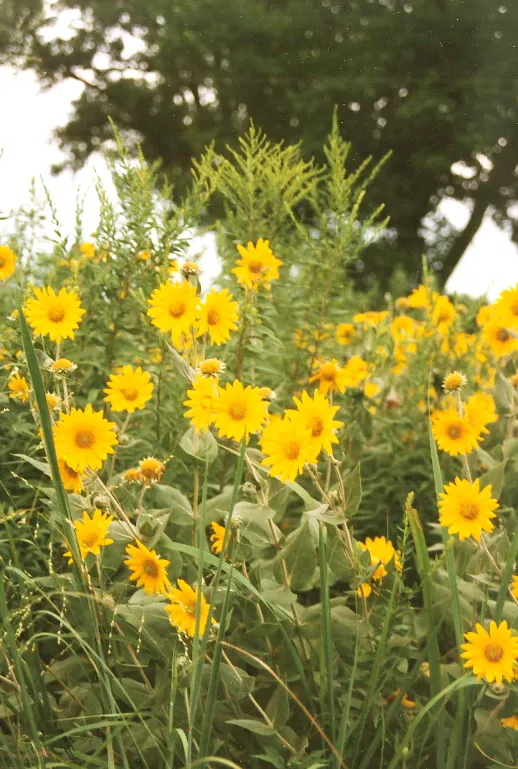 1 of 2
Native to the Great Plains, the Midwest, and the Southeast
Indiana to Mississippi, west to eastern Great Plains
- Light Full sun Sun tolerance
- Moisture Moisture preference
- Zones 4–8 Cold to heat range
- Bloom Jul–Sep Flowering time
- Height up to 6 ft to 1.8 m
- Life cycle Perennial Annual to perennial
In the garden
A prairie wildflower for full sun. At up to 6 ft, it needs room in meadows and sunny borders. Hardy in USDA zones 4–8.
Growing conditions
Light
Full sun Partial shade Full shade
Moisture
Dry Moist Wet
Hardiness zones
Find your zone:
Pollinators & wildlife
- Bees Common Eastern Bumble Bee
also Western Honey Bee, Eastern Carpenter Bee, Brown-belted Bumble Bee +40 more
Two-spotted Bumble Bee, American Bumble Bee, Ligated Furrow Bee, Bicolored Striped Sweat Bee, Pure Green Sweat bee, Bombus fervidus, Red-belted Bumble Bee, Two-spotted Longhorn Bee, Black-and-gold Bumble Bee, Half-black Bumble Bee, Lemon Cuckoo Bumble Bee, Flat-tailed Leafcutter Bee, Rusty-patched Bumble Bee, Dark-veined Longhorn Bee, Pugnacious Leafcutter Bee, Silky Striped Sweat Bee, Louisiana Painted-Dark bee, Sunflower Mining Bee, Silver-tailed Petalcutter, Megachile inimica, Petulant Leafcutter Bee, Squash Longhorn-Cuckoo, Agile Longhorn Bee, Megachile brevis, Ceratina dupla, Nomada vincta, Lasioglossum cinctipes, Osmia conjuncta, False Sunflower Cuckoo Nomad Bee, Big-cheeked Angled-Mason, Melissodes coloradensis, Melissodes bimaculatus bimaculatus, Strand's Carpenter Bee, Andrena polemonii, Melissodes dentiventris, Xenoglossa strenua, Svastra compta, Svastra obliqua, Two-spotted Miner Bee, Megachile policaris - Butterflies Monarch
also Eastern Tiger Swallowtail, Painted Lady, Zabulon Skipper +2 more
Papilio cresphontes, Silvery Checkerspot - Beetles Goldenrod Soldier Beetle
also Slender Flower Longhorn Beetle, Ornated Tumbling Flower Beetle, Metacmaeops vittata +1 more
Mordella scutellaris - Also visited by
- Flower flies:
Transverse-banded Flower Fly, Aldrichia ehrmanii +2 more
Scar-horned Blacklet, grasshopper bee fly - Hummingbirds: Ruby-throated Hummingbird
- Wasps: Hidalgo Mason Wasp
- Flower flies:
Butterflies that use this plant
Documented host and nectar records. Each links to a planting guide for that butterfly.
- Gorgone checkerspotcaterpillar host
- Eastern tiger swallowtailnectar
- Giant swallowtailnectar
- Monarch butterflynectar
- Painted ladynectar
- Silvery checkerspotnectar
Full plant details
Where it grows
- Habitat
- PrairieThe wild plant community it grows in.
- Native range
- The Great Plains, the Midwest, and the SoutheastUnited States (17): AL, AR, IA, IL, IN, KS, KY, LA, MN, MO, MS, NE, OK, SD, TN, TX, WI. Where it grows wild on its own, by state and province.
- Native distribution
- Indiana to Mississippi, west to eastern Great PlainsThe same native range, usually more exact than the state list, and often noting where it has spread beyond it.
Growing conditions
- Light
- Full sunHow much sun it takes, from full sun to full shade.
- Hardiness zones
- USDA 4–8 · Canadian 5–7The cold-to-heat climate range it survives.
- Soil
- Well-drained soilsThe soils it grows in naturally.
- Soil texture
- Light to heavy (sandy to clay)The soil grade it prefers, from sand to clay.
- Soil pH
- Mildly acid to mildly alkalineThe acidity to alkalinity it tolerates (7 is neutral).
- Soil quality
- Low (tolerates poor soil)How rich a soil it needs. Many natives prefer lean soil and flop in rich beds.
Growth & form
- Height
- up to 6 ft (to 1.8 m)Typical mature height.
- Spread
- ~3 ft (0.9 m)How wide one plant gets, a guide to spacing.
- Life cycle
- PerennialWhether it lives a single season (annual), two (biennial), or returns for years (perennial).
- Growth rate
- RapidA relative ranking versus other plants of the same type (USDA), not an absolute rate.
Flowers, foliage & fruit
- Type
- WildflowerWhat kind of plant it is.
- Bloom
- Jul–SepWhen it flowers.
- Flower color
- YellowThe bloom color, or colors.
- Fruit/Seeds
- Winged acheneThe seed or fruit it sets after flowering.
- Toxicity
- None knownWhether any part is poisonous to people or pets.