wetland shrub
Red osier dogwood
Cornus sericea
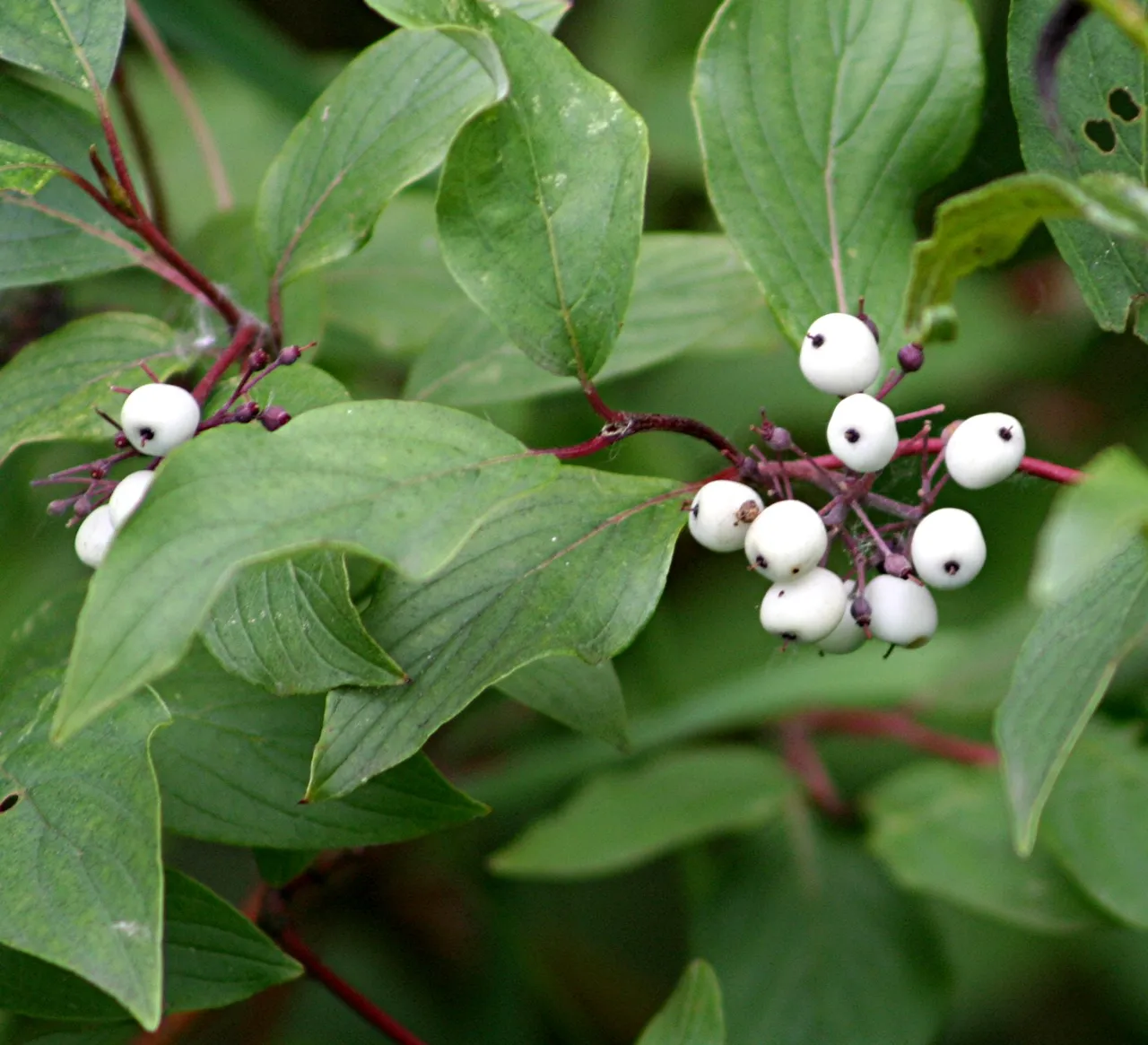
Native to much of the USA and Canada
Newfoundland to Alaska, south to Virginia, Nebraska, New Mexico mountains and northern California
- Light Partial shade Sun tolerance
- Moisture Moist Moisture preference
- Zones 1–10 Cold to heat range
- Bloom May–Jun Flowering time
- Height up to 12 ft to 3.7 m
- Life cycle Perennial Annual to perennial
In the garden
A wetland shrub for partial shade and evenly moist soil. At up to 12 ft, it needs room in rain gardens, pond edges, and damp low spots. Hardy in USDA zones 1–10.
Growing conditions
Light
Full sun Partial shade Full shade
Moisture
Dry Moist Wet
Hardiness zones
Find your zone:
Pollinators & wildlife
- Bees Common Eastern Bumble Bee
also Western Honey Bee, Brown-belted Bumble Bee, Two-spotted Bumble Bee +45 more
Yellow-faced Bumble Bee, Tricolored Bumble Bee, Black-tailed Bumble Bee, Bicolored Striped Sweat Bee, Pure Green Sweat bee, Bombus fervidus, Red-belted Bumble Bee, Perplexing Bumble Bee, Fuzzy-Horned Bumble Bee, Two-form Bumble Bee, Black-and-gold Bumble Bee, Colletes inaequalis, Orange-legged Furrow Bee, Yellow-banded Bumble Bee, Rusty-patched Bumble Bee, Confusing Furrow Bee, Hawthorn Mining Bee, Carlin's Mining Bee, Neighborly Mining Bee, Western Bumble Bee, Silky Striped Sweat Bee, Cresson's Mining Bee, Bare Dogwood Miner, Cresson's Sweat Bee, Hairy masked Bee, Snowy Mining Bee, Fragile Miner Bee, Common Masked Bee, Buff-tailed Bumble Bee, W-labrum Miner, Protuberance Miner Bee, Willow Flower Miner Bee, Short-fringed Miner, Shifty Miner Bee, Early Mining Bee, Common Carder Bumble Bee, Broad-faced Furrow Bee, Brown-fovea Miner, Lasioglossum majus, Milwaukee Mining Bee, Lasioglossum pilosum, Peaceful Sweat Bee, Andrena miserabilis, Lasioglossum zonulum, Dimple-bellied Sweat Bee - Flower flies Eastern Calligrapher
also Common Drone Fly, Transverse-banded Flower Fly, Thick-legged Hover Fly +12 more
Wasp-like Falsehorn, Orange-spined Drone Fly, Dusky Bog Fly, Bare-bellied Falsehorn, Northern Wasp Fly, Black-banded Falsehorn, Marmalade Hover Fly, Temnostoma excentrica, Pearly Sedgesitter, Hemipenthes morioides, Black-legged Gossamer, Tropidia quadrata - Beetles Asian Lady Beetle
also Seven-spotted Lady Beetle, Twenty-spotted Lady Beetle, Two-lined Leatherwing +12 more
Two-spotted Lady Beetle, Lined Longhorn Beetle, Parenthesis Lady Beetle, Dogwood Leaf Beetle, Grammoptera subargentata, Scripted Long-horned Beetle, Judolia montivagans, Double-lined Longhorn Beetle, Oedecnema gebleri, Broadbean Weevil, Vetch Bruchid, Agrilus planipennis - Also visited by
- Butterflies:
Monarch, Red Admiral +8 more
Pearl Crescent, Painted Lady, Common Ringlet, Silvery Blue, Northern Azure, Cyaniris neglecta, Incisalia niphon, Silvery Checkerspot - Moths:
Spongy Moth, Unicorn Prominent +5 more
White-spotted Sable, Impressive Dagger, Funerary Dagger, Spear-marked and White-banded Black Moths, Spotted Tussock Moth - Wasps: Bramble Mason Wasp
- Butterflies:
Butterflies that use this plant
Documented host and nectar records. Each links to a planting guide for that butterfly.
- Summer azurehost & nectar
- Common ringletnectar
- Eastern pine elfinnectar
- Monarch butterflynectar
- Painted ladynectar
- Pearl crescentnectar
- Red admiralnectar
- Silvery bluenectar
- Silvery checkerspotnectar
Full plant details
Where it grows
- Habitat
- WetlandThe wild plant community it grows in.
- Native range
- Much of the USA and CanadaUnited States (35): AK, AZ, CA, CO, CT, DE, IA, ID, IL, IN, MA, MD, ME, MI, MN, MT, ND, NE, NH, NJ, NM, NV, NY, OH, OR, PA, RI, SD, UT, VA, VT, WA, WI, WV, WY. Canada (8): AB, BC, MB, NB, NS, PE, QC, SK. Where it grows wild on its own, by state and province.
- Native distribution
- Newfoundland to Alaska, south to Virginia, Nebraska, New Mexico mountains and northern CaliforniaThe same native range, usually more exact than the state list, and often noting where it has spread beyond it.
Growing conditions
- Light
- Partial shadeHow much sun it takes, from full sun to full shade.
- Moisture
- MoistThe soil dampness it prefers, from dry to wet.
- Hardiness zones
- USDA 1–10 · Canadian 0–9The cold-to-heat climate range it survives.
- Soil
- Moist, well-drained soilsThe soils it grows in naturally.
- Soil texture
- Light to heavy (sandy to clay)The soil grade it prefers, from sand to clay.
- Soil pH
- Mildly acid to mildly alkalineThe acidity to alkalinity it tolerates (7 is neutral).
Growth & form
- Height
- up to 12 ft (to 3.7 m)Typical mature height.
- Spread
- ~13 ft (4 m)How wide one plant gets, a guide to spacing.
- Life cycle
- PerennialWhether it lives a single season (annual), two (biennial), or returns for years (perennial).
- Growth rate
- RapidA relative ranking versus other plants of the same type (USDA), not an absolute rate.
Flowers, foliage & fruit
- Type
- ShrubWhat kind of plant it is.
- Bloom
- May–JunWhen it flowers.
- Flower color
- WhiteThe bloom color, or colors.
- Toxicity
- None knownWhether any part is poisonous to people or pets.