woodland wildflower
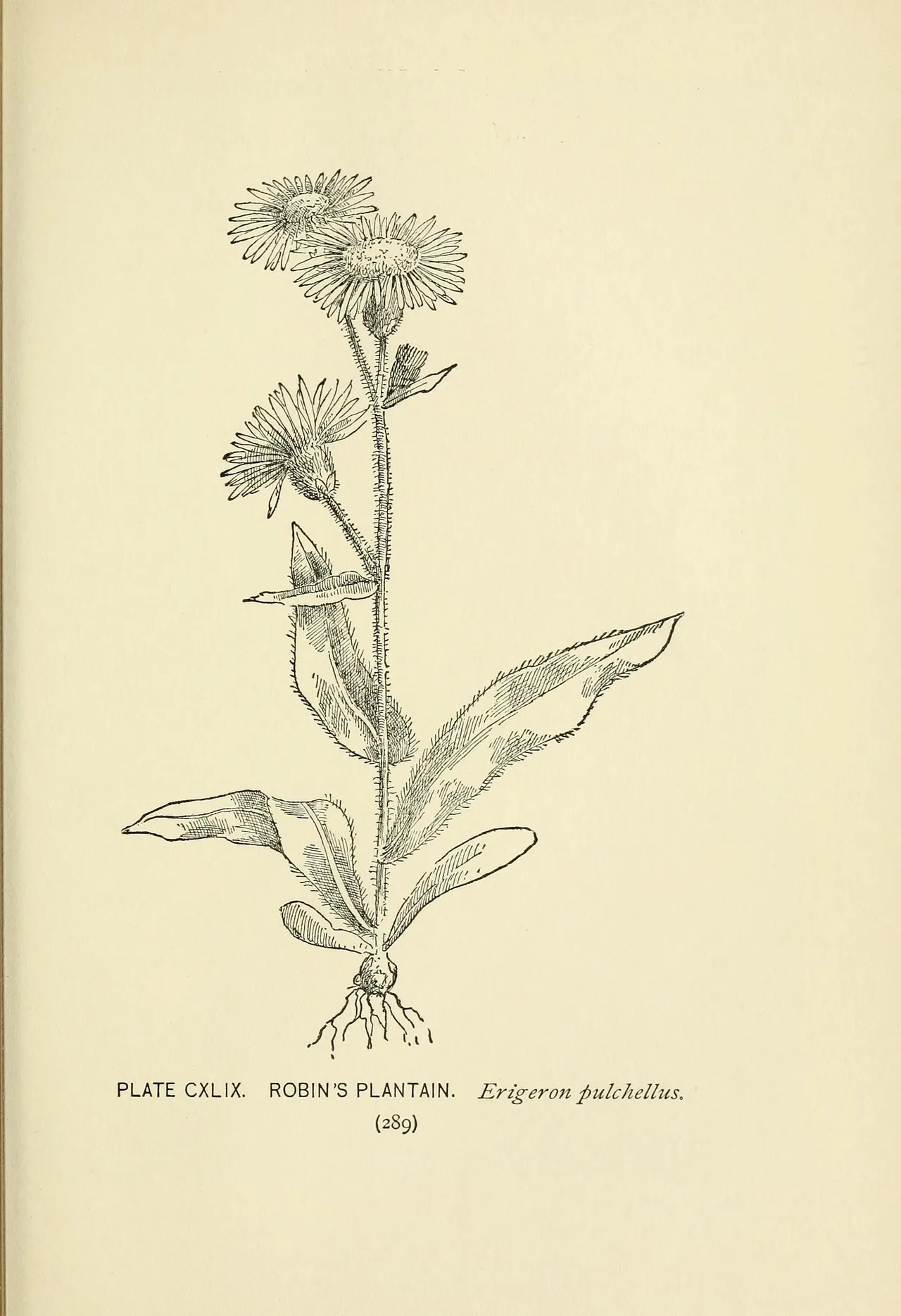
Robin's-plantain
Erigeron pulchellus
Also known as Robin's Plantain, Poor Robin's Plantain, Rose Petty, Robert's Plantain, Blue Spring-daisy
 1 of 2
Native to much of the USA and southern Canada
Maine and Ontario to southeastern Minnesota, south to Georgia, Mississippi and eastern Texas
- Light Partial shade Sun tolerance
- Moisture Moist Moisture preference
- Zones 3–8 Cold to heat range
- Bloom Mar–Jun Flowering time
- Height up to 2 ft to 0.6 m
- Life cycle Perennial Annual to perennial
In the garden
A woodland wildflower for partial shade and evenly moist soil. Its white flowers peak in April. At up to 2 ft, it suits shade gardens and woodland edges. Hardy in USDA zones 3–8.
Growing conditions
Light
Full sun Partial shade Full shade
Moisture
Dry Moist Wet
Hardiness zones
Find your zone:
When it blooms
The Robin's-plantain's white flowers bloom March to June, peaking in April. This spring display draws bees and butterflies.
Robin's-plantain blooms white, yellow, blue & purpleFoliage
Pollinators & wildlife
- Bees Common Eastern Bumble Bee
also Western Honey Bee, Two-spotted Bumble Bee, Ligated Furrow Bee +140 more
Bicolored Striped Sweat Bee, Pure Green Sweat bee, Hunt's Bumble Bee, Fuzzy-Horned Bumble Bee, Two-form Bumble Bee, Yellow-fronted Bumble Bee, Golden Sweat Bee, Confusing Furrow Bee, Alfalfa Leafcutter Bee, Indiscriminate Cuckoo Bumble Bee, Western Bumble Bee, Forest Bumble Bee, Slender-faced Masked Bee, frigid bumble bee, Colletes simulans, Articulated Nomad, Punctate Masked Bee, Annulate Masked Bee, Ceratina dupla, Hairy masked Bee, Lasioglossum nitidiusculum, Golden-tailed Woodborer, Little Masked Bee, Triepeolus cressonii, Heriades cressoni, Common Masked Bee, Large-headed Armoured-Resin bee, Nomada bifasciata, Robust Small-Mason, Black Masked Bee, Large Masked Bee, Spined Mason Bee, Golden Furrow Bee, Hylaeus cardioscapus, Linsenmaier's Nomad, Lasioglossum sabulosum, Lasioglossum pleurospeculum, Lasioglossum subfulvicorne, Hylaeus glacialis, Hylaeus pfankuchi, Snowy Masked Bee, Hylaeus moricei, Andrena amieti, Lasioglossum euboeense, Lasioglossum lissonotum, Lasioglossum alpigenum, Halictus carinthiacus, Hylaeus pilosulus, Heriades crenulatus, Translucent Miner, Hylaeus bifasciatus, Femoral Nomad, Grey-banded Mining Bee, Buff-tailed Mining Bee, Lasioglossum aeratum, Lasioglossum subfasciatum, Colletes mlokossewiczi, Hylaeus euryscapus, Small-headed Resin Bee, Hylaeus crassanus, Hylaeus alpinus, Eucera nigrifacies, Megachile genalis, Nomada facilis, Hylaeus gibbus, Osmia labialis, Megachile flabellipes, White-lipped Yellow-face Bee, Panurgus dentipes, Hylaeus sinuatus, Small Shiny Furrow Bee, Lasioglossum marginellum, Halictus leucaheneus, Chalk Yellow-face Bee, Lasioglossum majus, Hylaeus tyrolensis, Dotted Masked Bee, Narrowed Masked Bee, Forest Masked Bee, Shiny Dufourea, Polished Miner, Orange-vented Mason Bee, Broad-banded Nomad Bee, Nomada integra, Osmia mustelina, Hylaeus styriacus, Hairy-saddled Cellophane Bee, Reed Yellow-face Bee, Hylaeus difformis, Hylaeus paulus, Andrena livens, Hesperian Miner, Osmia rufohirta, Andrena nigroolivacea, Megachile melanopyga, Large Shaggy Bee, Small Shaggy Bee, Halictus seladonius, White-jawed Yellow-face Bee, Nomada distinguenda, Lasioglossum albocinctum, Andrena rhenana, Andrena taraxaci, Hylaeus kahri, Hylaeus imparilis, Hylaeus taeniolatus, Horned Masked Bee, Lasioglossum interruptum, Pseudapis diversipes, Snowy Mason, Lasioglossum minutulum, Ridge-gastered Furrow Bee, Lasioglossum lucidulum, Squat Furrow Bee, Lasioglossum subhirtum, Common Pantaloon Bee, Davies' Cellophane Bee, Gredler's Masked Bee, Fringed Furrow Bee, Lasioglossum discum, Onion Yellow-face Bee, Variegated Masked Bee, Lasioglossum lineare, Lasioglossum marginatum, Lasioglossum nigripes, Great Banded Furrow Bee, Short-horned Yellow-face Bee, Bare-saddled Cellophane Bee, Crenulate Armoured-Resin bee, Bombus flavidus flavidus, Lasioglossum podolicum, Lasioglossum laevidorsum, Lasioglossum tarsatum, Nomada pleurosticta, Lasioglossum laeve, Hylaeus duckei, Lasioglossum bluethgeni, Osmia scutellaris, Smeathman's Furrow Bee, Colletes ciliatus - Butterflies Red Admiral
also Pearl Crescent, American Lady, Eastern Tailed-Blue +33 more
Peck's Skipper, Checkered White, Canadian Tiger Swallowtail, Least Skipper, Hobomok Skipper, Arctic Skipper, Mustard White, Callippe Fritillary, Anna's Blue, Amblyscirtes hegon, Mead's Sulphur, Northern Grizzled Skipper, Ross's Alpine, Small Copper, Common Branded Skipper, Small Heath, Titania's Fritillary, Sooty Copper, Common Zebra Blue, Mormon Fritillary, Plebejus glandon, Lycaena cupreus, Clossiana improba, Parnassius smintheus smintheus, Snow's Copper, Magdalena Alpine, Chlosyne palla whitneyi, Speyeria mormonia, European Peacock Butterfly, Callophrys gryneus gryneus, Incisalia niphon, Elkalyce comyntas, Thecla edwardsi - Flower flies Margined Calligrapher
also Eastern Calligrapher, Common Drone Fly, Transverse-banded Flower Fly +7 more
Eurasian Drone Fly, Black-shouldered Drone Fly, The Merodon equestris Group, Yellow-legged Bog Fly, Common Globetail, Marmalade Hover Fly, Scar-horned Blacklet - Also visited by
- Wasps:
Perennial Mason Wasp, Ancistrocerus capra +2 more
Mediterranean Potter Wasp, Heath Potter Wasp - Beetles:
Oriental Beetle, Striped Cucumber Beetle +3 more
Yellow Velvet Beetle, Blistered Tumbling Flower Beetle, Propylaea quatuordecimpunctata - Moths: White Slant-line, White-spotted Sable
- Wasps:
Butterflies that use this plant
Documented host and nectar records. Each links to a planting guide for that butterfly.
- American ladynectar
- Canadian tiger swallowtailnectar
- Checkered whitenectar
- Eastern pine elfinnectar
- Eastern tailed-bluenectar
- Eastern tiger swallowtailnectar
- Edwards' hairstreaknectar
- Juniper hairstreaknectar
- Pearl crescentnectar
- Red admiralnectar
- Silver-bordered fritillarynectar
Full plant details
Where it grows
- Habitat
- WoodlandThe wild plant community it grows in.
- Native range
- Much of the USA and southern CanadaUnited States (33): AL, AR, CT, DC, GA, IA, IL, IN, KS, KY, LA, MA, MD, ME, MI, MN, MO, MS, NC, NH, NJ, NY, OH, OK, PA, RI, SC, TN, TX, VA, VT, WI, WV. Canada (2): ON, QC. Where it grows wild on its own, by state and province.
- Native distribution
- Maine and Ontario to southeastern Minnesota, south to Georgia, Mississippi and eastern TexasThe same native range, usually more exact than the state list, and often noting where it has spread beyond it.
Growing conditions
- Light
- Partial shadeHow much sun it takes, from full sun to full shade.
- Moisture
- MoistThe soil dampness it prefers, from dry to wet.
- Hardiness zones
- USDA 3–8 · Canadian 4–7The cold-to-heat climate range it survives.
- Soil
- Rich, sandy soilsThe soils it grows in naturally.
- Soil texture
- Light to heavy (sandy to clay)The soil grade it prefers, from sand to clay.
- Soil pH
- Acid to neutralThe acidity to alkalinity it tolerates (7 is neutral).
- Soil quality
- Low (tolerates poor soil)How rich a soil it needs. Many natives prefer lean soil and flop in rich beds.
Growth & form
- Height
- up to 2 ft (to 0.6 m)Typical mature height.
- Spread
- ~2 ft (0.6 m)How wide one plant gets, a guide to spacing.
- Life cycle
- PerennialWhether it lives a single season (annual), two (biennial), or returns for years (perennial).
- Growth rate
- RapidA relative ranking versus other plants of the same type (USDA), not an absolute rate.
Flowers, foliage & fruit
- Type
- WildflowerWhat kind of plant it is.
- Bloom
- Mar–JunWhen it flowers.
- Flower color
- White, Yellow, Blue, PurpleThe bloom color, or colors.
- Fruit/Seeds
- ripens Apr–JunThe seed or fruit it sets after flowering.
- Toxicity
- None knownWhether any part is poisonous to people or pets.