woodland wildflower
Sulfur buckwheat
Eriogonum umbellatum
Also known as Sulphur-flower Buckwheat, Sulphur-flower Wild Buckwheat, Sulphur Buckwheat, Sulphur-flower
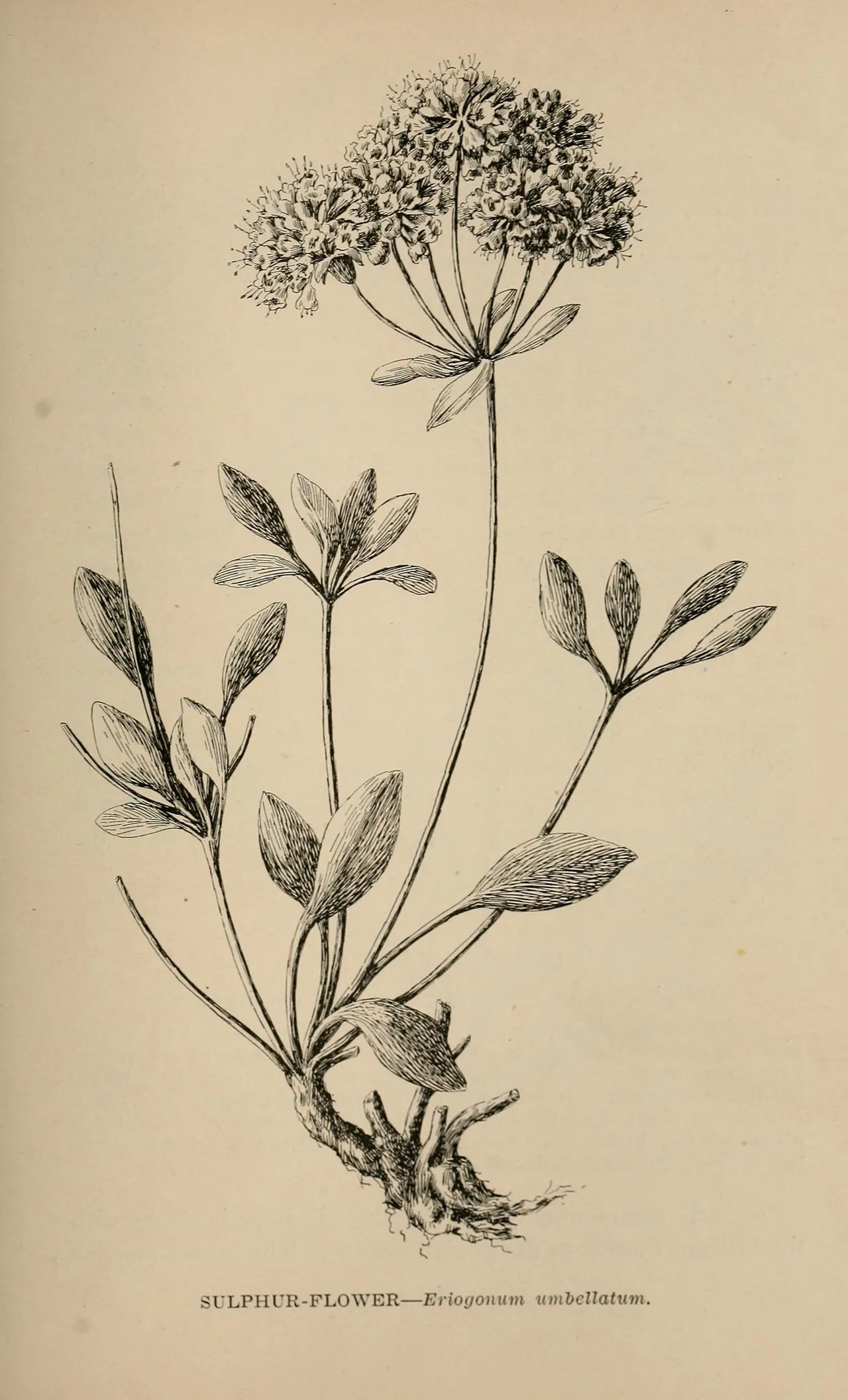 1 of 2
Native to the Pacific Coast, the Southwest, and the Rockies and southern Canada
Rocky Mountains (typical form) and other cold, western mount sites
- Light Full sun to part shade Sun tolerance
- Moisture Dry Moisture preference
- Zones 3–9 Cold to heat range
- Bloom Jun–Sep Flowering time
- Height up to 6 ft to 1.8 m
- Life cycle Perennial Annual to perennial
In the garden
A woodland wildflower for full sun to part shade and lean, dry soil. At up to 6 ft, it needs room in shade gardens and woodland edges. It shrugs off drought once established. Hardy in USDA zones 3–9.
Growing conditions
Light
Full sun Partial shade Full shade
Moisture
Dry Moist Wet
Hardiness zones
Find your zone:
Pollinators & wildlife
- Butterflies Red Admiral
also Pearl Crescent, Gray Hairstreak, American Lady +93 more
Orange Sulphur, Checkered White, Gray Buckeye, Dun Skipper, Woodland Skipper, Variable Checkerspot, Silvery Blue, Anise Swallowtail, Marine Blue, California Tortoiseshell, Acmon Blue, Reakirt's Blue, Boisduval's Blue, Northern Checkerspot, Melissa Blue, American Branded Skipper, Edith's Checkerspot, Lupine Blue, Callippe Fritillary, Persius Duskywing, Common Alpine, Lotus Hairstreak, Juba Skipper, Rural Skipper, Gorgone Checkerspot, Chryxus Arctic, Behr's Hairstreak, Two-banded Checkered-Skipper, California Hairstreak, Great Basin Wood-Nymph, Gorgon Copper, Zephyr Comma, Garita Skipperling, Glaucon Blue, Mottled Duskywing, Arachne Checkerspot, Pale Crescent, Nevada Skipper, Camillus Crescent, Argynnis callippe macaria, Western Sooty Hairstreak, Common Branded Skipper, Phyciodes batesii anasazi, Polites sabuleti draco, Plebejus lupini texanus, Plebejus shasta minnehaha, Occidryas anicia capella, Pawnee Skipper, Euphilotes enoptes ancilla, Siva Juniper Hairstreak, Plebejus glandon, Pahaska Skipper, Green Skipper, Cercyonis oetus, Harkenclenus titus, Polites mystic, Speyeria coronis, Speyeria mormonia, Silvery Checkerspot, Plebejus saepiolus, Coenonympha tullia, Speyeria callippe, Dotted Checkerspot, Plebejus lupini, Speyeria zerene, Phoebus Apollo, Speyeria edwardsii, Speyeria aphrodite, Lycaena xanthoides, Epidemia helloides, Pyrgus communis, Thorybes pylades, Neominois ridingsii, Uhler's Arctic, Arrowhead Blue, Thecla sheridanii, Euphilotes battoides, Mitoura spinetorum, Strymon saepium, Cynthia cardui, Lycaena heteronea, Sagebrush Sooty Hairstreak, Incisalia eryphon, Edith's Copper, Tharsalea rubidus, Blue Copper, Zerene eurydice, Anicia Checkerspot, Apodemia mormo, Heliopetes ericetorum, Mitoura gryneus, Columbian Blue, Occidryas colon - Bees Yellow-faced Bumble Bee
also Western Honey Bee, Bombus fervidus, Red-belted Bumble Bee +23 more
Hunt's Bumble Bee, Two-form Bumble Bee, Orange-legged Furrow Bee, Yellow-fronted Bumble Bee, California Bumble Bee, Great Basin Bumble Bee, Nearctic Bumble Bee, Urbane Digger Bee, Wide-striped Sweat Bee, Prunus Miner Bee, Pugnacious Leafcutter Bee, Western Bumble Bee, Forest Bumble Bee, Bufflehead Mason Bee, Golden-tailed Leafcutter Bee, Kincaid's Cellophane Bee, Lasioglossum cembrilacus, Colletes nigrifrons, Birtwell's Miner Bee, Osmia subaustralis, Inept Miner Bee, Arizona Small carpenter, Anthidiellum robertsoni - Flower flies Large-tailed Aphideater also Yellow-shouldered Drone Fly, Black-footed Globetail
- Also visited by
- Moths:
MacCulloch's Forester Moth, Lycaena rubidus +2 more
Lycaena rubidus sirius, Rufous-banded Crambid Moth - Beetles:
Yellow Velvet Beetle, Judolia instabilis +2 more
Red Split-necked Pachy, Wasp Beetle - Wasps: Golden Paper Wasp, Hidalgo Mason Wasp
- Moths:
Butterflies that use this plant
Documented host and nectar records. Each links to a planting guide for that butterfly.
- Acmon bluehost & nectar
- American ladynectar
- Aphrodite fritillarynectar
- Boisduval's bluenectar
- Checkered whitenectar
- Common buckeyenectar
- Common ringletnectar
- Common wood-nymphnectar
- Coral hairstreaknectar
- Eastern pine elfinnectar
- Edwards' hairstreaknectar
- Gorgone checkerspotnectar
- Gray hairstreaknectar
- Hedgerow hairstreaknectar
- Juniper hairstreaknectar
- Marine bluenectar
- Melissa bluenectar
- Orange sulphurnectar
- Pearl crescentnectar
- Reakirt's bluenectar
- Red admiralnectar
- Silvery bluenectar
- Silvery checkerspotnectar
Full plant details
Where it grows
- Habitat
- WoodlandThe wild plant community it grows in.
- Native range
- The Pacific Coast, the Southwest, and the Rockies and southern CanadaUnited States (11): AZ, CA, CO, ID, MT, NM, NV, OR, UT, WA, WY. Canada (2): AB, SK. Where it grows wild on its own, by state and province.
- Native distribution
- Rocky Mountains (typical form) and other cold, western mount sitesThe same native range, usually more exact than the state list, and often noting where it has spread beyond it.
Growing conditions
- Light
- Full sun to part shadeHow much sun it takes, from full sun to full shade.
- Moisture
- DryThe soil dampness it prefers, from dry to wet.
- Hardiness zones
- USDA 3–9 · Canadian 1–9The cold-to-heat climate range it survives.
- Soil
- Gravelly soilsThe soils it grows in naturally.
- Soil pH
- 6.5–9.0The acidity to alkalinity it tolerates (7 is neutral).
- Soil quality
- LowHow rich a soil it needs. Many natives prefer lean soil and flop in rich beds.
- Water use
- LowHow thirsty it is, a rough guide to how often to water.
- Drought tolerance
- HighRelative to plants of the same type and region, inferred from where it grows, not a days-without-water figure.
- Salinity tolerance
- HighHow well it copes with salty soil, near roads or the coast.
- Lime (CaCO₃) tolerance
- HighHow well it copes with chalky, lime-rich soil.
Growth & form
- Height
- up to 6 ft (to 1.8 m)Typical mature height.
- Life cycle
- PerennialWhether it lives a single season (annual), two (biennial), or returns for years (perennial).
- Growth rate
- SlowA relative ranking versus other plants of the same type (USDA), not an absolute rate.
- Shape
- RoundedIts overall silhouette.
- Root depth
- 20+ in (51+ cm)How far the roots reach, a guide to drought resilience and transplanting.
Flowers, foliage & fruit
- Type
- WildflowerWhat kind of plant it is.
- Bloom
- Jun–SepWhen it flowers.
- Flower color
- White, YellowThe bloom color, or colors.
- Toxicity
- None knownWhether any part is poisonous to people or pets.
Propagation & seed
- Cold stratification
- Not requiredWhether seed needs a cold, moist spell before it will germinate.
- Propagation
- Bare root, container, seedHow to start new plants.
- Seed
- ~0.2 million seeds per poundNotes on the seed and how to sow it.
- Seed spread rate
- SlowHow readily it self-sows. Slow or none means well-behaved, not a spreader.
- Seedling vigor
- MediumHow strongly young seedlings establish.
- Vegetative spread
- NoneWhether it creeps outward or stays put in a clump.