woodland wildflower
Tall goldenrod
Solidago altissima
Also known as Late Goldenrod, Canadian Goldenrod, Canada Goldenrod
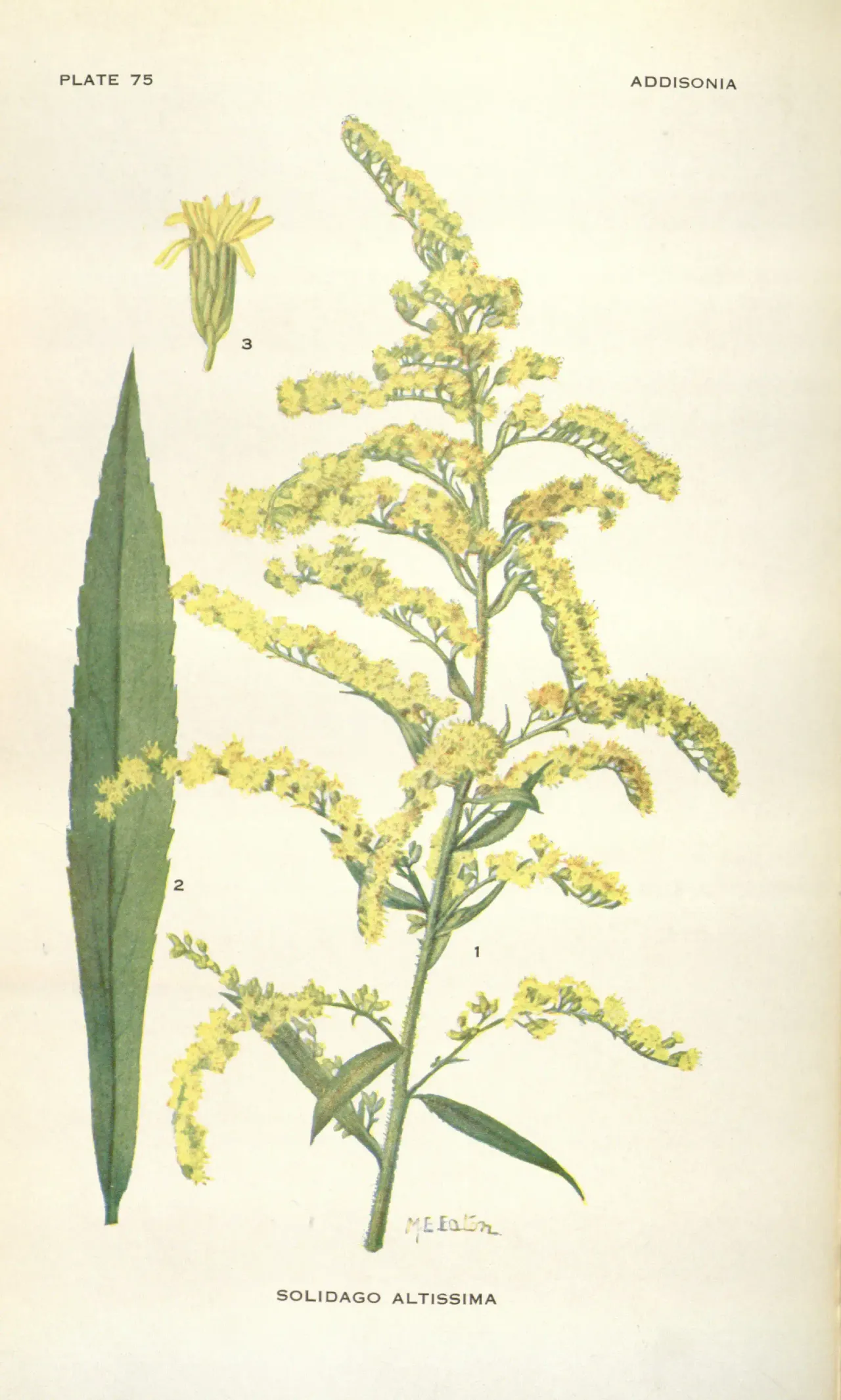 1 of 2
Native to most of the USA and southern Canada
Most of southern Canada and Alaska, south to Virginia, Louisiana and California
- Light Full sun to part shade Sun tolerance
- Moisture Moist Moisture preference
- Zones 3–10 Cold to heat range
- Bloom Aug–Nov Flowering time
- Height up to 6 ft to 1.8 m
- Life cycle Perennial Annual to perennial
In the garden
A woodland wildflower for full sun to part shade and evenly moist soil. Its yellow flowers peak in September. At up to 6 ft, it needs room in shade gardens and woodland edges. Hardy in USDA zones 3–10.
Growing conditions
Light
Full sun Partial shade Full shade
Moisture
Dry Moist Wet
Hardiness zones
Find your zone:
When it blooms
The Tall goldenrod's yellow flowers bloom August to November, peaking in September. This early-fall display draws butterflies and bees.
Tall goldenrod blooms yellowFoliage
Pollinators & wildlife
- Butterflies Monarch
also Gulf Fritillary, Red Admiral, Black Swallowtail +51 more
Pearl Crescent, Gray Hairstreak, Orange Sulphur, Eastern Tailed-Blue, Variegated Fritillary, Hackberry Emperor, Clouded Sulphur, Cloudless Sulphur, Common Wood-Nymph, Dun Skipper, Red-banded Hairstreak, Woodland Skipper, Pale Swallowtail, American Copper, Green Comma, Banded Hairstreak, Great Purple Hairstreak, Weidemeyer's Admiral, Gorgone Checkerspot, Behr's Hairstreak, California Hairstreak, Tailed Copper, Zephyr Comma, Arogos Skipper, Afranius Duskywing, Pale Crescent, Swamp Metalmark, Hops Azure, Common Branded Skipper, Speyeria atlantis hesperis, Epidemia dorcas florus, Russet Skipperling, Siva Juniper Hairstreak, Green Skipper, Cercyonis oetus, Harkenclenus titus, Ottoe Skipper, Polites origenes, Lycaena heteronea, Speyeria callippe, Lycaena xanthoides, Polites sabuleti, Epidemia helloides, Strymon saepium, Speyeria coronis, Speyeria mormonia, Cynthia cardui, Speyeria aphrodite, Argynnis hyperbius hyperbius, Common Mapwing, Limenitis astyanax - Bees Common Eastern Bumble Bee
also Western Honey Bee, Eastern Carpenter Bee, Brown-belted Bumble Bee +24 more
Ligated Furrow Bee, Tricolored Bumble Bee, Pure Green Sweat bee, Red-belted Bumble Bee, Perplexing Bumble Bee, Half-black Bumble Bee, Lemon Cuckoo Bumble Bee, Yellow-banded Bumble Bee, Rusty-patched Bumble Bee, Spurred Ceratina, Southern Plains Bumble Bee, Dark-winged Sweat Bee, Hairy-banded Mining Bee, Cloudy-winged Mining Bee, Sanderson's Bumble Bee, Colletes simulans, Goldenrod Longhorn-Cuckoo Bee, Lasioglossum cinctipes, Friendless Sweat Bee, Xylocopa virginica virginica, Halictidae sp., Florida Masked Bee, Xylocopa appendiculata circumvolans, Drury's Long-horned Bee - Wasps Bald-faced Hornet
also Eastern Yellowjacket, Metric Paper Wasp, European Hornet +24 more
Fraternal Potter Wasp, Four-toothed Mason Wasp, Southern Yellowjacket, Common Aerial Yellowjacket, Euodynerus foraminatus, Bramble Mason Wasp, Red-marked Pachodynerus Wasp, Southern Paper Wasp, Ancistrocerus capra, Perennial Mason Wasp, Euodynerus megaera, Parasitic Aerial Yellowjacket, Euodynerus hidalgo boreoorientalis, Canadian potter wasp, Euodynerus crypticus, Polistes daminula, Fine-backed Red Paper Wasp, Apache Paper Wasp, Ancistrocerus campestris, Zethus spinipes, Vespula vidua, German Yellowjacket, Leptochilus republicanus, Zethus spinipes variegatus - Also visited by
- Flower flies:
Margined Calligrapher, Eastern Calligrapher +10 more
Common Drone Fly, Transverse-banded Flower Fly, Long-tailed Aphideater, Thick-legged Hover Fly, Eurasian Drone Fly, Black-shouldered Drone Fly, Northern Plushback, Bald-faced Hornet Fly, Black-horned Smoothtail, Phytomia zonata - Moths:
Fall Webworm Moth, Yellow-collared Scape Moth +11 more
Black-letter Darts, Dingy Cutworm Moth, Black-and-yellow Lichen Moth, Swordsman Dart, Lycaena hyllus, Bethune's Pinion, Norman’s Dart, Scarlet-bodied Wasp Moth, Diathrausta reconditalis, Agriphila ruricolella, Cucullia convexipennis - Beetles:
Asian Lady Beetle, Seven-spotted Lady Beetle +7 more
Spotted Cucumber Beetle, Goldenrod Soldier Beetle, Spotted Pink Lady Beetle, Locust Borer, Variegated Lady Beetle, Goldenrod Leaf Beetle, Goldenrod Leafminer
- Flower flies:
Butterflies that use this plant
Documented host and nectar records. Each links to a planting guide for that butterfly.
- American coppernectar
- Aphrodite fritillarynectar
- Banded hairstreaknectar
- Black swallowtailnectar
- Clouded sulphurnectar
- Cloudless sulphurnectar
- Common wood-nymphnectar
- Coral hairstreaknectar
- Eastern tailed-bluenectar
- Gorgone checkerspotnectar
- Gray hairstreaknectar
- Gulf fritillarynectar
- Hedgerow hairstreaknectar
- Juniper hairstreaknectar
- Monarch butterflynectar
- Orange sulphurnectar
- Pale swallowtailnectar
- Pearl crescentnectar
- Red admiralnectar
- Red-banded hairstreaknectar
- Variegated fritillarynectar
Full plant details
Where it grows
- Habitat
- WoodlandThe wild plant community it grows in.
- Native range
- Most of the USA and southern CanadaUnited States (43): AL, AR, AZ, CA, CO, CT, DC, DE, FL, GA, IA, IL, IN, KS, KY, LA, MA, MD, ME, MI, MN, MO, MS, MT, NC, ND, NE, NH, NJ, NM, NY, OH, OK, PA, RI, SC, SD, TN, TX, VA, VT, WI, WV. Canada (6): NB, NS, ON, PE, QC, SK. Where it grows wild on its own, by state and province.
- Native distribution
- Most of southern Canada and Alaska, south to Virginia, Louisiana and CaliforniaThe same native range, usually more exact than the state list, and often noting where it has spread beyond it.
Growing conditions
- Light
- Full sun to part shadeHow much sun it takes, from full sun to full shade.
- Moisture
- MoistThe soil dampness it prefers, from dry to wet.
- Hardiness zones
- USDA 3–10 · Canadian 3–7The cold-to-heat climate range it survives.
- Soil
- Moist to dry soils. Clay, Clay Loam, Medium Loam, Sandy Loam, Sandy, Caliche typeThe soils it grows in naturally.
- Soil pH
- 5.2–7.3The acidity to alkalinity it tolerates (7 is neutral).
- Soil quality
- LowHow rich a soil it needs. Many natives prefer lean soil and flop in rich beds.
- Water use
- MediumHow thirsty it is, a rough guide to how often to water.
- Salinity tolerance
- NoneHow well it copes with salty soil, near roads or the coast.
- Lime (CaCO₃) tolerance
- MediumHow well it copes with chalky, lime-rich soil.
Growth & form
- Height
- up to 6 ft (to 1.8 m)Typical mature height.
- Life cycle
- PerennialWhether it lives a single season (annual), two (biennial), or returns for years (perennial).
- Growth rate
- RapidA relative ranking versus other plants of the same type (USDA), not an absolute rate.
- Shape
- ErectIts overall silhouette.
- Root depth
- 8+ in (20+ cm)How far the roots reach, a guide to drought resilience and transplanting.
Flowers, foliage & fruit
- Type
- WildflowerWhat kind of plant it is.
- Bloom
- Aug–NovWhen it flowers.
- Flower color
- YellowThe bloom color, or colors.
- Fruit/Seeds
- Achene; ripens Jan–DecThe seed or fruit it sets after flowering.
- Toxicity
- None knownWhether any part is poisonous to people or pets.
Propagation & seed
- Cold stratification
- Not requiredWhether seed needs a cold, moist spell before it will germinate.
- Propagation
- Bare root, seed, sprigsHow to start new plants.
- Seed
- ~0.7 million seeds per poundNotes on the seed and how to sow it.
- Seed spread rate
- SlowHow readily it self-sows. Slow or none means well-behaved, not a spreader.
- Seedling vigor
- MediumHow strongly young seedlings establish.
- Vegetative spread
- ModerateWhether it creeps outward or stays put in a clump.