woodland wildflower
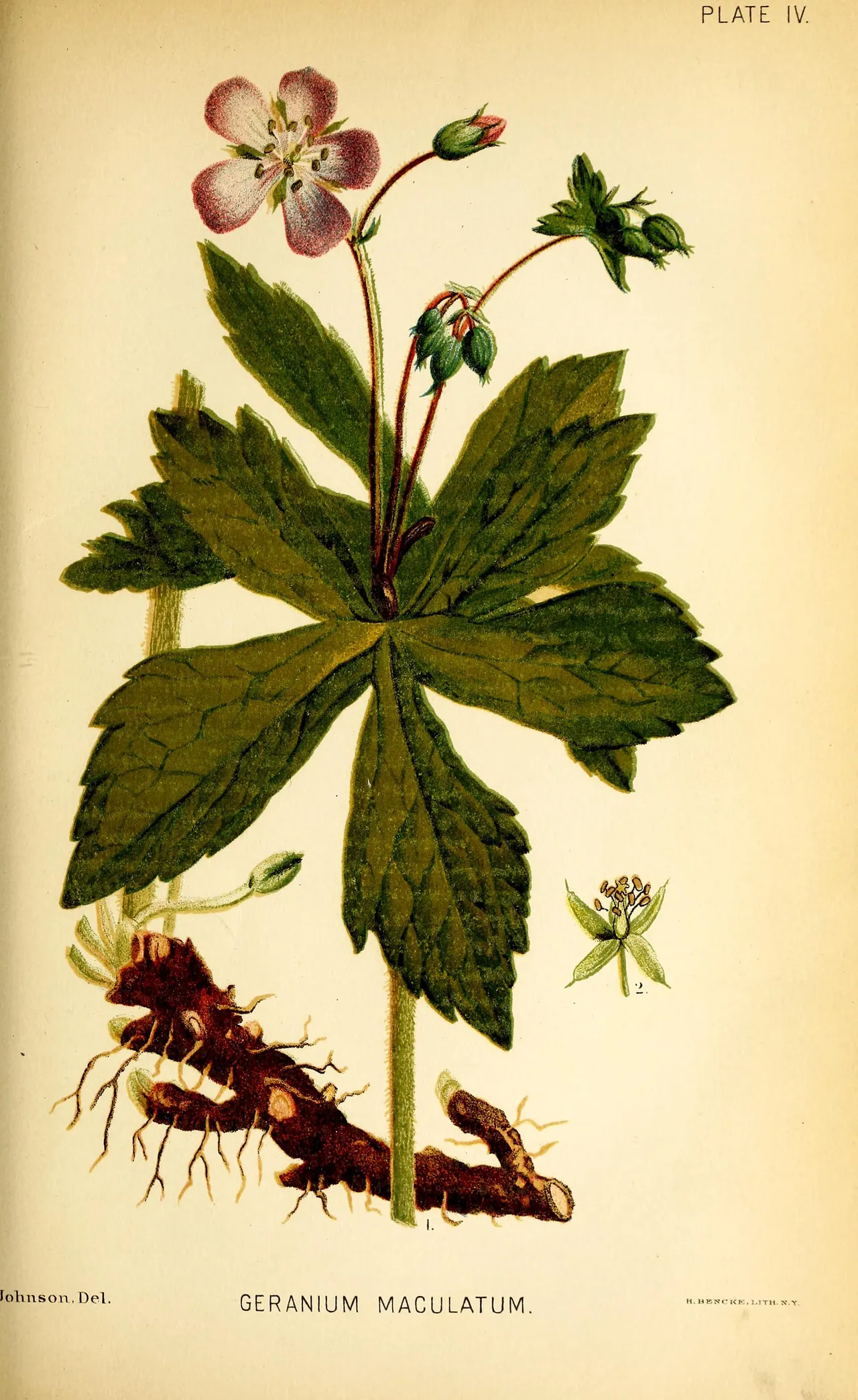
Wild geranium
Geranium maculatum
Also known as Spotted Geranium, Cranesbill
 1 of 3
Native to much of the USA and southern Canada
Newfoundland, Quebec, Nova Scotia, and Ontario, Maine to Georgia, west to Manitoba, southeastern South Dakota, eastern Kansas and Arkansas
- Light Part shade to shade Sun tolerance
- Moisture Moist Moisture preference
- Zones 3–8 Cold to heat range
- Bloom Apr–Jun Flowering time
- Height up to 3 ft to 0.9 m
- Life cycle Perennial Annual to perennial
In the garden
A woodland wildflower for part to full shade and evenly moist soil. Its white flowers peak in May. At up to 3 ft, it suits shade gardens and woodland edges. Hardy in USDA zones 3–8.
Growing conditions
Light
Full sun Partial shade Full shade
Moisture
Dry Moist Wet
Hardiness zones
Find your zone:
When it blooms
The Wild geranium's white flowers bloom April to June, peaking in May. This late-spring display draws bees and butterflies.
Wild geranium blooms white, pink & purpleFoliage
Pollinators & wildlife
- Bees Common Eastern Bumble Bee
also Western Honey Bee, Eastern Carpenter Bee, Brown-belted Bumble Bee +69 more
Two-spotted Bumble Bee, American Bumble Bee, Ligated Furrow Bee, Tricolored Bumble Bee, Bicolored Striped Sweat Bee, Pure Green Sweat bee, Bombus fervidus, Red-belted Bumble Bee, Perplexing Bumble Bee, Fuzzy-Horned Bumble Bee, Half-black Bumble Bee, Colletes inaequalis, Orange-legged Furrow Bee, Yellow-fronted Bumble Bee, Lemon Cuckoo Bumble Bee, Brown-winged Striped Sweat Bee, Flat-tailed Leafcutter Bee, Golden Sweat Bee, Spurred Ceratina, Blue Orchard Bee, Horn-faced Mason Bee, Orange-tipped Wood-digger, Eastern Thistle Longhorn Bee, Dark-winged Sweat Bee, Black-and-yellow Nomad Bee, Bufflehead Mason Bee, Sanderson's Bumble Bee, Rugose-chested Sweat Bee, Say's Cuckoo Leafcutter Bee, Deep-blue Sweat Bee, Cranesbill Miner, Black-and-green Metallic-Sweat bee, Ceratina dupla, Anthophora ursina, Experienced Sweat Bee, Osmia pumila, Spot-sided Dark Bee, Maine Blueberry Bee, Beardtongue scraper bee, False Sunflower Cuckoo Nomad Bee, Cresson's Nomad Bee, Eucera rosae, Osmia collinsiae, Variable Cuckoo Bumble Bee, Goatsbeard Miner Bee, Andrena personata, Osmia simillima, Nomada sulphurata, minor cuckoo sweat bee, Colletes productus, Colourful Willow Miner Bee, Forbes's Sweat Bee, Cuneate Nomad Bee, Mock-orange Scissor Bee, Nimble Ceratina, Xylocopa virginica virginica, Dunning's Miner, Waterleaf Mining Bee, Lasioglossum coriaceum, Nason's Mining Bee, Spring Beauty Miner, Andrena polemonii, Agapostemon viridulus, Hoplitis pilosifrons, Eucera belfragei, Denticulate Nomad, Augochlora nominata, Augochlorella persimilis, Tetragona dissecta - Butterflies Eastern Tiger Swallowtail
also Pearl Crescent, Silver-spotted Skipper, Pipevine Swallowtail +14 more
Spicebush Swallowtail, Zabulon Skipper, Peck's Skipper, Canadian Tiger Swallowtail, Silvery Blue, Hobomok Skipper, Long Dash, Dreamy Duskywing, Amblyscirtes hegon, Thecla edwardsi, Papilio cresphontes, Juvenal's Duskywing, West Virginia White, Elkalyce comyntas - Beetles Asian Lady Beetle
also Spotted Pink Lady Beetle, Fourteen-spotted Lady Beetle, Polished Lady Beetle +11 more
Two-lined Leatherwing, Acmaeodera tubulus, Lined Longhorn Beetle, Trachysida mutabilis, Stripe-legged Long-horned Beetle, Pachyschelus purpureus, Downy Long-horned Beetle, Greenish Flower Chafer, Double-lined Longhorn Beetle, Evodinus monticola, Chlorophorus glaucus - Also visited by
- Flower flies:
Margined Calligrapher, Eastern Calligrapher +10 more
Long-tailed Aphideater, Thick-legged Hover Fly, Black-shouldered Drone Fly, The Merodon equestris Group, Yellow-shouldered Drone Fly, Variable Duskyface Fly, American Snout Fly, Broad-headed Marsh Fly, Bombylius coquilletti, Bombylius pulchellus - Moths:
Snowberry Clearwing, Hummingbird Clearwing +4 more
Horned Spanworm Moth, Morbid Owlet, White Slant-line, White-spotted Sable - Wasps: Bramble Mason Wasp, Parancistrocerus leionotus
- Flower flies:
Butterflies that use this plant
Documented host and nectar records. Each links to a planting guide for that butterfly.
- American snoutnectar
- Canadian tiger swallowtailnectar
- Eastern tiger swallowtailnectar
- Edwards' hairstreaknectar
- Giant swallowtailnectar
- Pearl crescentnectar
- Pipevine swallowtailnectar
- Silver-spotted skippernectar
- Silvery bluenectar
- Spicebush swallowtailnectar
Full plant details
Where it grows
- Habitat
- WoodlandThe wild plant community it grows in.
- Native range
- Much of the USA and southern CanadaUnited States (33): AL, AR, CT, DC, DE, GA, IA, IL, IN, KS, KY, MA, MD, ME, MI, MN, MO, MS, NC, ND, NH, NJ, NY, OH, PA, RI, SC, SD, TN, VA, VT, WI, WV. Canada (5): MB, NL, NS, ON, QC. Where it grows wild on its own, by state and province.
- Native distribution
- Newfoundland, Quebec, Nova Scotia, and Ontario, Maine to Georgia, west to Manitoba, southeastern South Dakota, eastern Kansas and ArkansasThe same native range, usually more exact than the state list, and often noting where it has spread beyond it.
Growing conditions
- Light
- Part shade to shadeHow much sun it takes, from full sun to full shade.
- Moisture
- MoistThe soil dampness it prefers, from dry to wet.
- Hardiness zones
- USDA 3–8 · Canadian 4–7The cold-to-heat climate range it survives.
- Soil
- Rich, acidThe soils it grows in naturally.
- Soil texture
- Light to heavy (sandy to clay)The soil grade it prefers, from sand to clay.
- Soil pH
- Mildly acid to mildly alkalineThe acidity to alkalinity it tolerates (7 is neutral).
- Water use
- MediumHow thirsty it is, a rough guide to how often to water.
Growth & form
- Height
- up to 3 ft (to 0.9 m)Typical mature height.
- Spread
- ~2 ft (0.5 m)How wide one plant gets, a guide to spacing.
- Life cycle
- PerennialWhether it lives a single season (annual), two (biennial), or returns for years (perennial).
- Growth rate
- ModerateA relative ranking versus other plants of the same type (USDA), not an absolute rate.
Flowers, foliage & fruit
- Type
- WildflowerWhat kind of plant it is.
- Bloom
- Apr–JunWhen it flowers.
- Flower color
- White, Pink, PurpleThe bloom color, or colors.
- Fruit/Seeds
- Schizocarp (beaked); ripens May–JunThe seed or fruit it sets after flowering.
- Toxicity
- None knownWhether any part is poisonous to people or pets.