wetland wildflower
Common sneezeweed
Helenium autumnale
Also known as Fall Sneezeweed, Autumn Sneezeweed
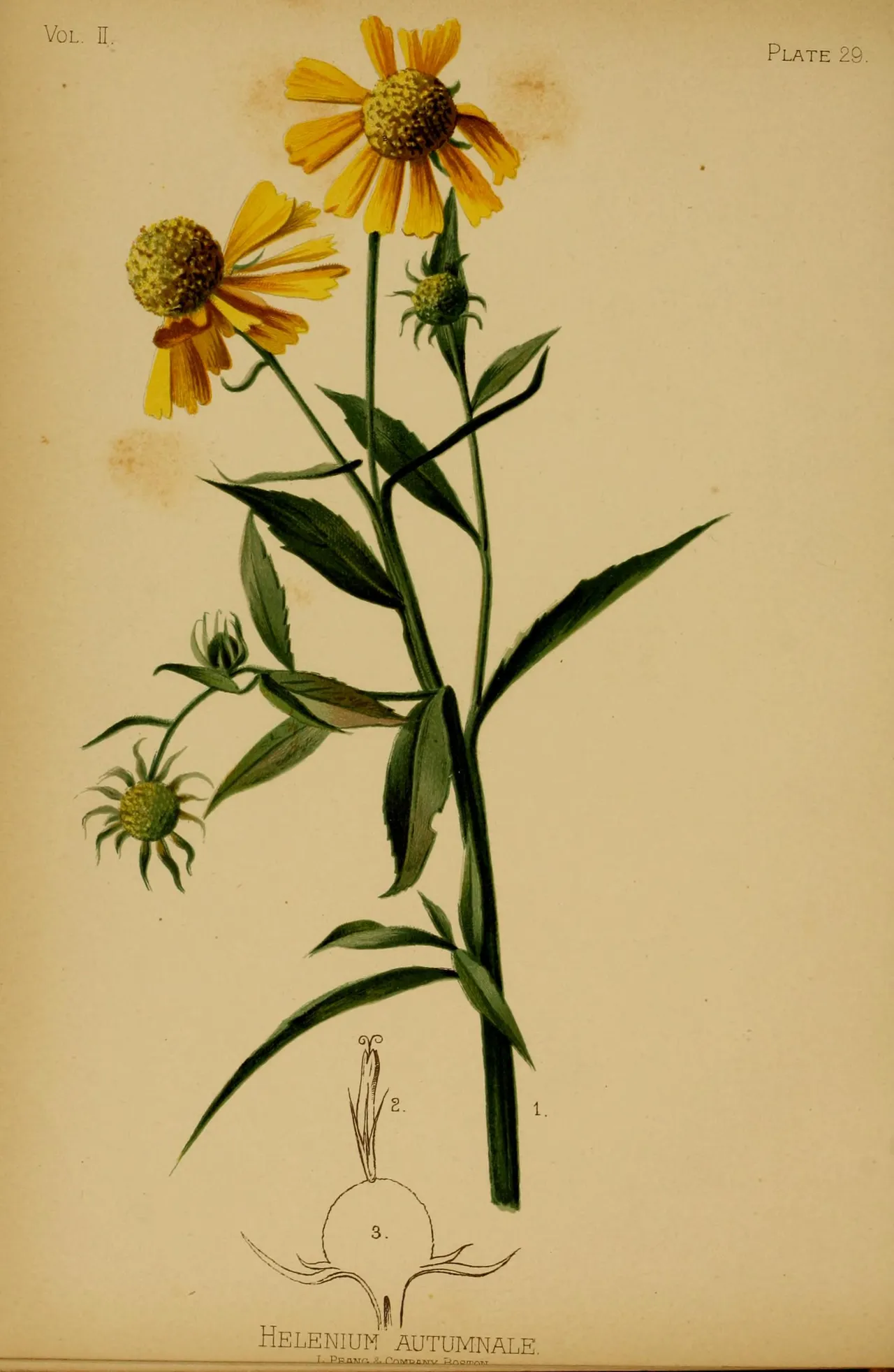 1 of 2
Native to most of the USA and southern Canada
Western Quebec to British Columbia, south to South Carolina, Texas and northern California; naturalized in New England
- Light Full sun Sun tolerance
- Moisture Moist Moisture preference
- Zones 3–9 Cold to heat range
- Bloom Aug–Oct Flowering time
- Height up to 5 ft to 1.5 m
- Life cycle Perennial Annual to perennial
In the garden
A wetland wildflower for full sun and evenly moist soil. Its yellow flowers peak in September. At up to 5 ft, it needs room in rain gardens, pond edges, and damp low spots. Hardy in USDA zones 3–9.
Growing conditions
Light
Full sun Partial shade Full shade
Moisture
Dry Moist Wet
Hardiness zones
Find your zone:
When it blooms
The Common sneezeweed's yellow flowers bloom August to October, peaking in September. This early-fall display draws bees and butterflies.
Common sneezeweed blooms yellowFoliage
Pollinators & wildlife
- Bees Common Eastern Bumble Bee
also Western Honey Bee, Eastern Carpenter Bee, Brown-belted Bumble Bee +61 more
American Bumble Bee, Yellow-faced Bumble Bee, Ligated Furrow Bee, Tricolored Bumble Bee, Black-tailed Bumble Bee, Bicolored Striped Sweat Bee, Pure Green Sweat bee, Red-belted Bumble Bee, Two-spotted Longhorn Bee, Half-black Bumble Bee, Lemon Cuckoo Bumble Bee, Carpenter-mimic Leafcutter Bee, Flat-tailed Leafcutter Bee, Sculptured Resin Bee, Poey's Furrow Bee, Rusty-patched Bumble Bee, Confusing Furrow Bee, Spurred Ceratina, Western Leafcutter Bee, Alfalfa Leafcutter Bee, Yellowish Cuckoo Bumble bee, Dark-veined Longhorn Bee, broad-handed leafcutter bee, Southern Plains Bumble Bee, Lucorum-group Bumble Bees, Louisiana Painted-Dark bee, Bristle Sweat Bee, Golden-tailed Leafcutter Bee, Petulant Leafcutter Bee, Worthy Longhorn, Florida Small Carpenter, Agile Longhorn Bee, Megachile brevis, Colletes nudus, Obliterated Nomad, Triepeolus cressonii, Big-cheeked Angled-Mason, Melissodes boltoniae, Melissodes vernoniae, Forbes's Sweat Bee, Colourful Willow Miner Bee, Pseudopanurgus passiflorae, Yellow-spotted Cuckoo Nomad Bee, Andrena miserabilis, Sunflower Burrowing-Resin bee, Valiant Long-horned Bee, Nimble Ceratina, Svastra obliqua, Forest Cuckoo Bumble bee, Bombus sp., Early Bumble Bee, Drury's Long-horned Bee, Agapostemon viridulus, Colletes compactus, Coelioxys brevis, Coelioxys dolichos, Horn-faced Leafcutter Bee, Bombus vancouverensis vancouverensis, Lunate Longhorn-cuckoo Bee, Colletes compactus compactus, Coelioxys modesta - Butterflies Monarch
also Pearl Crescent, Fiery Skipper, Silver-spotted Skipper +17 more
Painted Lady, Gray Hairstreak, American Lady, Orange Sulphur, Eastern Tailed-Blue, Zabulon Skipper, Eastern Black Swallowtail, American Snout, Dainty Sulphur, Woodland Skipper, American Copper, Purplish Copper, Western White, Dorcas Copper, Plains Branded Skipper, Polites sabuleti, Silvery Checkerspot - Flower flies Margined Calligrapher
also Eastern Calligrapher, Transverse-banded Flower Fly, Thick-legged Hover Fly +13 more
Eurasian Drone Fly, Black-shouldered Drone Fly, Forked Globetail, Yellow-legged Flower Fly, Common Loopwing Aphideater, Hunchbacked Bee Fly, Volucella bombylans, Paravilla separata, Bombylius atriceps, Eupeodes nielseni, Yellow-legged Leafwalker, Aster Bee Fly, Poecilanthrax alcyon - Also visited by
- Moths:
Yellow-collared Scape Moth, Wavy-lined and Southern Emeralds +9 more
Arcigera Flower Moth, Inornate Pyrausta Moth, Subgothic and Tricose Darts, Signate Quaker, Nearctic Beet Webworm, Single-dotted Wave, Darker-spotted Straw Moth, Celery Leaftier Moth, Hawaiian Beet Webworm Moth - Beetles:
Goldenrod Soldier Beetle, Goldenrod Leafminer +6 more
Black Diabrotica, Mournful Long-horned Beetle, Onthophagus pennsylvanicus, Downy Long-horned Beetle, Chauliognathus pennsylvanicus, northern corn rootworm - Wasps: Eastern Yellowjacket, German Yellowjacket
- Moths:
Butterflies that use this plant
Documented host and nectar records. Each links to a planting guide for that butterfly.
- Dainty sulphurhost & nectar
- American coppernectar
- American ladynectar
- American snoutnectar
- Black swallowtailnectar
- Eastern tailed-bluenectar
- Fiery skippernectar
- Gray hairstreaknectar
- Monarch butterflynectar
- Orange sulphurnectar
- Painted ladynectar
- Pearl crescentnectar
- Silver-spotted skippernectar
- Silvery checkerspotnectar
Full plant details
Where it grows
- Habitat
- WetlandThe wild plant community it grows in.
- Native range
- Most of the USA and southern CanadaUnited States (43): AL, AR, AZ, CA, CO, DC, DE, FL, GA, IA, ID, IL, IN, KS, KY, LA, MD, MI, MN, MO, MS, MT, NC, ND, NE, NJ, NM, NV, NY, OH, OK, OR, PA, SC, SD, TN, TX, UT, VA, WA, WI, WV, WY. Canada (7): AB, BC, MB, NT, ON, QC, SK. Where it grows wild on its own, by state and province.
- Native distribution
- Western Quebec to British Columbia, south to South Carolina, Texas and northern California; naturalized in New EnglandThe same native range, usually more exact than the state list, and often noting where it has spread beyond it.
Growing conditions
- Light
- Full sunHow much sun it takes, from full sun to full shade.
- Moisture
- MoistThe soil dampness it prefers, from dry to wet.
- Hardiness zones
- USDA 3–9 · Canadian 2–8The cold-to-heat climate range it survives.
- Soil
- Moist clay soilsThe soils it grows in naturally.
- Soil texture
- Light to heavy (sandy to clay)The soil grade it prefers, from sand to clay.
- Soil pH
- 4.0–7.5The acidity to alkalinity it tolerates (7 is neutral).
- Soil quality
- LowHow rich a soil it needs. Many natives prefer lean soil and flop in rich beds.
- Water use
- MediumHow thirsty it is, a rough guide to how often to water.
- Salinity tolerance
- LowHow well it copes with salty soil, near roads or the coast.
- Lime (CaCO₃) tolerance
- HighHow well it copes with chalky, lime-rich soil.
Growth & form
- Height
- up to 5 ft (to 1.5 m)Typical mature height.
- Spread
- ~2 ft (0.5 m)How wide one plant gets, a guide to spacing.
- Life cycle
- PerennialWhether it lives a single season (annual), two (biennial), or returns for years (perennial).
- Growth rate
- RapidA relative ranking versus other plants of the same type (USDA), not an absolute rate.
- Shape
- ErectIts overall silhouette.
- Root depth
- 6+ in (15+ cm)How far the roots reach, a guide to drought resilience and transplanting.
Flowers, foliage & fruit
- Type
- WildflowerWhat kind of plant it is.
- Bloom
- Aug–OctWhen it flowers.
- Flower color
- YellowThe bloom color, or colors.
- Fruit/Seeds
- ripens Aug–OctThe seed or fruit it sets after flowering.
- Toxicity
- Poisonous if eatenWhether any part is poisonous to people or pets.
Propagation & seed
- Cold stratification
- Not requiredWhether seed needs a cold, moist spell before it will germinate.
- Propagation
- Bare root, seedHow to start new plants.
- Seed
- ~1 million seeds per poundNotes on the seed and how to sow it.
- Seed spread rate
- RapidHow readily it self-sows. Slow or none means well-behaved, not a spreader.
- Seedling vigor
- HighHow strongly young seedlings establish.
- Vegetative spread
- NoneWhether it creeps outward or stays put in a clump.