wetland shrub
Northern highbush blueberry
Vaccinium corymbosum
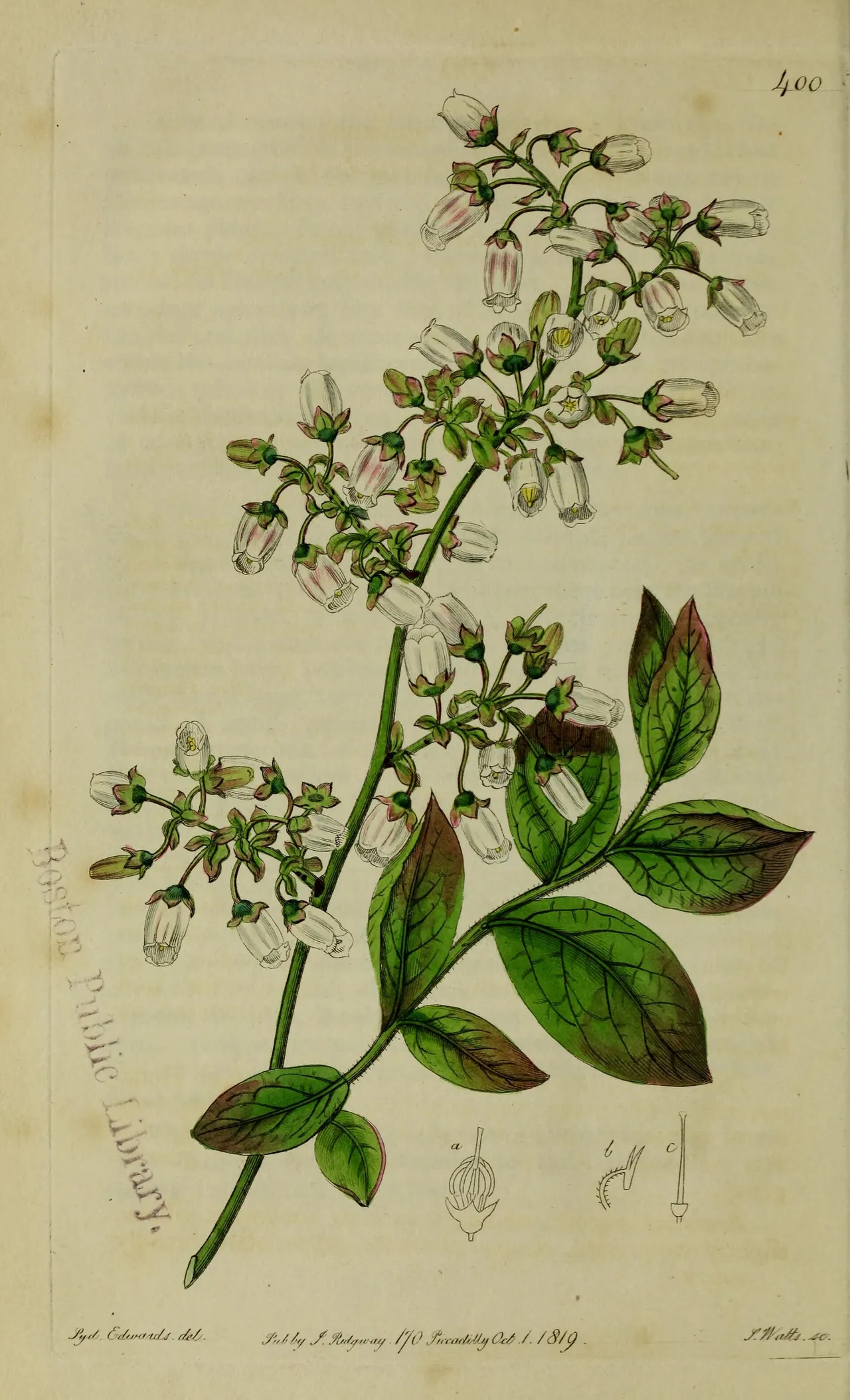 1 of 2
Native to much of the USA and southern Canada
Nova Scotia to southern Wisconsin, south to Georgia and Alabama
- Light Full sun to shade Sun tolerance
- Moisture Dry to wet Moisture preference
- Zones 3–10 Cold to heat range
- Bloom Apr–May Flowering time
- Height up to 15 ft to 4.6 m
- Life cycle Perennial Annual to perennial
In the garden
A wetland shrub for sun through shade and consistently moist to wet soil. Its white and pink flowers peak in May. At up to 15 ft, it needs room in rain gardens, pond edges, and damp low spots. Hardy in USDA zones 3–10.
Growing conditions
Light
Full sun Partial shade Full shade
Moisture
Dry Moist Wet
Hardiness zones
Find your zone:
When it blooms
The Northern highbush blueberry's white and pink flowers bloom April to May, peaking in May. This late-spring display draws bees and flower flies.
Northern highbush blueberry blooms white & pinkFoliage
Pollinators & wildlife
- Bees Common Eastern Bumble Bee
also Western Honey Bee, Eastern Carpenter Bee, Brown-belted Bumble Bee +192 more
Two-spotted Bumble Bee, Yellow-faced Bumble Bee, Ligated Furrow Bee, Tricolored Bumble Bee, Black-tailed Bumble Bee, Bicolored Striped Sweat Bee, Pure Green Sweat bee, Bombus fervidus, Two-spotted Longhorn Bee, Perplexing Bumble Bee, Fuzzy-Horned Bumble Bee, European Woolcarder Bee, Two-form Bumble Bee, Half-black Bumble Bee, Colletes inaequalis, Orange-legged Furrow Bee, Yellow-fronted Bumble Bee, Agapostemon texanus, California Bumble Bee, Northern Amber Bumble Bee, Brown-winged Striped Sweat Bee, Yellow-banded Bumble Bee, Flat-tailed Leafcutter Bee, Golden Sweat Bee, Confusing Furrow Bee, Spurred Ceratina, Blue Orchard Bee, Alfalfa Leafcutter Bee, Wilke's Mining Bee, Yellowish Cuckoo Bumble bee, Sitka Bumble Bee, Augochloropsis metallica, Hawthorn Mining Bee, Horn-faced Mason Bee, Nomada luteola, Carlin's Mining Bee, Prunus Miner Bee, Dark-winged Sweat Bee, Neighborly Mining Bee, Rufous-backed Cellophane Bee, Silky Striped Sweat Bee, Blueberry Mason bee, Lucorum-group Bumble Bees, Bufflehead Mason Bee, Frigid Mining Bee, Sanderson's Bumble Bee, Ceratina acantha, Bristle Sweat Bee, Cresson's Mining Bee, Colletes simulans, Patchwork Leafcutter Bee, Barbara's Mining Bee, Deep-blue Sweat Bee, Sphecodes ranunculi, Bare Dogwood Miner, Bradley's Mining Bee, Blue Mason Bee, Agile Longhorn Bee, Orange-legged Miner Bee, Megachile brevis, Black-and-green Metallic-Sweat bee, Ceratina dupla, Ceratina mikmaqi, Cresson's Sweat Bee, Long-lipped Miner, Produced Small-Mason, Andrena fenningeri, Tridentate Miner, Snowy Mining Bee, Carolina Miner Bee, Red Mason Bee, Imitator Miner Bee, Experienced Sweat Bee, Osmia pumila, Grinnell's Small-Mason, Very Smooth Sweat Bee, Banks' Mining Bee, Commodius Miner Bee, Sphecodes aroniae, Sandhills Cellophane Bee, Pointed Sweat Bee, Perplexed Miner Bee, Lasioglossum subviridatum, hoary sweat bee, Tiny Small carpenter, White-haired Golden Sweat Bee, Friendless Sweat Bee, Black-tipped Miner Bee, Forbes' Mining Bee, Weems's Sweat Bee, Toothed Miner Bee, Caerulean Miner Bee, Fox's Sweat Bee, Hitchens's Sweat Bee, Pygmy Nomad, Osmia proxima, Ashy Mining Bee, Nevada Sweat Bee, Tooth-bellied Mason Bee, Osmia simillima, Goatsbeard Miner Bee, Birkmann's Sweat Bee, W-labrum Miner, Buff-tailed Bumble Bee, Willow Flower Miner Bee, Lasioglossum tarponense, Andrena ilicis, Andrena suavis, Osmia tristella, Red-tailed Bumble Bee, Osmia pusilla, Victoria Miner Bee, Shaggy Furrow Bee, Grey-patched Mining Bee, Osmia albiventris, Morrison's Miner Bee, Paulista Bumble Bee, Osmia hesperos, Long-faced Sweat Bee, Trevor's Miner Bee, Peaceful Sweat Bee, Andrena sp., Shrewd Sweat Bee, Copper-tinted Miner Bee, Blue-and-black Mining Bee, Narrow-legged Miner Bee, Singular Miner Bee, Andrena transnigra, Maria Miner Bee, Andrena miserabilis, Partly-haired Miner Bee, Osmia dolerosa, Lasioglossum zonulum, Brown-bellied Sweat Bee, Lasioglossum coriaceum, Lasioglossum pilosum, cranberry leafcutter bee, Mountain Bumble Bee, Fork-jawed Nomad Bee, Common Carder Bumble Bee, Tree Bumble Bee, Early Bumble Bee, Blueberry Digger Bee, Regular Mining Bee, Lasioglossum leucocomum, Sphecodes stygius, Blueberry Cellophane Bee, Oblong Sweat Bee, Xylocopa ciliata, Xylocopa macrops, Xylocopa splendidula, Lasioglossum zephyrum, Bellicose Bumble Bee, Xylocopa augusti, Tawny Mining Bee, Buffish Mining Bee, Mellow Miner, Broad-margined Mining Bee, Grey-backed Mining Bee, Ashy Furrow Bee, Hairy-footed Flower Bee, Vestal Cuckoo Bumble bee, Andrena carantonica, Depressed Nomad, Mountain Mason Bee, Lasioglossum heterognathum, Composite Cuckoo Nomad Bee, Short-palped Miner, Cresson's Cuckoo Sweat Bee, Flattened Sweat Bee, Lasioglossum lineatulum, Nightmare Sweat Bee, Milwaukee Mining Bee, Rugose Mining Bee, Brown-fovea Miner, Quebec Sweat Bee, Macoupin County sweat bee, Giant Bumble Bee, Bombus ruderatus, Garden Bumble Bee, Cuneate Nomad Bee, Early Mining Bee, Robertson's Miner Bee, Plated Miner Bee, Nason's Mining Bee, Dunning's Miner, Truncate Sweat Bee, Xylocopa virginica virginica, Andrena hilaris, Osmia sandhouseae, Bombus sp., Augochloropsis sumptuosa - Flower flies Common Drone Fly
also Eurasian Drone Fly, Black-shouldered Drone Fly, The Merodon equestris Group +27 more
Western Aphideater, Black-margined Flower Fly, Variable Duskyface Fly, Western Calligrapher, Yellow-haired Sun Fly, Broad-headed Marsh Fly, Volucella bombylans, Common Flower Fly, Hairy-eyed Flower Fly, Black-footed Globetail, Broad-banded Aphideater, Woolly-tailed Marsh Fly, Platycheirus peltatus Group, Migrant Hover Fly, Eurasian Smoothwing, Trivittate Marsh Fly, Imatisma posticata, Orange-spotted Drone Fly, Temnostoma vespiforme, Yellow-spotted Pond Fly, Yellow-bowed Smoothwing, Chrysotoxum cautum, Tapered Drone Fly, Heineken Fly, Spring Epistrophe, Black-thighed Flower Fly, Sun Fly - Butterflies Monarch
also Eastern Tiger Swallowtail, Red Admiral, Gray Hairstreak +12 more
American Lady, Zabulon Skipper, Eastern Black Swallowtail, Subtropical Lady, Brazilian Lady, Tailed Sulphur, Typhedanus undulatus, Callophrys lanoraieensis, Frosted Elfin, Henry's Elfin, Incisalia niphon, Mitoura hesseli - Also visited by
- Wasps:
Bald-faced Hornet, Eastern Yellowjacket +3 more
Common Aerial Yellowjacket, Euodynerus bidens, American Yellowjacket - Moths:
White-marked Tussock Moth, Hummingbird Clearwing +3 more
Eight-spotted Forester Moth, Bedstraw Hawkmoth, White-spotted Sable - Beetles: Two-spotted Lady Beetle, Evodinus monticola
- Hummingbirds: Ruby-throated Hummingbird
- Wasps:
Butterflies that use this plant
Documented host and nectar records. Each links to a planting guide for that butterfly.
- American ladynectar
- Black swallowtailnectar
- Eastern pine elfinnectar
- Eastern tiger swallowtailnectar
- Gray hairstreaknectar
- Monarch butterflynectar
- Red admiralnectar
Full plant details
Where it grows
- Habitat
- WetlandThe wild plant community it grows in.
- Native range
- Much of the USA and southern CanadaUnited States (25): AL, CT, DC, DE, GA, IL, IN, KY, MA, MD, ME, MI, NC, NH, NJ, NY, OH, PA, RI, SC, TN, VA, VT, WI, WV. Canada (4): NB, NS, ON, QC. Where it grows wild on its own, by state and province.
- Native distribution
- Nova Scotia to southern Wisconsin, south to Georgia and AlabamaThe same native range, usually more exact than the state list, and often noting where it has spread beyond it.
Growing conditions
- Light
- Full sun to shadeHow much sun it takes, from full sun to full shade.
- Moisture
- Dry to wetThe soil dampness it prefers, from dry to wet.
- Hardiness zones
- USDA 3–10 · Canadian 3–8The cold-to-heat climate range it survives.
- Soil
- Wet to dry, acid, rocky soils to organic peatsThe soils it grows in naturally.
- Soil texture
- Light to medium (sandy to loamy)The soil grade it prefers, from sand to clay.
- Soil pH
- 4.7–7.5The acidity to alkalinity it tolerates (7 is neutral).
- Soil quality
- MediumHow rich a soil it needs. Many natives prefer lean soil and flop in rich beds.
- Water use
- MediumHow thirsty it is, a rough guide to how often to water.
- Salinity tolerance
- HighHow well it copes with salty soil, near roads or the coast.
- Lime (CaCO₃) tolerance
- LowHow well it copes with chalky, lime-rich soil.
Growth & form
- Height
- up to 15 ft (to 4.6 m)Typical mature height.
- Spread
- ~7 ft (2 m)How wide one plant gets, a guide to spacing.
- Life cycle
- PerennialWhether it lives a single season (annual), two (biennial), or returns for years (perennial).
- Growth rate
- ModerateA relative ranking versus other plants of the same type (USDA), not an absolute rate.
- Shape
- ErectIts overall silhouette.
- Root depth
- 16+ in (41+ cm)How far the roots reach, a guide to drought resilience and transplanting.
Flowers, foliage & fruit
- Type
- ShrubWhat kind of plant it is.
- Bloom
- Apr–MayWhen it flowers.
- Flower color
- White, PinkThe bloom color, or colors.
- Fruit/Seeds
- ripens May–AugThe seed or fruit it sets after flowering.
- Toxicity
- None knownWhether any part is poisonous to people or pets.
Propagation & seed
- Cold stratification
- Not requiredWhether seed needs a cold, moist spell before it will germinate.
- Propagation
- Bare root, container, cuttings, seedHow to start new plants.
- Seed
- ~1.0 million seeds per poundNotes on the seed and how to sow it.
- Seed spread rate
- SlowHow readily it self-sows. Slow or none means well-behaved, not a spreader.
- Seedling vigor
- LowHow strongly young seedlings establish.
- Vegetative spread
- NoneWhether it creeps outward or stays put in a clump.