woodland wildflower
Pearly everlasting
Anaphalis margaritacea
Also known as Western Pearly Everlasting, Pearly-everlasting
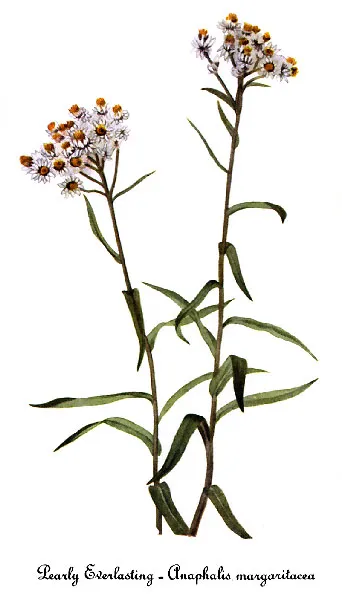 1 of 3
Native to much of the USA and Canada
Newfoundland to Alaska, south to Virginia, Iowa, the Black Hills, New Mexico and California, to Baja California, Sonora, and Chihuahua in northwestern Mexico.
- Light Full sun to part shade Sun tolerance
- Moisture Dry Moisture preference
- Zones 2–9 Cold to heat range
- Bloom Jul–Oct Flowering time
- Height up to 3 ft to 0.9 m
- Life cycle Perennial Annual to perennial
In the garden
A woodland wildflower for full sun to part shade and lean, dry soil. Its white and yellow flowers peak in August. At up to 3 ft, it suits shade gardens and woodland edges. It shrugs off drought once established. Hardy in USDA zones 2–9.
Growing conditions
Hardiness zones
When it blooms
The Pearly everlasting's white and yellow flowers bloom July to October, peaking in August. This late-summer display draws bees and butterflies.
Pearly everlasting blooms white & yellowFoliage
Pollinators & wildlife
- Bees Common Eastern Bumble Bee
also Western Honey Bee, Brown-belted Bumble Bee, Yellow-faced Bumble Bee +170 more
Ligated Furrow Bee, Tricolored Bumble Bee, Black-tailed Bumble Bee, Pure Green Sweat bee, Bombus fervidus, Red-belted Bumble Bee, Two-spotted Longhorn Bee, Fuzzy-Horned Bumble Bee, Two-form Bumble Bee, Half-black Bumble Bee, Orange-legged Furrow Bee, Yellow-fronted Bumble Bee, Vancouver Bumble Bee, Tripartite Sweat Bee, Yellow-banded Bumble Bee, Oblong Woolcarder Bee, Great Basin Bumble Bee, Rusty-patched Bumble Bee, Confusing Furrow Bee, Nearctic Bumble Bee, Western Leafcutter Bee, Yellowish Cuckoo Bumble bee, Sitka Bumble Bee, Indiscriminate Cuckoo Bumble Bee, Prunus Miner Bee, Western Bumble Bee, Forest Bumble Bee, Cloudy-winged Mining Bee, Slender-faced Masked Bee, Eastern Miner Bee, Variable Pebble Bee, Punctate Masked Bee, Least Cellophane-cuckoo Bee, Annulate Masked Bee, Cresson's Masked Bee, Olympia Cellophane-cuckoo Bee, Compact Cellophane-Cuckoo, Hairy masked Bee, Lasioglossum nitidiusculum, Golden-tailed Woodborer, Little Masked Bee, Kincaid's Cellophane Bee, Common Masked Bee, Glittering Cellophane Bee, Large-headed Armoured-Resin bee, Nomada bifasciata, Robust Small-Mason, Marin County Sweat Bee, Black Masked Bee, Distinguished Sweat Bee, Hylaeus wootoni, Large Masked Bee, Spined Mason Bee, Golden Furrow Bee, Linsenmaier's Nomad, Lasioglossum sabulosum, Lasioglossum pleurospeculum, Lasioglossum podolicum, Lasioglossum laevidorsum, Lasioglossum subfulvicorne, Hylaeus glacialis, Hylaeus pfankuchi, Snowy Masked Bee, Lasioglossum problematicum, Lasioglossum tarsatum, Hylaeus moricei, Nomada pleurosticta, Andrena amieti, Lasioglossum euboeense, Lasioglossum lissonotum, Lasioglossum alpigenum, Halictus carinthiacus, Hylaeus pilosulus, Heriades crenulatus, Translucent Miner, Peaceful Sweat Bee, Lasioglossum laeve, Hylaeus bifasciatus, Femoral Nomad, British Columbia Miner Bee, Grey-banded Mining Bee, Buff-tailed Mining Bee, Lasioglossum aeratum, Lasioglossum subfasciatum, Colletes mlokossewiczi, Hylaeus duckei, Hylaeus euryscapus, Small-headed Resin Bee, Hylaeus crassanus, Hylaeus alpinus, Eucera nigrifacies, Megachile genalis, Nomada facilis, Hylaeus gibbus, Osmia labialis, Megachile flabellipes, White-lipped Yellow-face Bee, Panurgus dentipes, Lasioglossum bluethgeni, Hylaeus sinuatus, Small Shiny Furrow Bee, Lasioglossum marginellum, Halictus leucaheneus, Chalk Yellow-face Bee, Lasioglossum majus, Hylaeus tyrolensis, Dotted Masked Bee, Osmia scutellaris, Narrowed Masked Bee, Forest Masked Bee, Shiny Dufourea, Polished Miner, Orange-vented Mason Bee, Broad-banded Nomad Bee, Nomada integra, Osmia mustelina, Brown-bellied Sweat Bee, Hylaeus styriacus, Hairy-saddled Cellophane Bee, Reed Yellow-face Bee, Andrena rhenana, Andrena taraxaci, White-jawed Yellow-face Bee, Andrena livens, Hylaeus difformis, Lasioglossum lucidulum, Lasioglossum marginatum, Ridge-gastered Furrow Bee, Lasioglossum zonulum, Hylaeus taeniolatus, Squat Furrow Bee, Hylaeus imparilis, Onion Yellow-face Bee, Lasioglossum albocinctum, Variegated Masked Bee, Dimple-bellied Sweat Bee, Snowy Mason, Nomada distinguenda, Lasioglossum interruptum, Lasioglossum subhirtum, Hesperian Miner, Megachile melanopyga, Halictus seladonius, Lasioglossum minutulum, Pseudapis diversipes, Gredler's Masked Bee, Small Shaggy Bee, Bare-saddled Cellophane Bee, Hylaeus paulus, Osmia rufohirta, Fringed Furrow Bee, Lasioglossum lineare, Andrena nigroolivacea, Large Shaggy Bee, Lasioglossum discum, Common Pantaloon Bee, Davies' Cellophane Bee, Great Banded Furrow Bee, Lasioglossum nigripes, Horned Masked Bee, Hylaeus kahri, Short-horned Yellow-face Bee, Colletes hyalinus hyalinus, Colletes lutzi lutzi, Cinquefoil Masked Bee, Bombus flavidus flavidus, Bombus vancouverensis vancouverensis, Coelioxys modesta, Crenulate Armoured-Resin bee, Horn-faced Leafcutter Bee - Butterflies Monarch
also Red Admiral, Pearl Crescent, Painted Lady +71 more
Gray Hairstreak, American Lady, Eastern Tailed-Blue, Viceroy, Common Ringlet, Common Wood-Nymph, Gray Buckeye, Woodland Skipper, Northern Azure, American Copper, Boisduval's Blue, Green Comma, Banded Hairstreak, Milbert's Tortoiseshell, Hoary Comma, Purplish Copper, Western White, Melissa Blue, Hydaspe Fritillary, American Branded Skipper, American Silver-bordered Fritillary, Clodius Parnassian, Arctic Fritillary, Coral Hairstreak, Anna's Blue, Pacific Fritillary, Coronis Fritillary, Juba Skipper, Zephyr Comma, Olympia Marble, Nelson's Hairstreak, Inornate Ringlet, Colorado Silverspot, Large White, Common Branded Skipper, Gatekeeper, Ringlet, Holly Blue, Speckled Wood, European Peacock Butterfly, Green-veined White, Small Tortoiseshell, Occidryas anicia capella, Speyeria atlantis hesperis, Epidemia dorcas florus, Cercyonis oetus, Cynthia cardui, Lycaena heteronea, Lycaena xanthoides, Strymon saepium, Plebejus saepiolus, Lycaena nivalis, Aglais milberti furcillata, Hesperia colorado hulbirti, Plebejus glandon, Edith's Copper, Occidryas colon, Mormon Fritillary, Mariposa Copper, Blue Copper, Greenish Blue, Coenonympha california california, Danaus plexippus plexippus, Columbine Duskywing, Strymon sylvinus, Leonard's Skipper, Anicia Checkerspot, Pine White, Eresia aveyrona mylitta, Rice's Blue, Cyaniris neglecta - Flower flies Margined Calligrapher
also Eastern Calligrapher, Common Drone Fly, Transverse-banded Flower Fly +18 more
Eurasian Drone Fly, Black-shouldered Drone Fly, Black-margined Flower Fly, Western Calligrapher, Tufted Globetail, Orange-legged Drone Fly, Yellow-haired Sun Fly, Black-footed Drone Fly, Banded Thintail, Bald-faced Hornet Fly, Hunchbacked Bee Fly, Dimorphic Sickleleg, Dorcadion Bee Fly, Undivided Lucent, Eurasian Smoothwing, Interrupted Hornet Fly, Western Pond Fly, Western Forest Sedgesitter - Also visited by
- Beetles:
Goldenrod Soldier Beetle, Margined Leatherwing Beetle +10 more
Banded Longhorn Beetle, Common Red Soldier Beetle, Yellow Velvet Beetle, Bee-mimic Beetle, Xestoleptura crassipes, Etorofus obliteratus, Judolia instabilis, Typocerus sparsus, Broom Seed Beetle, Three-banded Lady Beetle - Wasps:
Bald-faced Hornet, Eastern Yellowjacket +11 more
Fraternal Potter Wasp, Common Aerial Yellowjacket, Euodynerus foraminatus, Bramble Mason Wasp, Ancistrocerus capra, Cross Potter Wasp, Ancistrocerus antilope, One-banded Mason Wasp, American Yellowjacket, Ancistrocerus campestris, Vespula vidua - Moths:
Fall Webworm Moth, Police Car Moth +7 more
Cinnabar moth, Darker Diacme Moth, Fireweed Clearwing Moth, Strawberry Crown Moth, Lycaena rubidus, Ctenucha rubroscapa, Hawaiian Beet Webworm Moth
- Beetles:
Butterflies that use this plant
Documented host and nectar records. Each links to a planting guide for that butterfly.
- American ladyhost & nectar
- American coppernectar
- Banded hairstreaknectar
- Boisduval's bluenectar
- Common buckeyenectar
- Common ringletnectar
- Common wood-nymphnectar
- Coral hairstreaknectar
- Eastern tailed-bluenectar
- Gray hairstreaknectar
- Hedgerow hairstreaknectar
- Melissa bluenectar
- Milbert's tortoiseshellnectar
- Monarch butterflynectar
- Painted ladynectar
- Pearl crescentnectar
- Red admiralnectar
- Silver-bordered fritillarynectar
- Summer azurenectar
- Viceroynectar
Full plant details
Where it grows
- Habitat
- WoodlandThe wild plant community it grows in.
- Native range
- Much of the USA and CanadaUnited States (39): AK, AZ, CA, CO, CT, DE, IA, ID, IL, IN, KS, KY, MA, MD, ME, MI, MN, MO, MT, NC, NE, NH, NJ, NM, NV, NY, OH, OR, PA, RI, SD, TN, UT, VA, VT, WA, WI, WV, WY. Canada (12): AB, BC, MB, NB, NL, NS, NT, ON, PE, QC, SK, YT. Where it grows wild on its own, by state and province.
- Native distribution
- Newfoundland to Alaska, south to Virginia, Iowa, the Black Hills, New Mexico and California, to Baja California, Sonora, and Chihuahua in northwestern Mexico.The same native range, usually more exact than the state list, and often noting where it has spread beyond it.
Growing conditions
- Light
- Full sun to part shadeHow much sun it takes, from full sun to full shade.
- Moisture
- DryThe soil dampness it prefers, from dry to wet.
- Hardiness zones
- USDA 2–9 · Canadian 0–9The cold-to-heat climate range it survives.
- Soil
- Sandy or gravelly soilsThe soils it grows in naturally.
- Soil texture
- Light to medium (sandy to loamy)The soil grade it prefers, from sand to clay.
- Soil pH
- 6.0–7.5The acidity to alkalinity it tolerates (7 is neutral).
- Soil quality
- MediumHow rich a soil it needs. Many natives prefer lean soil and flop in rich beds.
- Water use
- MediumHow thirsty it is, a rough guide to how often to water.
- Drought tolerance
- HighRelative to plants of the same type and region, inferred from where it grows, not a days-without-water figure.
- Salinity tolerance
- NoneHow well it copes with salty soil, near roads or the coast.
- Lime (CaCO₃) tolerance
- LowHow well it copes with chalky, lime-rich soil.
Growth & form
- Height
- up to 3 ft (to 0.9 m)Typical mature height.
- Spread
- ~3 ft (1 m)How wide one plant gets, a guide to spacing.
- Life cycle
- PerennialWhether it lives a single season (annual), two (biennial), or returns for years (perennial).
- Growth rate
- RapidA relative ranking versus other plants of the same type (USDA), not an absolute rate.
- Shape
- ErectIts overall silhouette.
- Root depth
- 6+ in (15+ cm)How far the roots reach, a guide to drought resilience and transplanting.
Flowers, foliage & fruit
- Type
- WildflowerWhat kind of plant it is.
- Bloom
- Jul–OctWhen it flowers.
- Flower color
- White, YellowThe bloom color, or colors.
- Fruit/Seeds
- ripens Aug–OctThe seed or fruit it sets after flowering.
- Toxicity
- None knownWhether any part is poisonous to people or pets.
Propagation & seed
- Cold stratification
- Required (cold, moist)Whether seed needs a cold, moist spell before it will germinate.
- Propagation
- Container, seedHow to start new plants.
- Seed
- ~8 million seeds per poundNotes on the seed and how to sow it.
- Seed spread rate
- RapidHow readily it self-sows. Slow or none means well-behaved, not a spreader.
- Seedling vigor
- MediumHow strongly young seedlings establish.
- Vegetative spread
- NoneWhether it creeps outward or stays put in a clump.