woodland wildflower
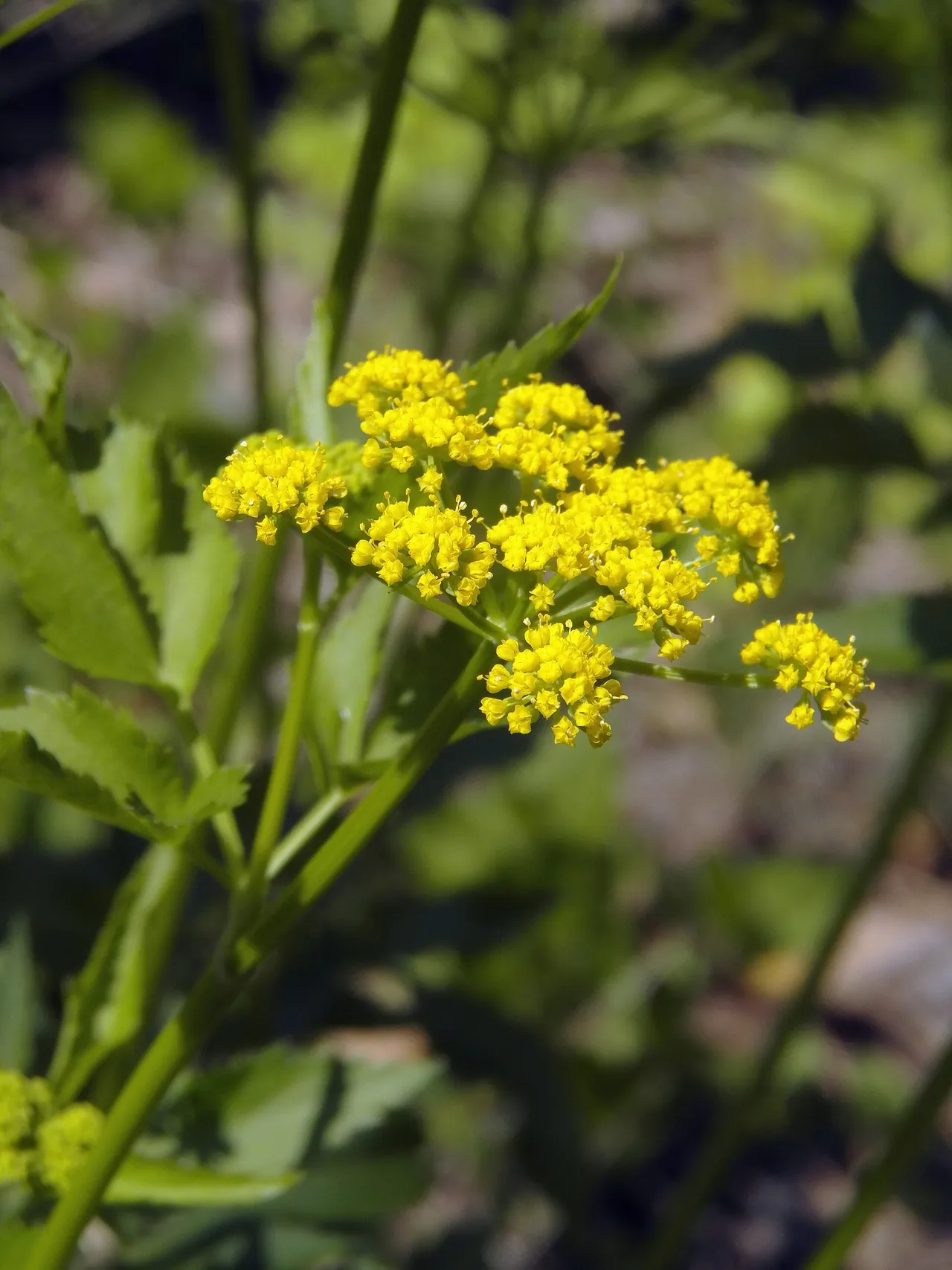
Golden Alexanders
Zizia aurea
Also known as Golden Zizia
 1 of 2
Native to much of the USA and southern Canada
Quebec to Saskatchewan and Flathead county, Montana, south to New England, Florida and Texas
- Light Full sun to part shade Sun tolerance
- Moisture Moist Moisture preference
- Zones 3–9 Cold to heat range
- Bloom Apr–Jun Flowering time
- Height up to 3 ft to 0.9 m
- Life cycle Perennial Annual to perennial
In the garden
A woodland wildflower for full sun to part shade and evenly moist soil. Its yellow flowers peak in May. At up to 3 ft, it suits shade gardens and woodland edges. Hardy in USDA zones 3–9.
Growing conditions
Light
Full sun Partial shade Full shade
Moisture
Dry Moist Wet
Hardiness zones
Find your zone:
When it blooms
The Golden Alexanders's yellow flowers bloom April to June, peaking in May. This late-spring display draws bees and flower flies.
Golden Alexanders blooms yellowFoliage
Pollinators & wildlife
- Bees Common Eastern Bumble Bee
also Western Honey Bee, Eastern Carpenter Bee, Brown-belted Bumble Bee +95 more
American Bumble Bee, Ligated Furrow Bee, Tricolored Bumble Bee, Bicolored Striped Sweat Bee, Pure Green Sweat bee, Red-belted Bumble Bee, Black-and-gold Bumble Bee, Half-black Bumble Bee, Colletes inaequalis, Orange-legged Furrow Bee, Golden Sweat Bee, Modest Masked Bee, Confusing Furrow Bee, Spurred Ceratina, Wilke's Mining Bee, Yellowish Cuckoo Bumble bee, Hawthorn Mining Bee, Carlin's Mining Bee, Neighborly Mining Bee, Rufous-backed Cellophane Bee, Silky Striped Sweat Bee, Northeastern Sweat Bee, Bristle Sweat Bee, Slender-faced Masked Bee, Rugose-chested Sweat Bee, Parallel-striped Sweat Bee, Cresson's Mining Bee, Silver-tailed Petalcutter, Red-footed Cuckoo Leafcutter, Articulated Nomad, Sphecodes ranunculi, Viereck's Sweat Bee, Bare Dogwood Miner, Red-tailed Mining Bee, Allegheny Mining Bee, Orange-legged Miner Bee, Nude Mining Bee, Annulate Masked Bee, Black-and-green Metallic-Sweat bee, Ceratina dupla, Cresson's Masked Bee, Hylaeus affinis, Cresson's Sweat Bee, Golden-Alexanders Mining Bee, Nomada superba, Snowy Mining Bee, Alumroot Cellophane Bee, Imitator Miner Bee, Experienced Sweat Bee, Osmia pumila, Spot-sided Dark Bee, Commodius Miner Bee, Maine Blueberry Bee, Sphecodes aroniae, hoary sweat bee, Forbes' Mining Bee, Fox's Sweat Bee, Nomada affabilis, W-labrum Miner, Lasioglossum platyparius, white-winged sweat bee, Wheeler's Miner Bee, Box-headed Furrow Bee, Andrena ilicis, Milwaukee Mining Bee, Pseudopanurgus passiflorae, Megachile policaris, Vertical Masked Bee, Lasioglossum oceanicum, Xylocopa virginica virginica, Western Red-legged Miner Bee, Rugose Mining Bee, Nason's Mining Bee, Clark's Mining Bee, Mesilla Masked Bee, Anthophora aeneiventris, Lasioglossum simplex, Andrena sayi, Lasioglossum coreopsis, Sphecodes dichrous, Cresson's Cuckoo Sweat Bee, Leioproctus clypeatus, Augochlora feronia, Hoplitis pilosifrons, Denticulate Nomad, Augochlora nominata, Nomada sayi, Forbes's Sweat Bee, Short-horned Yellow-face Bee, Lasioglossum tegulare, Tetragona dissecta, Augochlorella persimilis, Zephyr Sweat Bee, Waterleaf Mining Bee, Singular Miner Bee - Flower flies Margined Calligrapher
also Eastern Calligrapher, Common Drone Fly, Oblique Streaktail +34 more
Long-tailed Aphideater, Narrow-headed Marsh Fly, Thick-legged Hover Fly, Eurasian Drone Fly, Greater Bee Fly, Black-shouldered Drone Fly, The Merodon equestris Group, Yellow-shouldered Drone Fly, Common Grass Skimmer, Tufted Globetail, Common Lagoon Fly, Broad-headed Marsh Fly, Common Flower Fly, Black-footed Globetail, Short-haired Leafwalker, Violet Leafwalker, Northern Wasp Fly, Aldrichia ehrmanii, Large-spotted Halfband, Bombylius coquilletti, Variable Globetail, Anasimyia anausis, Two-lined Swamp Fly, Tropidia quadrata, Sun Fly, Paragus bicolor, Paragus tibialis, Sphaerophoria cylindricus, Pictipennis species group, Black-horned Pufftail, Short-haired Wrinklehead, Mount Hood Blacklet, Shiny Thickleg, Orange-horned Hammertail - Butterflies Monarch
also Red Admiral, Black Swallowtail, Pearl Crescent +22 more
Gray Hairstreak, Eastern Tailed-Blue, Zabulon Skipper, Eastern Black Swallowtail, Checkered White, Common Ringlet, Red-banded Hairstreak, Canadian Tiger Swallowtail, Silvery Blue, Hobomok Skipper, American Copper, Dreamy Duskywing, American Silver-bordered Fritillary, Bronze Copper, Mustard White, Dusted Skipper, Cyaniris neglecta, Mitoura gryneus, Euptychia cymela, Limenitis arthemis arthemis, Elkalyce comyntas, Heodes hypophlaeas - Also visited by
- Wasps:
Bald-faced Hornet, Eastern Yellowjacket +13 more
Fraternal Potter Wasp, Southern Yellowjacket, Euodynerus foraminatus, Bramble Mason Wasp, Ancistrocerus catskill, European tube wasp, Euodynerus hidalgo boreoorientalis, Parancistrocerus pedestris, Parancistrocerus pensylvanicus, One-banded Mason Wasp, Hidalgo Mason Wasp, Ancistrocerus campestris, Zethus spinipes - Beetles:
Asian Lady Beetle, Margined Leatherwing Beetle +12 more
Spotted Pink Lady Beetle, Fourteen-spotted Lady Beetle, Common Red Soldier Beetle, Polished Lady Beetle, Cantharis livida, Onthophagus pennsylvanicus, Notated Lady Beetle, Double-lined Longhorn Beetle, Evodinus monticola, Redbud Seed Weevil, Chlorophorus glaucus, Wrinkled Soldier Beetle - Moths:
Hummingbird Clearwing, Bluegrass Webworm Moth +8 more
Eight-spotted Forester Moth, White-striped Black, White Spring Moth, Nessus Sphinx, Celery Looper Moth, White-spotted Sable, Orange Mint Moth, Common Spring Moth
- Wasps:
Butterflies that use this plant
Documented host and nectar records. Each links to a planting guide for that butterfly.
- Black swallowtailhost & nectar
- American coppernectar
- Banded hairstreaknectar
- Canadian tiger swallowtailnectar
- Checkered whitenectar
- Common ringletnectar
- Dainty sulphurnectar
- Eastern tailed-bluenectar
- Eastern tiger swallowtailnectar
- Gray hairstreaknectar
- Juniper hairstreaknectar
- Monarch butterflynectar
- Pearl crescentnectar
- Red admiralnectar
- Red-banded hairstreaknectar
- Red-spotted purplenectar
- Silver-bordered fritillarynectar
- Silvery bluenectar
- Summer azurenectar
Full plant details
Where it grows
- Habitat
- WoodlandThe wild plant community it grows in.
- Native range
- Much of the USA and southern CanadaUnited States (39): AL, AR, CT, DC, DE, FL, GA, IA, IL, IN, KS, KY, LA, MA, MD, ME, MI, MN, MO, MS, MT, NC, ND, NE, NH, NJ, NY, OH, OK, PA, RI, SC, SD, TN, TX, VA, VT, WI, WV. Canada (6): MB, NB, NS, ON, QC, SK. Where it grows wild on its own, by state and province.
- Native distribution
- Quebec to Saskatchewan and Flathead county, Montana, south to New England, Florida and TexasThe same native range, usually more exact than the state list, and often noting where it has spread beyond it.
Growing conditions
- Light
- Full sun to part shadeHow much sun it takes, from full sun to full shade.
- Moisture
- MoistThe soil dampness it prefers, from dry to wet.
- Hardiness zones
- USDA 3–9 · Canadian 3–7The cold-to-heat climate range it survives.
- Soil
- Moist, sandy or sandy-clay soilsThe soils it grows in naturally.
- Soil texture
- Light to heavy (sandy to clay)The soil grade it prefers, from sand to clay.
- Soil pH
- Mildly acid to mildly alkalineThe acidity to alkalinity it tolerates (7 is neutral).
Growth & form
- Height
- up to 3 ft (to 0.9 m)Typical mature height.
- Life cycle
- PerennialWhether it lives a single season (annual), two (biennial), or returns for years (perennial).
Flowers, foliage & fruit
- Type
- WildflowerWhat kind of plant it is.
- Bloom
- Apr–JunWhen it flowers.
- Flower color
- YellowThe bloom color, or colors.
- Fruit/Seeds
- Schizocarp; ripens May–AugThe seed or fruit it sets after flowering.
- Toxicity
- None knownWhether any part is poisonous to people or pets.