prairie wildflower
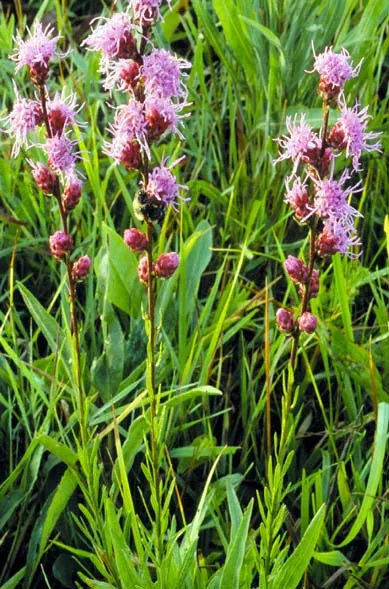
Rough blazing star
Liatris aspera
Also known as Tall Blazing Star, Tall Gayfeather, Tall Liatris, Rough Gayfeather, Rough Liatris, Button Snakeroot
 1 of 3
Native to much of the USA and southern Canada
Southern Ontario to West Virginia and South Carolina, west to North Dakota and eastern Texas
- Light Full sun Sun tolerance
- Moisture Dry Moisture preference
- Zones 3–9 Cold to heat range
- Bloom Jul–Sep Flowering time
- Height up to 6 ft to 1.8 m
- Life cycle Perennial Annual to perennial
In the garden
A prairie wildflower for full sun and lean, dry soil. Its pink and purple flowers peak in August. At up to 6 ft, it needs room in meadows and sunny borders. It shrugs off drought once established. Hardy in USDA zones 3–9.
Growing conditions
Hardiness zones
When it blooms
The Rough blazing star's pink and purple flowers bloom July to September, peaking in August. This late-summer display draws butterflies and bees.
Rough blazing star blooms pink & purpleFoliage
Pollinators & wildlife
- Butterflies Monarch
also Eastern Tiger Swallowtail, Black Swallowtail, Pearl Crescent +15 more
Fiery Skipper, Painted Lady, American Lady, Orange Sulphur, Great Spangled Fritillary, Variegated Fritillary, Zabulon Skipper, Peck's Skipper, Tawny-edged Skipper, Aphrodite Fritillary, Arogos Skipper, Cynthia cardui, Leonard's Skipper, Polites coras, Clossiana toddi ammiralis - Bees Common Eastern Bumble Bee
also Eastern Carpenter Bee, Brown-belted Bumble Bee, American Bumble Bee +10 more
Bombus fervidus, Red-belted Bumble Bee, European Woolcarder Bee, Black-and-gold Bumble Bee, Half-black Bumble Bee, Lemon Cuckoo Bumble Bee, Brown-winged Striped Sweat Bee, Rusty-patched Bumble Bee, broad-handed leafcutter bee, Southern Plains Bumble Bee - Moths Yellow-collared Scape Moth
also Corn Earworm Moth, Dingy Cutworm Moth, Inornate Pyrausta Moth +1 more
Blazing Star Clearwing - Also visited by
- Beetles: Goldenrod Soldier Beetle, northern corn rootworm
- Flower flies: Margined Calligrapher, Thick-legged Hover Fly
- Hummingbirds: Ruby-throated Hummingbird
Butterflies that use this plant
Documented host and nectar records. Each links to a planting guide for that butterfly.
- American ladynectar
- Aphrodite fritillarynectar
- Black swallowtailnectar
- Eastern tiger swallowtailnectar
- Fiery skippernectar
- Great spangled fritillarynectar
- Monarch butterflynectar
- Orange sulphurnectar
- Painted ladynectar
- Pearl crescentnectar
- Silver-bordered fritillarynectar
- Variegated fritillarynectar
Full plant details
Where it grows
- Habitat
- PrairieThe wild plant community it grows in.
- Native range
- Much of the USA and southern CanadaUnited States (27): AL, AR, FL, GA, IA, IL, IN, KS, KY, LA, MI, MN, MO, MS, NC, ND, NE, NY, OH, OK, SC, SD, TN, TX, VA, WI, WV. Canada (2): MB, ON. Where it grows wild on its own, by state and province.
- Native distribution
- Southern Ontario to West Virginia and South Carolina, west to North Dakota and eastern TexasThe same native range, usually more exact than the state list, and often noting where it has spread beyond it.
Growing conditions
- Light
- Full sunHow much sun it takes, from full sun to full shade.
- Moisture
- DryThe soil dampness it prefers, from dry to wet.
- Hardiness zones
- USDA 3–9 · Canadian 4–7The cold-to-heat climate range it survives.
- Soil
- Sandy or rocky soilsThe soils it grows in naturally.
- Drought tolerance
- HighRelative to plants of the same type and region, inferred from where it grows, not a days-without-water figure.
Growth & form
- Height
- up to 6 ft (to 1.8 m)Typical mature height.
- Life cycle
- PerennialWhether it lives a single season (annual), two (biennial), or returns for years (perennial).
Flowers, foliage & fruit
- Type
- WildflowerWhat kind of plant it is.
- Bloom
- Jul–SepWhen it flowers.
- Flower color
- Pink, PurpleThe bloom color, or colors.
- Fruit/Seeds
- Achene; ripens Aug–OctThe seed or fruit it sets after flowering.
- Toxicity
- None knownWhether any part is poisonous to people or pets.