woodland wildflower
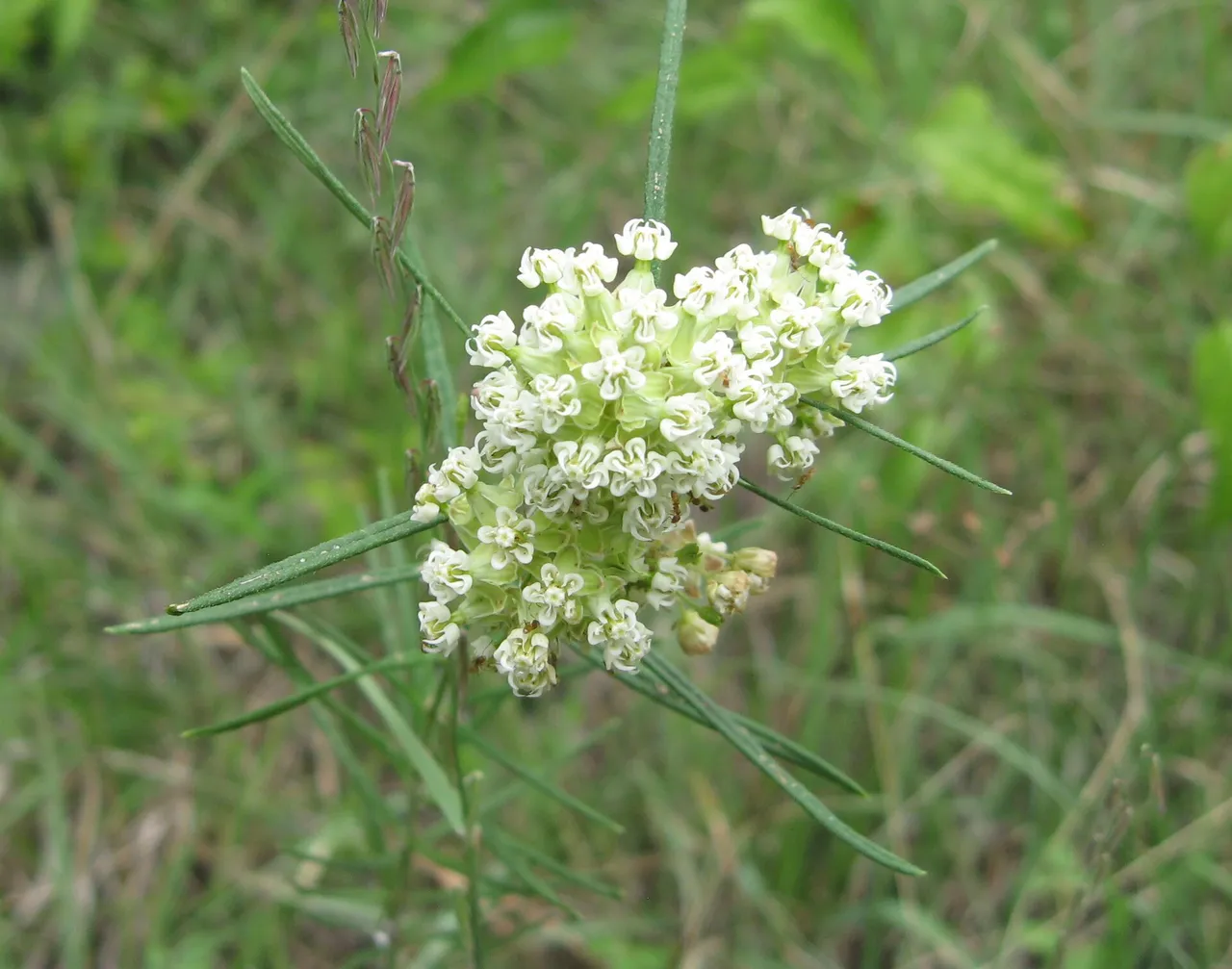
Whorled milkweed
Asclepias verticillata
Also known as Eastern Whorled Milkweed
Native to much of the USA and southern Canada
Massachusetts to Montana, south to Florida and eastern Texas; also southern Canada
- Light Full sun to part shade Sun tolerance
- Moisture Dry Moisture preference
- Zones 3–10 Cold to heat range
- Bloom May–Sep Flowering time
- Height up to 3 ft to 0.9 m
- Life cycle Perennial Annual to perennial
In the garden
A woodland wildflower for full sun to part shade and lean, dry soil. Its white and green flowers peak in July. At up to 3 ft, it suits shade gardens and woodland edges. Hardy in USDA zones 3–10.
Growing conditions
Light
Full sun Partial shade Full shade
Moisture
Dry Moist Wet
Hardiness zones
Find your zone:
When it blooms
The Whorled milkweed's white and green flowers bloom May to September, peaking in July. This midsummer display draws bees and butterflies.
Whorled milkweed blooms white & greenFoliage
Pollinators & wildlife
- Bees Common Eastern Bumble Bee
also Western Honey Bee, Eastern Carpenter Bee, Brown-belted Bumble Bee +47 more
Two-spotted Bumble Bee, American Bumble Bee, Ligated Furrow Bee, Bombus fervidus, Two-spotted Longhorn Bee, Black-and-gold Bumble Bee, Orange-legged Furrow Bee, Agapostemon texanus, Sculptured Resin Bee, Rusty-patched Bumble Bee, Confusing Furrow Bee, broad-handed leafcutter bee, Southern Plains Bumble Bee, Silky Striped Sweat Bee, Bristle Sweat Bee, Slender-faced Masked Bee, Rugose-chested Sweat Bee, Deep-blue Sweat Bee, Viereck's Sweat Bee, Nude Mining Bee, Megachile brevis, Ceratina dupla, Hylaeus affinis, Carinate Armored-Resin bee, Experienced Sweat Bee, Lasioglossum cinctipes, Obliterated Nomad, Illinois Sweat Bee, Big-cheeked Angled-Mason, Broad-faced Masked Bee, white-winged sweat bee, Ceylalictus variegatus, Protandrena cockerelli, Sphecodes heraclei heraclei, Lunate Longhorn-cuckoo Bee, Coelioxys alternata, Colletes compactus, Forbes's Sweat Bee, Sunflower Shortface, Xenoglossa strenua, Augochlora feronia, Coelioxys brevis, Tetragona dissecta, Megachile integra, Sphecodes dichrous, Cresson's Cuckoo Sweat Bee, Norton's Alkali Bee - Butterflies Monarch
also Eastern Tiger Swallowtail, Red Admiral, Pearl Crescent +20 more
Silver-spotted Skipper, Pipevine Swallowtail, Gray Hairstreak, Eastern Tailed-Blue, Variegated Fritillary, Queen, Spicebush Swallowtail, Viceroy, Red-banded Hairstreak, Tawny-edged Skipper, Common Sootywing, Bronze Copper, Striated Queen, Karner Blue, Mastor vialis, Papilio cresphontes, Speyeria cybele, Polites coras, Elkalyce comyntas, Anosia plexippus - Flower flies Margined Calligrapher
also Transverse-banded Flower Fly, Oblique Streaktail, Thick-legged Hover Fly +14 more
Yellow-shouldered Drone Fly, Wavy Mucksucker, Broad-headed Marsh Fly, Exoprosopa fasciata, Common Flower Fly, Yellow-legged Bog Fly, Poecilognathus sulphurea, Two-spotted Leafwalker, Tropidia quadrata, White-haired Pithead, Paragus bicolor, Sphaerophoria cylindricus, grasshopper bee fly, Maize Calligrapher - Also visited by
- Beetles:
Red Milkweed Beetle, Goldenrod Soldier Beetle +7 more
Yellow-horned Flower Longhorn Beetle, Slender Flower Longhorn Beetle, Notch-tipped Flower Longhorn Beetle, Onthophagus pennsylvanicus, Typocerus lunulatus, Chlorophorus glaucus, Chauliognathus pennsylvanicus - Wasps:
Bald-faced Hornet, Eastern Yellowjacket +7 more
Fraternal Potter Wasp, Common Aerial Yellowjacket, Ancistrocerus catskill, European tube wasp, Odynerus arvensis, Odynerus foraminatus, Vespula vidua - Moths:
Green Cloverworm Moth, Yellow-collared Scape Moth +6 more
Ipsilon Dart Moth, Garden Webworm Moth, Celery Looper Moth, Eastern Grass-veneer, Unexpected Cycnia Moth, Common Looper Moth
- Beetles:
Butterflies that use this plant
Documented host and nectar records. Each links to a planting guide for that butterfly.
- Monarch butterflyhost & nectar
- Queenhost & nectar
- Banded hairstreaknectar
- Eastern tailed-bluenectar
- Eastern tiger swallowtailnectar
- Giant swallowtailnectar
- Gray hairstreaknectar
- Great spangled fritillarynectar
- Pearl crescentnectar
- Pipevine swallowtailnectar
- Red admiralnectar
- Red-banded hairstreaknectar
- Silver-spotted skippernectar
- Spicebush swallowtailnectar
- Variegated fritillarynectar
- Viceroynectar
Full plant details
Where it grows
- Habitat
- WoodlandThe wild plant community it grows in.
- Native range
- Much of the USA and southern CanadaUnited States (38): AL, AR, CT, DC, DE, FL, GA, IA, IL, IN, KS, KY, LA, MA, MD, MI, MN, MO, MS, MT, NC, ND, NE, NJ, NY, OH, OK, PA, RI, SC, SD, TN, TX, VA, VT, WI, WV, WY. Canada (3): MB, ON, SK. Where it grows wild on its own, by state and province.
- Native distribution
- Massachusetts to Montana, south to Florida and eastern Texas; also southern CanadaThe same native range, usually more exact than the state list, and often noting where it has spread beyond it.
Growing conditions
- Light
- Full sun to part shadeHow much sun it takes, from full sun to full shade.
- Moisture
- DryThe soil dampness it prefers, from dry to wet.
- Hardiness zones
- USDA 3–10 · Canadian 3–7The cold-to-heat climate range it survives.
- Soil
- Sandy, clayey or rocky soilsThe soils it grows in naturally.
- Water use
- LowHow thirsty it is, a rough guide to how often to water.
Growth & form
- Height
- up to 3 ft (to 0.9 m)Typical mature height.
- Life cycle
- PerennialWhether it lives a single season (annual), two (biennial), or returns for years (perennial).
Flowers, foliage & fruit
- Type
- WildflowerWhat kind of plant it is.
- Bloom
- May–SepWhen it flowers.
- Flower color
- White, GreenThe bloom color, or colors.
- Fruit/Seeds
- Follicle (seed pod); ripens Aug–OctThe seed or fruit it sets after flowering.
- Toxicity
- Poisonous if eatenWhether any part is poisonous to people or pets.