prairie wildflower
Prairie blazing star
Liatris pycnostachya
Also known as Prairie Gayfeather, Prairie Liatris, Kansas Blazing Star, Kansas Gayfeather, Kansas Liatris, Cat-tail Blazing Star, Cat-tail Gayfeather, Cat-tail Liatris, Hairy Button-snakeroot
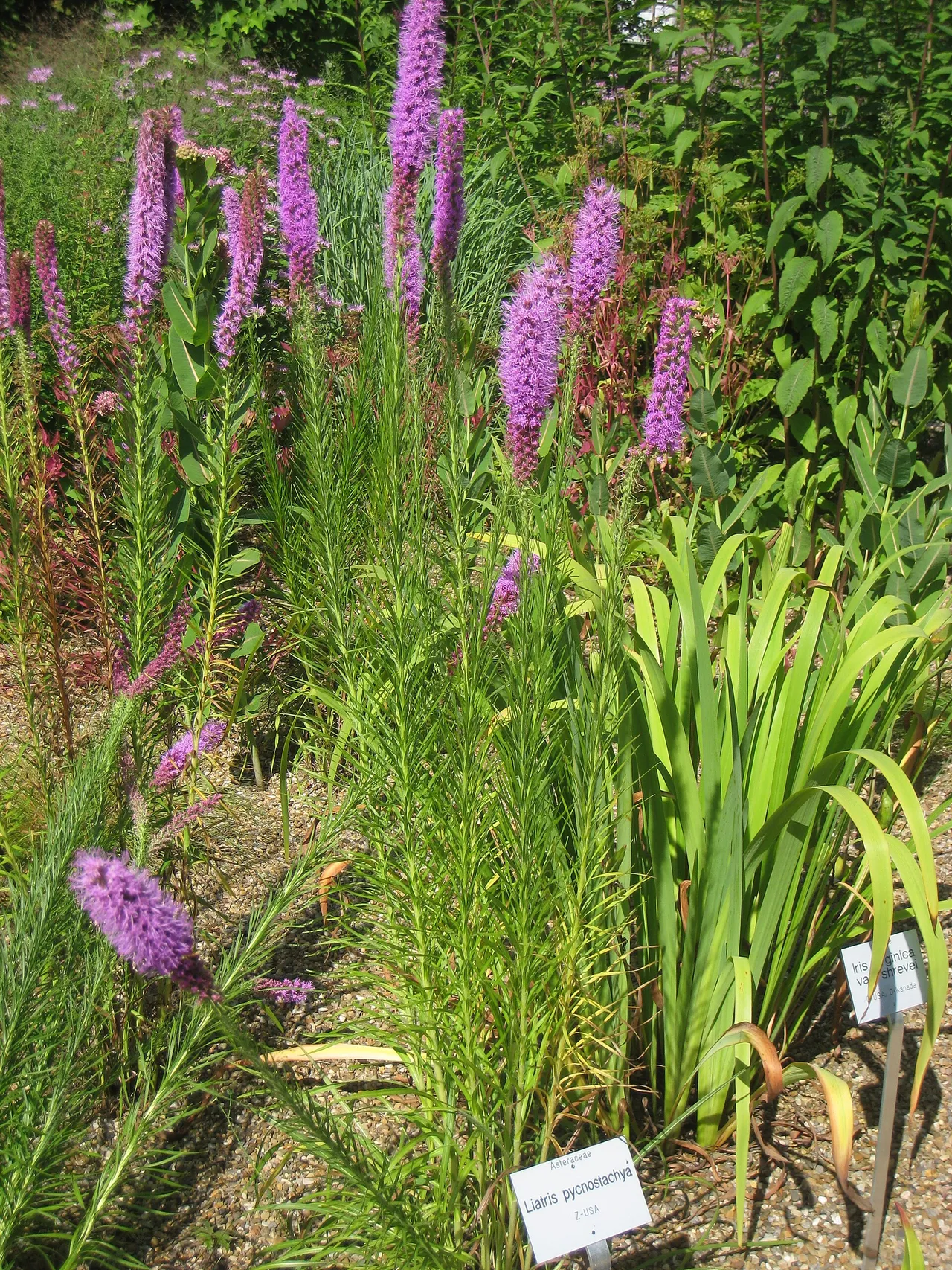 1 of 2
Native to the Great Plains, the Midwest, and the Southeast
Wisconsin to South Dakota, south to Louisiana and eastern Texas
- Light Full sun Sun tolerance
- Moisture Dry to moist Moisture preference
- Zones 3–9 Cold to heat range
- Bloom Jul–Aug Flowering time
- Height up to 6 ft to 1.8 m
- Life cycle Perennial Annual to perennial
In the garden
A prairie wildflower for full sun and dry to moist soil. Its pink and purple flowers peak in July. At up to 6 ft, it needs room in meadows and sunny borders. It shrugs off drought once established. Hardy in USDA zones 3–9.
Growing conditions
Hardiness zones
When it blooms
The Prairie blazing star's pink and purple flowers bloom July to August, peaking in July. This midsummer display draws bees and butterflies.
Prairie blazing star blooms pink & purpleFoliage
Pollinators & wildlife
- Bees Common Eastern Bumble Bee
also Western Honey Bee, Brown-belted Bumble Bee, Two-spotted Bumble Bee +28 more
American Bumble Bee, Ligated Furrow Bee, Tricolored Bumble Bee, Bicolored Striped Sweat Bee, Bombus fervidus, Two-spotted Longhorn Bee, Black-and-gold Bumble Bee, Half-black Bumble Bee, Lemon Cuckoo Bumble Bee, Rusty-patched Bumble Bee, Blue Orchard Bee, broad-handed leafcutter bee, Southern Plains Bumble Bee, Megachile inimica, Squash Longhorn-Cuckoo, Agile Longhorn Bee, Ceratina dupla, Triepeolus simplex, Triepeolus cressonii, Small Willow Miner Bee, Melissodes coloradensis, Eastern Cuckoo Sweat Bee, Field Cuckoo Bumble bee, Bombus sp., Lunate Longhorn-cuckoo Bee, Svastra obliqua, Agapostemon viridulus, Triepeolus concavus - Butterflies Monarch
also Eastern Tiger Swallowtail, Common Buckeye, Silver-spotted Skipper +22 more
Pipevine Swallowtail, Gray Hairstreak, American Lady, Orange Sulphur, Great Spangled Fritillary, Queen, Spicebush Swallowtail, Viceroy, Zabulon Skipper, Cloudless Sulphur, Peck's Skipper, Dun Skipper, Long-tailed Skipper, Tawny-edged Skipper, Palamedes Swallowtail, Eufala Skipper, Aphrodite Fritillary, Papilio cresphontes, Danaus plexippus plexippus, Speyeria idalia, Polites coras, Anosia plexippus - Flower flies Common Drone Fly
also Yellow-shouldered Drone Fly, Eastern Hornet Fly, Broad-headed Marsh Fly +2 more
Exoprosopa fasciata, grasshopper bee fly - Also visited by
- Moths:
Snowberry Clearwing, Hummingbird Clearwing +3 more
Master's Dart, Carrot Seed Moth, Toadflax Brocade Moth - Beetles: Goldenrod Soldier Beetle, Black Diabrotica
- Wasps: Eastern Yellowjacket
- Moths:
Butterflies that use this plant
Documented host and nectar records. Each links to a planting guide for that butterfly.
- American ladynectar
- Aphrodite fritillarynectar
- Cloudless sulphurnectar
- Common buckeyenectar
- Eastern tiger swallowtailnectar
- Giant swallowtailnectar
- Gray hairstreaknectar
- Great spangled fritillarynectar
- Monarch butterflynectar
- Orange sulphurnectar
- Palamedes swallowtailnectar
- Pipevine swallowtailnectar
- Queennectar
- Silver-spotted skippernectar
- Spicebush swallowtailnectar
- Viceroynectar
Full plant details
Where it grows
- Habitat
- PrairieThe wild plant community it grows in.
- Native range
- The Great Plains, the Midwest, and the SoutheastUnited States (16): AR, IA, IL, IN, KS, KY, LA, MN, MO, MS, ND, NE, OK, SD, TX, WI. Where it grows wild on its own, by state and province.
- Native distribution
- Wisconsin to South Dakota, south to Louisiana and eastern TexasThe same native range, usually more exact than the state list, and often noting where it has spread beyond it.
Growing conditions
- Light
- Full sunHow much sun it takes, from full sun to full shade.
- Moisture
- Dry to moistThe soil dampness it prefers, from dry to wet.
- Hardiness zones
- USDA 3–9 · Canadian 4–7The cold-to-heat climate range it survives.
- Soil
- Moist, well-drained soils. Rocky, Sandy, Sandy Loam, preferably of poor qualityThe soils it grows in naturally.
- Soil pH
- 6.0–8.5The acidity to alkalinity it tolerates (7 is neutral).
- Soil quality
- MediumHow rich a soil it needs. Many natives prefer lean soil and flop in rich beds.
- Water use
- MediumHow thirsty it is, a rough guide to how often to water.
- Drought tolerance
- HighRelative to plants of the same type and region, inferred from where it grows, not a days-without-water figure.
- Salinity tolerance
- NoneHow well it copes with salty soil, near roads or the coast.
- Lime (CaCO₃) tolerance
- LowHow well it copes with chalky, lime-rich soil.
Growth & form
- Height
- up to 6 ft (to 1.8 m)Typical mature height.
- Life cycle
- PerennialWhether it lives a single season (annual), two (biennial), or returns for years (perennial).
- Growth rate
- SlowA relative ranking versus other plants of the same type (USDA), not an absolute rate.
- Shape
- ErectIts overall silhouette.
- Root depth
- 14+ in (36+ cm)How far the roots reach, a guide to drought resilience and transplanting.
Flowers, foliage & fruit
- Type
- WildflowerWhat kind of plant it is.
- Bloom
- Jul–AugWhen it flowers.
- Flower color
- Pink, PurpleThe bloom color, or colors.
- Fruit/Seeds
- Achene; ripens Jul–NovThe seed or fruit it sets after flowering.
- Toxicity
- None knownWhether any part is poisonous to people or pets.
Propagation & seed
- Cold stratification
- Required (cold, moist)Whether seed needs a cold, moist spell before it will germinate.
- Propagation
- Container, corm, cuttings, seedHow to start new plants.
- Seed
- ~0.1 million seeds per poundNotes on the seed and how to sow it.
- Seed spread rate
- SlowHow readily it self-sows. Slow or none means well-behaved, not a spreader.
- Seedling vigor
- MediumHow strongly young seedlings establish.
- Vegetative spread
- NoneWhether it creeps outward or stays put in a clump.