prairie wildflower
Rattlesnake master
Eryngium yuccifolium
Also known as Button Eryngo, Button Snakeroot, Beargrass, Bear's Grass
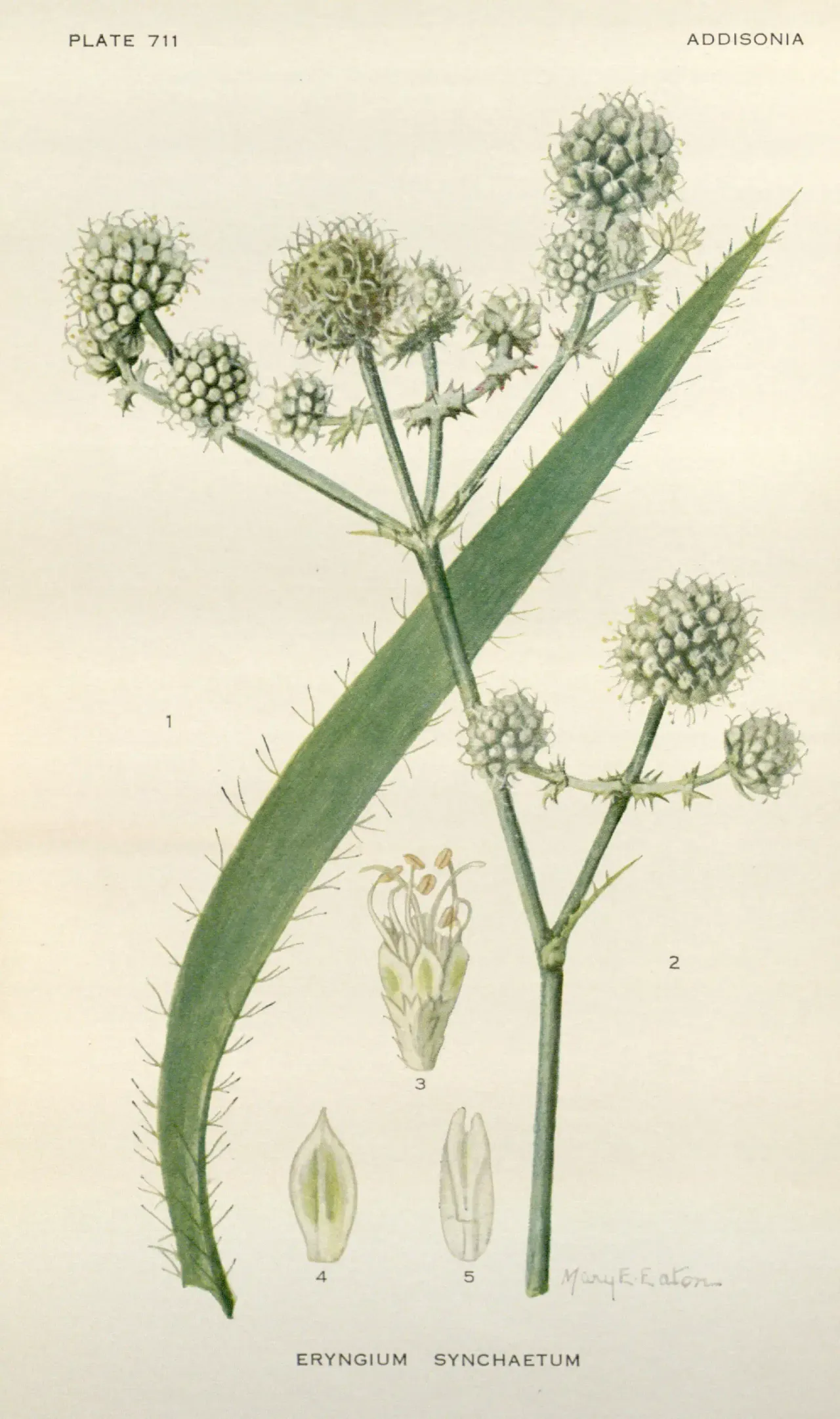 1 of 2
Native to much of the USA
Florida to coastal and blackland prairies in Texas, north to New Jersey, western Indiana, southern Minnesota and Nebraska
- Light Full sun Sun tolerance
- Moisture Moist Moisture preference
- Zones 4–10 Cold to heat range
- Bloom Jun–Aug Flowering time
- Height up to 6 ft to 1.8 m
- Life cycle Perennial Annual to perennial
In the garden
A prairie wildflower for full sun and evenly moist soil. Its white flowers peak in July. At up to 6 ft, it needs room in meadows and sunny borders. Hardy in USDA zones 4–10.
Growing conditions
Light
Full sun Partial shade Full shade
Moisture
Dry Moist Wet
Hardiness zones
Find your zone:
When it blooms
The Rattlesnake master's white flowers bloom June to August, peaking in July. This midsummer display draws bees and butterflies.
Rattlesnake master blooms whiteFoliage
Pollinators & wildlife
- Bees Common Eastern Bumble Bee
also Western Honey Bee, Eastern Carpenter Bee, Brown-belted Bumble Bee +66 more
Two-spotted Bumble Bee, American Bumble Bee, Ligated Furrow Bee, Black-tailed Bumble Bee, Pure Green Sweat bee, Bombus fervidus, Red-belted Bumble Bee, Two-spotted Longhorn Bee, Perplexing Bumble Bee, Black-and-gold Bumble Bee, Orange-legged Furrow Bee, Southern Carpenter Bee, Brown-winged Striped Sweat Bee, Yellow-banded Bumble Bee, Carpenter-mimic Leafcutter Bee, Flat-tailed Leafcutter Bee, Sculptured Resin Bee, Oblong Woolcarder Bee, Rusty-patched Bumble Bee, Modest Masked Bee, Confusing Furrow Bee, Alfalfa Leafcutter Bee, Southern Plains Bumble Bee, Silky Striped Sweat Bee, Louisiana Painted-Dark bee, Bristle Sweat Bee, Slender-faced Masked Bee, Rugose-chested Sweat Bee, Parallel-striped Sweat Bee, Eastern Miner Bee, Nevada Nomia, Petulant Leafcutter Bee, Say's Cuckoo Leafcutter Bee, Brown-winged Long-horned Bee, Texas Nomad Bee, Perplexing Rotund-Resin bee, Megachile brevis, Ceratina dupla, Hylaeus affinis, Hairy masked Bee, Experienced Sweat Bee, Lasioglossum cinctipes, Triepeolus cressonii, Goatsbeard Miner Bee, white-winged sweat bee, Sphecodes smilacinae, Anthidiellum notatum notatum, Sphecodes heraclei ignitus, Ornate Masked Bee, Ptilothrix bombiformis, Schwarz's Masked Bee, Hylaeus confluens, Megachile rugifrons, Coelioxys octodentata, Yellow-spotted Cuckoo Nomad Bee, Lunate Longhorn-cuckoo Bee, Anthophora aeneiventris, Sphecodes dichrous, Cresson's Cuckoo Sweat Bee, Augochlora feronia, Forbes's Sweat Bee, Coelioxys brevis, Short-horned Yellow-face Bee, Two-banded Cellophane-cuckoo Bee, Colletes ciliatus, Baker's Nomia - Butterflies Monarch
also Eastern Tiger Swallowtail, Red Admiral, Pearl Crescent +38 more
Common Buckeye, Fiery Skipper, Silver-spotted Skipper, Painted Lady, Gray Hairstreak, American Lady, Eastern Tailed-Blue, Queen, Viceroy, Peck's Skipper, American Snout, Checkered White, Horace's Duskywing, Common Wood-Nymph, Dun Skipper, Red-banded Hairstreak, Tawny-edged Skipper, Banded Hairstreak, Little Glassywing, Great Purple Hairstreak, Common Sootywing, White M Hairstreak, Berry's Skipper, Prairie Arogos Skipper, Eastern Snout, Limenitis archippus archippus, Limenitis arthemis arthemis, Mitoura gryneus, Cyaniris neglecta, Fulvous Hairstreak, Thecla edwardsi, Speyeria idalia, Silvery Checkerspot, Elymnias mimalon, Polites coras, Elkalyce comyntas, Anosia plexippus, Swarthy Skipper - Wasps Bald-faced Hornet
also Eastern Yellowjacket, Metric Paper Wasp, Fraternal Potter Wasp +33 more
Four-toothed Mason Wasp, Common Aerial Yellowjacket, Euodynerus foraminatus, Bramble Mason Wasp, Red-marked Pachodynerus Wasp, Southern Paper Wasp, Ancistrocerus capra, Perennial Mason Wasp, Blackjacket, Euodynerus pratensis, Pseudodynerus quadrisectus, European tube wasp, Euodynerus megaera, Parancistrocerus fulvipes, Parasitic Aerial Yellowjacket, Euodynerus hidalgo boreoorientalis, Cross Potter Wasp, Euodynerus crypticus, Parancistrocerus pedestris, Euodynerus castigatus, Euodynerus hidalgo hidalgo, One-banded Mason Wasp, Polistes dorsalis dorsalis, Bahamian Paper Wasp, Ancistrocerus campestris, Vespula vidua, Hidalgo Mason Wasp, Zethus spinipes, Eumenes belfragei, Stenodynerus anormis, Leptochilus republicanus, Vertical potter wasp, Zethus spinipes variegatus - Also visited by
- Flower flies:
Margined Calligrapher, Eastern Calligrapher +27 more
Common Drone Fly, Transverse-banded Flower Fly, Oblique Streaktail, Thick-legged Hover Fly, Eurasian Drone Fly, Virginia Giant Hover Fly, Yellow-shouldered Drone Fly, Northern Plushback, Tufted Globetail, Common Lagoon Fly, Orange-legged Drone Fly, Chrysanthrax cypris, Band-winged Bee Fly, Wavy Mucksucker, Exoprosopa fasciata, Volucella bombylans, Adorned Bee Fly, Blue-polished Drone Fly, Palpada agrorum, Tropidia quadrata, Paragus tibialis, Sphaerophoria cylindricus, Villa alternata, grasshopper bee fly, Geron rufipes, Maize Calligrapher, Tropical Plushback - Beetles:
Asian Lady Beetle, Spotted Cucumber Beetle +15 more
Goldenrod Soldier Beetle, Common Green June Beetle, Margined Leatherwing Beetle, Spotted Pink Lady Beetle, Banded Longhorn Beetle, Larger Elm Leaf Beetle, Black Diabrotica, Mordellistena comata, Inserted Case-bearing Leaf Beetle, Greenish Flower Chafer, Tumbling Ragdoll, Downy Long-horned Beetle, Euphoria sepulchralis, Chlorophorus glaucus, Flat-headed Baldcypress Sapwood Beetle - Moths:
Virginia Ctenucha Moth, Yellow-collared Scape Moth +14 more
Wavy-lined and Southern Emeralds, Squash Vine Borer, Discolored Renia Moth, Exposed Bird Dropping Moth, Common Spragueia Moth, Black-and-yellow Lichen Moth, Ironweed Clearwing Moth, Clymene Moth, Ithaca Clearwing Moth, Peachtree Borer Moth, Ornate Bella Moth, Acontia candefacta, Utetheisa bella, Blackberry Looper Moth - Birds: American Goldfinch
- Flower flies:
Butterflies that use this plant
Documented host and nectar records. Each links to a planting guide for that butterfly.
- American ladynectar
- American snoutnectar
- Banded hairstreaknectar
- Checkered whitenectar
- Common buckeyenectar
- Common wood-nymphnectar
- Eastern tailed-bluenectar
- Eastern tiger swallowtailnectar
- Edwards' hairstreaknectar
- Fiery skippernectar
- Gray hairstreaknectar
- Juniper hairstreaknectar
- Monarch butterflynectar
- Painted ladynectar
- Pearl crescentnectar
- Queennectar
- Red admiralnectar
- Red-banded hairstreaknectar
- Red-spotted purplenectar
- Silver-spotted skippernectar
- Silvery checkerspotnectar
- Summer azurenectar
- Viceroynectar
Full plant details
Where it grows
- Habitat
- PrairieThe wild plant community it grows in.
- Native range
- Much of the USAUnited States (24): AL, AR, FL, GA, IA, IL, IN, KS, KY, LA, MD, MN, MO, MS, NC, NE, NJ, OH, OK, SC, TN, TX, VA, WI. Where it grows wild on its own, by state and province.
- Native distribution
- Florida to coastal and blackland prairies in Texas, north to New Jersey, western Indiana, southern Minnesota and NebraskaThe same native range, usually more exact than the state list, and often noting where it has spread beyond it.
Growing conditions
- Light
- Full sunHow much sun it takes, from full sun to full shade.
- Moisture
- MoistThe soil dampness it prefers, from dry to wet.
- Hardiness zones
- USDA 4–10 · Canadian 5–7The cold-to-heat climate range it survives.
- Soil
- Various well-drained soilsThe soils it grows in naturally.
- Soil texture
- Light to medium (sandy to loamy)The soil grade it prefers, from sand to clay.
- Soil pH
- Mildly acid to mildly alkalineThe acidity to alkalinity it tolerates (7 is neutral).
- Soil quality
- Low (tolerates poor soil)How rich a soil it needs. Many natives prefer lean soil and flop in rich beds.
- Water use
- MediumHow thirsty it is, a rough guide to how often to water.
Growth & form
- Height
- up to 6 ft (to 1.8 m)Typical mature height.
- Spread
- ~2 ft (0.5 m)How wide one plant gets, a guide to spacing.
- Life cycle
- PerennialWhether it lives a single season (annual), two (biennial), or returns for years (perennial).
Flowers, foliage & fruit
- Type
- WildflowerWhat kind of plant it is.
- Bloom
- Jun–AugWhen it flowers.
- Flower color
- WhiteThe bloom color, or colors.
- Fruit/Seeds
- Schizocarp; ripens Jul–NovThe seed or fruit it sets after flowering.
- Toxicity
- None knownWhether any part is poisonous to people or pets.