wetland wildflower
Common boneset
Eupatorium perfoliatum
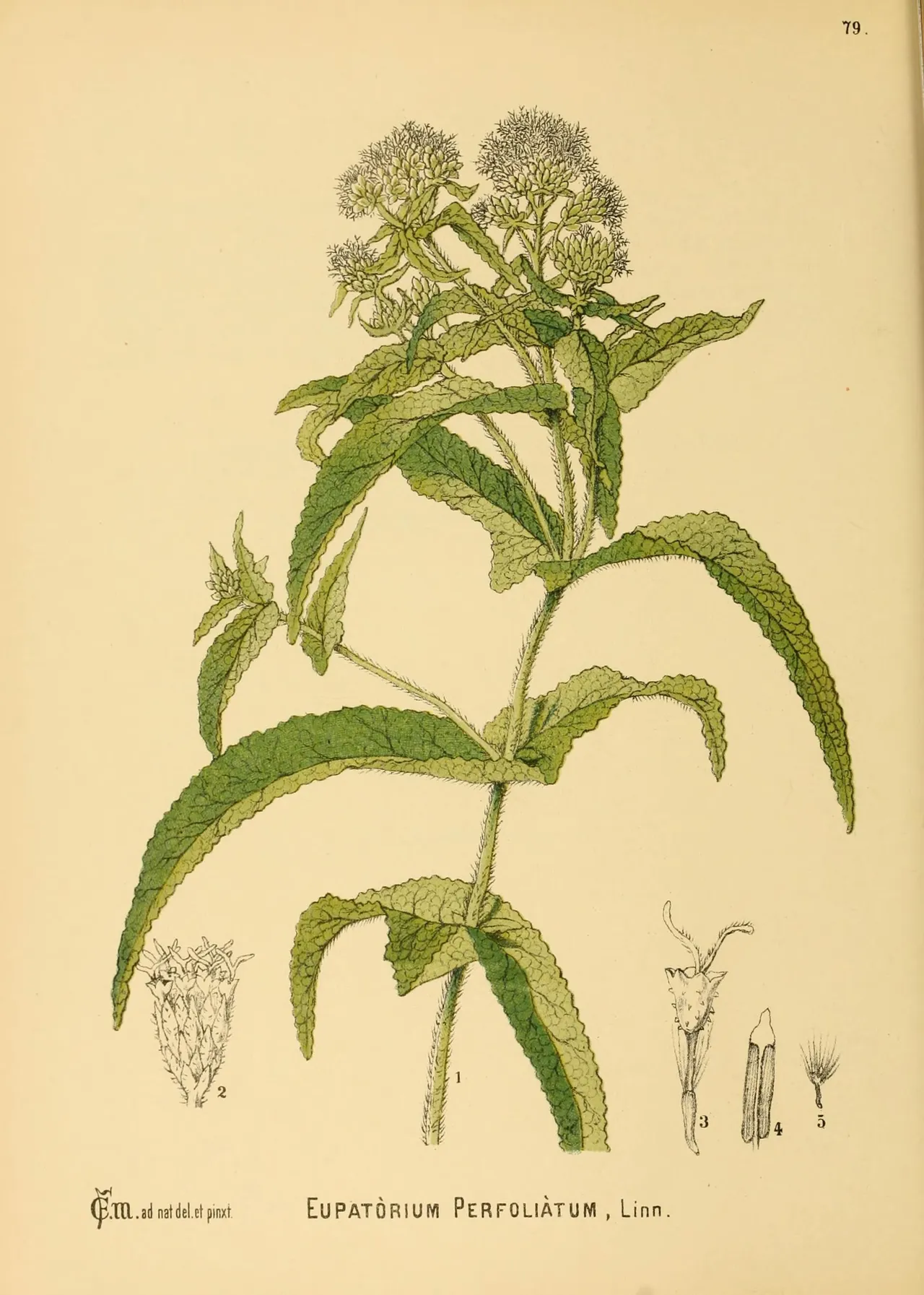 1 of 2
Native to much of the USA and southern Canada
Eastern Canada to Florida, west to eastern Dakotas, western Nebraska, eastern Kansas and northern Texas
- Light Full sun to shade Sun tolerance
- Moisture Moist to wet Moisture preference
- Zones 3–9 Cold to heat range
- Bloom Jul–Sep Flowering time
- Height up to 6 ft to 1.8 m
- Life cycle Perennial Annual to perennial
In the garden
A wetland wildflower for sun through shade and consistently moist to wet soil. Its white flowers peak in August. At up to 6 ft, it needs room in rain gardens, pond edges, and damp low spots. Hardy in USDA zones 3–9.
Growing conditions
Light
Full sun Partial shade Full shade
Moisture
Dry Moist Wet
Hardiness zones
Find your zone:
When it blooms
The Common boneset's white flowers bloom July to September, peaking in August. This late-summer display draws butterflies and bees.
Common boneset blooms whiteFoliage
Pollinators & wildlife
- Butterflies Monarch
also Eastern Tiger Swallowtail, Red Admiral, Red-spotted Admiral +48 more
Pearl Crescent, Common Buckeye, Silver-spotted Skipper, Painted Lady, Gray Hairstreak, Mourning Cloak, American Lady, Eastern Tailed-Blue, Great Spangled Fritillary, Spicebush Swallowtail, Question Mark, Viceroy, Clouded Sulphur, Eastern Black Swallowtail, Peck's Skipper, American Snout, Eastern Comma, Common Ringlet, Common Wood-Nymph, Red-banded Hairstreak, Least Skipper, Wild Indigo Duskywing, Northern Azure, American Copper, Tawny-edged Skipper, Banded Hairstreak, Milbert's Tortoiseshell, Atlantis Fritillary, Aphrodite Fritillary, American Silver-bordered Fritillary, Bronze Copper, Coral Hairstreak, Midsummer Tiger Swallowtail, White M Hairstreak, Dion Skipper, Limenitis archippus archippus, Cyaniris neglecta, Danaus plexippus plexippus, Leonard's Skipper, Limenitis arthemis arthemis, Euphydryas phaeton, Limenitis astyanax, Mitoura gryneus, Clossiana toddi ammiralis, Thecla edwardsi, Black Dash, Cynthia cardui, Anosia plexippus - Bees Common Eastern Bumble Bee
also Western Honey Bee, Eastern Carpenter Bee, Brown-belted Bumble Bee +45 more
Two-spotted Bumble Bee, Ligated Furrow Bee, Tricolored Bumble Bee, Bicolored Striped Sweat Bee, Pure Green Sweat bee, Bombus fervidus, Red-belted Bumble Bee, Orange-legged Furrow Bee, Lemon Cuckoo Bumble Bee, Yellow-banded Bumble Bee, Carpenter-mimic Leafcutter Bee, Flat-tailed Leafcutter Bee, Rusty-patched Bumble Bee, Modest Masked Bee, Confusing Furrow Bee, Spurred Ceratina, Yellowish Cuckoo Bumble bee, broad-handed leafcutter bee, Southern Plains Bumble Bee, Hairy-banded Mining Bee, Silky Striped Sweat Bee, Northeastern Sweat Bee, Louisiana Painted-Dark bee, Sunflower Mining Bee, Colletes simulans, Colletes latitarsis, Eastern Spine-shouldered Cellophane Bee, Megachile brevis, Hylaeus affinis, Cyclops Blood Bee, Little Masked Bee, False Sunflower Cuckoo Nomad Bee, Illinois Cuckoo Sweat Bee, Colletes eulophi, white-winged sweat bee, Quebec Sweat Bee, Drury's Long-horned Bee, Coelioxys modesta, Lasioglossum zonulum, Pseudopanurgus labrosus, Eastern Cuckoo Sweat Bee, Augochlora feronia, Short-horned Yellow-face Bee, Augochlorella persimilis, Sphecodes heraclei heraclei - Wasps Bald-faced Hornet
also Eastern Yellowjacket, Fraternal Potter Wasp, Four-toothed Mason Wasp +19 more
Common Aerial Yellowjacket, Euodynerus foraminatus, Bramble Mason Wasp, Ancistrocerus capra, Perennial Mason Wasp, Blackjacket, Ancistrocerus catskill, Pseudodynerus quadrisectus, European tube wasp, Parasitic Aerial Yellowjacket, Euodynerus hidalgo boreoorientalis, Parancistrocerus pensylvanicus, Hidalgo Mason Wasp, Ancistrocerus campestris, Zethus spinipes, Vespula vidua, German Yellowjacket, Parancistrocerus leionotus yumus, Northern Aerial Yellowjacket - Also visited by
- Flower flies:
Margined Calligrapher, Eastern Calligrapher +25 more
Common Drone Fly, Transverse-banded Flower Fly, Thick-legged Hover Fly, Eurasian Drone Fly, Yellow-shouldered Drone Fly, Tufted Globetail, Eastern Hornet Fly, Oblique-banded Pond Fly, Orange-legged Drone Fly, Bald-faced Hornet Fly, Hunchbacked Bee Fly, Black-horned Smoothtail, Exoprosopa fasciata, Common Flower Fly, Hairy-eyed Flower Fly, Dusky-banded Leafwalker, Poecilanthrax tegminipennis, Blue-polished Drone Fly, Bombylius atriceps, Orange-spotted Drone Fly, grasshopper bee fly, White-haired Pithead, Cheilosia punctulata, Maize Calligrapher, Villa fulviana - Moths:
Snowberry Clearwing, Yellow-collared Scape Moth +25 more
Wavy-lined and Southern Emeralds, Delicate Cycnia Moth, White-striped Black, Carrot Seed Moth, Celery Looper Moth, Arcigera Flower Moth, Common Grass-veneer, Squash Vine Borer, Common Carpet Moth, White-spotted Sable, Black-and-yellow Lichen Moth, Raspberry Pyrausta Moth, Purple-backed Cabbageworm Moth, Ragweed Flower Moth, Three-lined Flower Moth, Virginia Creeper Clearwing, Knee-joint Dart, Boneset Borer Moth, Apple Bark Borer, Clear and Strigulose Daggers and Allies, Pyrausta acrionalis, Common Looper Moth, Patalene olyzonaria, Peachtree Borer Moth, Mythimna unipuncta - Beetles:
Asian Lady Beetle, Seven-spotted Lady Beetle +17 more
Spotted Cucumber Beetle, Goldenrod Soldier Beetle, Spotted Pink Lady Beetle, Locust Borer, Fourteen-spotted Lady Beetle, Banded Longhorn Beetle, Common Red Soldier Beetle, Wide-horned Soldier Beetle, Notch-tipped Flower Longhorn Beetle, Mournful Long-horned Beetle, Honeylocust Agrilus, Mordellistena comata, Red-shouldered Pine Borer, Downy Long-horned Beetle, Metacmaeops vittata, Chauliognathus pennsylvanicus, Euphoria sepulchralis - Hummingbirds: Ruby-throated Hummingbird
- Flower flies:
Butterflies that use this plant
Documented host and nectar records. Each links to a planting guide for that butterfly.
- American coppernectar
- American ladynectar
- American snoutnectar
- Aphrodite fritillarynectar
- Banded hairstreaknectar
- Black swallowtailnectar
- Clouded sulphurnectar
- Common buckeyenectar
- Common ringletnectar
- Common wood-nymphnectar
- Coral hairstreaknectar
- Eastern commanectar
- Eastern tailed-bluenectar
- Eastern tiger swallowtailnectar
- Edwards' hairstreaknectar
- Gray hairstreaknectar
- Great spangled fritillarynectar
- Juniper hairstreaknectar
- Milbert's tortoiseshellnectar
- Monarch butterflynectar
- Mourning cloaknectar
- Painted ladynectar
- Pearl crescentnectar
- Question marknectar
- Red admiralnectar
- Red-banded hairstreaknectar
- Red-spotted purplenectar
- Silver-bordered fritillarynectar
- Silver-spotted skippernectar
- Spicebush swallowtailnectar
- Summer azurenectar
- Viceroynectar
Full plant details
Where it grows
- Habitat
- WetlandThe wild plant community it grows in.
- Native range
- Much of the USA and southern CanadaUnited States (38): AL, AR, CT, DC, DE, FL, GA, IA, IL, IN, KS, KY, LA, MA, MD, ME, MI, MN, MO, MS, NC, ND, NE, NH, NJ, NY, OH, OK, PA, RI, SC, SD, TN, TX, VA, VT, WI, WV. Canada (6): MB, NB, NS, ON, PE, QC. Where it grows wild on its own, by state and province.
- Native distribution
- Eastern Canada to Florida, west to eastern Dakotas, western Nebraska, eastern Kansas and northern TexasThe same native range, usually more exact than the state list, and often noting where it has spread beyond it.
Growing conditions
- Light
- Full sun to shadeHow much sun it takes, from full sun to full shade.
- Moisture
- Moist to wetThe soil dampness it prefers, from dry to wet.
- Hardiness zones
- USDA 3–9 · Canadian 3–7The cold-to-heat climate range it survives.
- Soil
- Moist to wet soilsThe soils it grows in naturally.
- Soil texture
- Light to heavy (sandy to clay)The soil grade it prefers, from sand to clay.
- Soil pH
- Mildly acid to mildly alkalineThe acidity to alkalinity it tolerates (7 is neutral).
Growth & form
- Height
- up to 6 ft (to 1.8 m)Typical mature height.
- Life cycle
- PerennialWhether it lives a single season (annual), two (biennial), or returns for years (perennial).
Flowers, foliage & fruit
- Type
- WildflowerWhat kind of plant it is.
- Bloom
- Jul–SepWhen it flowers.
- Flower color
- WhiteThe bloom color, or colors.
- Fruit/Seeds
- ripens Sep–NovThe seed or fruit it sets after flowering.
- Toxicity
- None knownWhether any part is poisonous to people or pets.