woodland wildflower
Narrowleaf mountainmint
Pycnanthemum tenuifolium
Also known as Narrowleaf Mountain Mint, Slender Mountain Mint, Common Horsemint
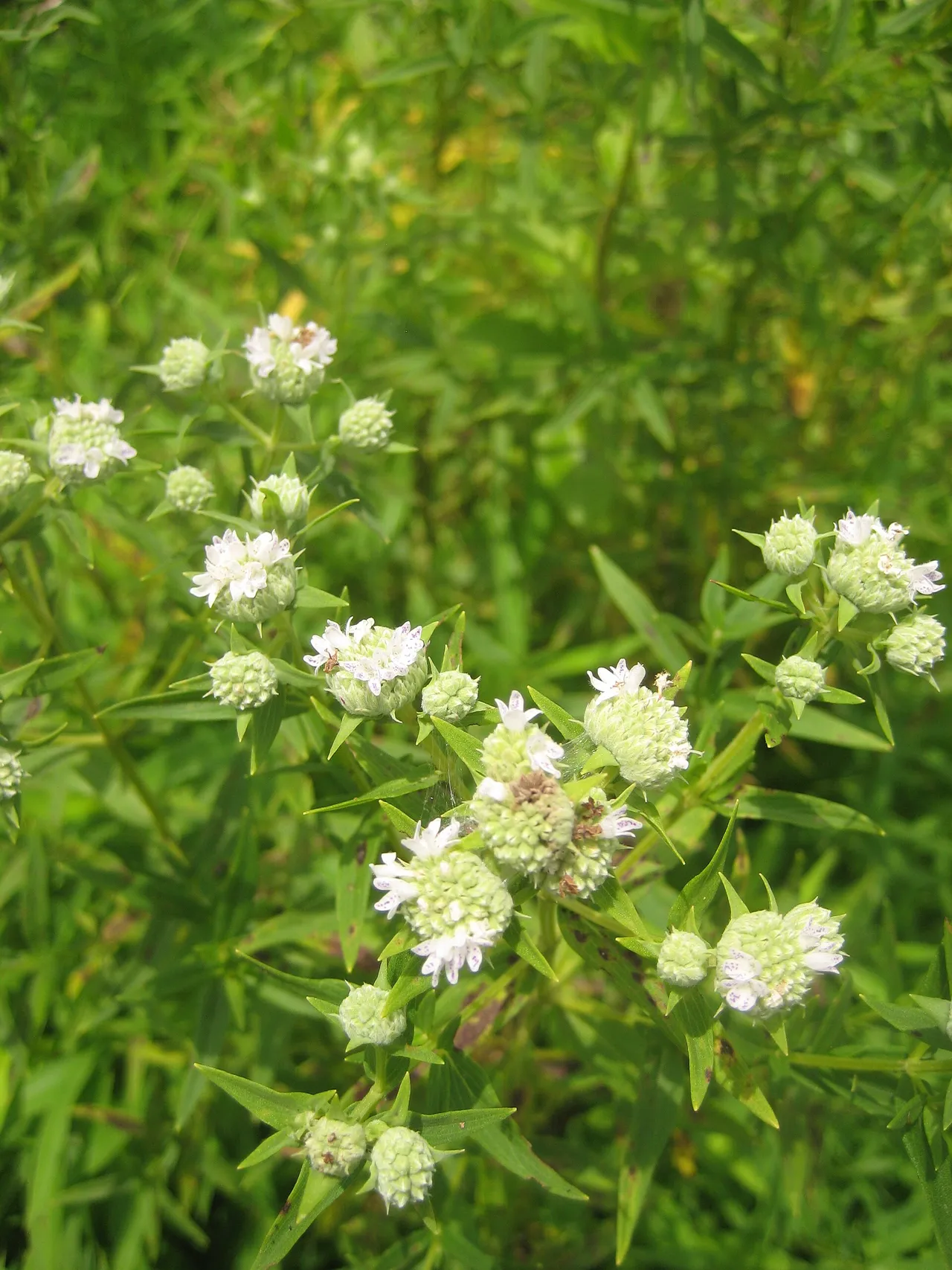
Native to much of the USA
Maine to Georgia, west to Wisconsin, Iowa, eastern Kansas and eastern Texas
- Light Full sun to part shade Sun tolerance
- Moisture Dry to moist Moisture preference
- Zones 4–9 Cold to heat range
- Bloom Jun–Sep Flowering time
- Height
- Life cycle Perennial Annual to perennial
In the garden
A woodland wildflower for full sun to part shade and dry to moist soil. Hardy in USDA zones 4–9.
Growing conditions
Light
Full sun Partial shade Full shade
Moisture
Dry Moist Wet
Hardiness zones
Find your zone:
Pollinators & wildlife
- Bees Common Eastern Bumble Bee
also Western Honey Bee, Eastern Carpenter Bee, Brown-belted Bumble Bee +97 more
Two-spotted Bumble Bee, American Bumble Bee, Ligated Furrow Bee, Tricolored Bumble Bee, Bicolored Striped Sweat Bee, Pure Green Sweat bee, Red-belted Bumble Bee, Hunt's Bumble Bee, Two-spotted Longhorn Bee, Perplexing Bumble Bee, Black-and-gold Bumble Bee, Half-black Bumble Bee, Orange-legged Furrow Bee, Agapostemon texanus, Lemon Cuckoo Bumble Bee, Brown-winged Striped Sweat Bee, Yellow-banded Bumble Bee, Flat-tailed Leafcutter Bee, Sculptured Resin Bee, Oblong Woolcarder Bee, Golden Sweat Bee, Rusty-patched Bumble Bee, Modest Masked Bee, Confusing Furrow Bee, Spurred Ceratina, Alfalfa Leafcutter Bee, Yellowish Cuckoo Bumble bee, broad-handed leafcutter bee, Southern Plains Bumble Bee, Texas Leafcutter Bee, Silky Striped Sweat Bee, Nomada vegana, Louisiana Painted-Dark bee, Bristle Sweat Bee, Rugose-chested Sweat Bee, Parallel-striped Sweat Bee, Eastern Miner Bee, Petulant Leafcutter Bee, Brown-winged Long-horned Bee, Squash Longhorn-Cuckoo, Colletes latitarsis, Viereck's Sweat Bee, Texas Nomad Bee, Worthy Longhorn, Agile Longhorn Bee, Sumac Cellophane-Cuckoo, Small-handed Leaf-cutter Bee, Megachile brevis, Ceratina dupla, Hylaeus affinis, Triepeolus simplex, Goldenrod Cellophane Bee, Experienced Sweat Bee, Thistle Longhorn-Cuckoo, Lasioglossum cinctipes, Osmia conjuncta, Triepeolus cressonii, hoary sweat bee, Broad-faced Masked Bee, Halictus tectus, Goatsbeard Miner Bee, Variable Cuckoo Bumble Bee, Virginia Mining Bee, Colletes eulophi, Sixteen-spotted Cuckoo Carder Bee, Tickseed Longhorn Bee, Eastern Scaly Miner Bee, Dusty Cuckoo Nomad Bee, Williston's Cellophane Bee, Macropis patellata, Giant Sweat Bee, Lunate Longhorn-cuckoo Bee, Coelioxys modesta, Drury's Long-horned Bee, Xylocopa virginica virginica, Augochlorella persimilis, Eucera belfragei, Peponapis pruinosa, Melissodes dentiventris, Anthophora aeneiventris, Leioproctus clypeatus, Svastra obliqua, Augochlora feronia, Hoplitis pilosifrons, Augochlora nominata, Forbes's Sweat Bee, Coelioxys brevis, Short-horned Yellow-face Bee, Lasioglossum tegulare, Triepeolus nevadensis, Two-banded Cellophane-cuckoo Bee, Coelioxys alternata, Sphecodes antennariae, Svastra compta, Svastra petulca, Bare-saddled Cellophane Bee, Xeromelecta interrupta - Butterflies Monarch
also Eastern Tiger Swallowtail, Red Admiral, Black Swallowtail +60 more
Pearl Crescent, Common Buckeye, Fiery Skipper, Silver-spotted Skipper, Painted Lady, Pipevine Swallowtail, Gray Hairstreak, American Lady, Orange Sulphur, Eastern Tailed-Blue, Great Spangled Fritillary, Variegated Fritillary, Spicebush Swallowtail, Viceroy, Zabulon Skipper, Eastern Black Swallowtail, Peck's Skipper, Checkered White, Horace's Duskywing, Common Ringlet, Common Wood-Nymph, Dun Skipper, Red-banded Hairstreak, Least Skipper, Wild Indigo Duskywing, American Copper, Tawny-edged Skipper, Banded Hairstreak, Southern Dogface, Little Glassywing, Common Sootywing, Broad-winged Skipper, Dreamy Duskywing, Southern Skipperling, American Silver-bordered Fritillary, Coral Hairstreak, Sleepy Duskywing, Striped Hairstreak, Hoary Edge, Southern Cloudywing, Little Metalmark, Wallengrenia otho, Crossline Skipper, Byssus Skipper, Regal Fritillary, Little Yellow, Papilio cresphontes, Protographium marcellus, Wallengrenia egeremet, Black Dash, Cyaniris neglecta, Abaeis nicippe, Silvery Checkerspot, Mitoura gryneus, Atrytone delaware, Cynthia cardui, Thorybes daunus, Speyeria cybele, Polites coras, Elkalyce comyntas - Flower flies Margined Calligrapher
also Eastern Calligrapher, Common Drone Fly, Transverse-banded Flower Fly +23 more
Thick-legged Hover Fly, Eurasian Drone Fly, Black-shouldered Drone Fly, Yellow-shouldered Drone Fly, Tufted Globetail, Eastern Hornet Fly, Common Lagoon Fly, Chrysanthrax cypris, Band-winged Bee Fly, Wavy Mucksucker, Bald-faced Hornet Fly, Broad-headed Marsh Fly, Hunchbacked Bee Fly, Peg-legged Compost Fly, Bald Bee Fly, Sphaerophoria cylindricus, Villa alternata, Exoprosopa meigenii, Rhynchanthrax parvicornis, Mallota cimbiciformis, Eristalis vinetorum, Yellow Mimic Fly, Tropical Plushback - Also visited by
- Wasps:
Metric Paper Wasp, Fraternal Potter Wasp +19 more
Four-toothed Mason Wasp, Common Aerial Yellowjacket, Euodynerus foraminatus, Bramble Mason Wasp, Ancistrocerus capra, Perennial Mason Wasp, Pseudodynerus quadrisectus, Parancistrocerus fulvipes, Euodynerus hidalgo boreoorientalis, Parancistrocerus leionotus, Parancistrocerus pedestris, Parancistrocerus vagus, Euodynerus hidalgo hidalgo, Vertical potter wasp, Zethus spinipes, Hidalgo Mason Wasp, Ancistrocerus campestris, One-banded Mason Wasp, Polistes exclamans - Beetles:
Asian Lady Beetle, Goldenrod Soldier Beetle +19 more
Margined Leatherwing Beetle, Spotted Pink Lady Beetle, Oriental Beetle, Locust Borer, Banded Longhorn Beetle, Zebra Longhorn Beetle, Yellow-horned Flower Longhorn Beetle, Slender Flower Longhorn Beetle, Eight-spotted Tumbling Flower Beetle, Notch-tipped Flower Longhorn Beetle, Mournful Long-horned Beetle, Pygmy Chafer, Strangalia famelica solitaria, Euderces picipes, Brachyleptura vagans, Metacmaeops vittata, Mordella scutellaris, Chlorophorus glaucus, Tumbling Ragdoll - Moths:
Yellow-collared Scape Moth, Wavy-lined and Southern Emeralds +10 more
Delicate Cycnia Moth, Carrot Seed Moth, Arcigera Flower Moth, Squash Vine Borer, White-roped Glaphyria Moth, Small Bird-dropping Moth, Variable Reddish and California Pyrausta Moths, White-spotted Sable, Common Spragueia Moth, Orange Mint Moth
- Wasps:
Butterflies that use this plant
Documented host and nectar records. Each links to a planting guide for that butterfly.
- American coppernectar
- American ladynectar
- Banded hairstreaknectar
- Black swallowtailnectar
- Checkered whitenectar
- Common buckeyenectar
- Common ringletnectar
- Common wood-nymphnectar
- Coral hairstreaknectar
- Eastern tailed-bluenectar
- Eastern tiger swallowtailnectar
- Fiery skippernectar
- Giant swallowtailnectar
- Gray hairstreaknectar
- Great spangled fritillarynectar
- Juniper hairstreaknectar
- Little yellownectar
- Monarch butterflynectar
- Orange sulphurnectar
- Painted ladynectar
- Pearl crescentnectar
- Pipevine swallowtailnectar
- Red admiralnectar
- Red-banded hairstreaknectar
- Silver-bordered fritillarynectar
- Silver-spotted skippernectar
- Silvery checkerspotnectar
- Sleepy orangenectar
- Spicebush swallowtailnectar
- Summer azurenectar
- Variegated fritillarynectar
- Viceroynectar
- Zebra swallowtailnectar
Full plant details
Where it grows
- Habitat
- WoodlandThe wild plant community it grows in.
- Native range
- Much of the USAUnited States (33): AL, AR, CT, DC, DE, GA, IA, IL, IN, KS, KY, LA, MA, MD, ME, MI, MO, MS, NC, NH, NJ, NY, OH, OK, PA, RI, SC, TN, TX, VA, VT, WI, WV. Where it grows wild on its own, by state and province.
- Native distribution
- Maine to Georgia, west to Wisconsin, Iowa, eastern Kansas and eastern TexasThe same native range, usually more exact than the state list, and often noting where it has spread beyond it.
Growing conditions
- Light
- Full sun to part shadeHow much sun it takes, from full sun to full shade.
- Moisture
- Dry to moistThe soil dampness it prefers, from dry to wet.
- Hardiness zones
- USDA 4–9 · Canadian 5–7The cold-to-heat climate range it survives.
- Soil
- Various moist to dry soilsThe soils it grows in naturally.
- Water use
- MediumHow thirsty it is, a rough guide to how often to water.
- Drought tolerance
- MediumRelative to plants of the same type and region, inferred from where it grows, not a days-without-water figure.
Growth & form
- Life cycle
- PerennialWhether it lives a single season (annual), two (biennial), or returns for years (perennial).
Flowers, foliage & fruit
- Type
- WildflowerWhat kind of plant it is.
- Bloom
- Jun–SepWhen it flowers.
- Flower color
- WhiteThe bloom color, or colors.
- Fruit/Seeds
- NutletsThe seed or fruit it sets after flowering.
- Toxicity
- None knownWhether any part is poisonous to people or pets.