wetland shrub
Sweet Pepperbush
Clethra alnifolia
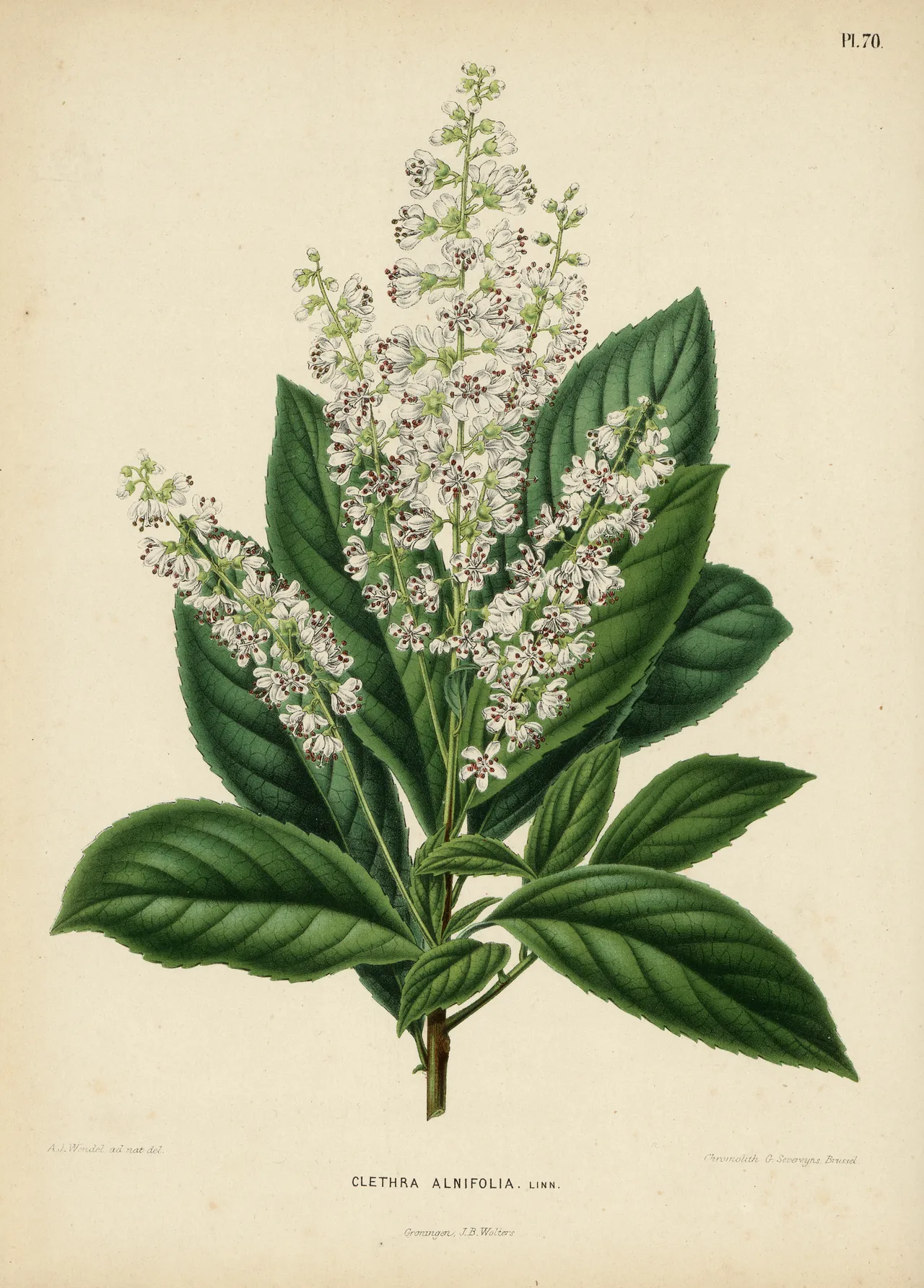 1 of 2
Native to the Northeast and the Southeast
Mississippi to Florida, north through eastern portions of the coastal states to southern Maine; also locally in Louisiana and Texas
- Light Full sun to shade Sun tolerance
- Moisture Moist to wet Moisture preference
- Zones 4–9 Cold to heat range
- Bloom Jul–Aug Flowering time
- Height
- Life cycle Perennial Annual to perennial
In the garden
A wetland shrub for sun through shade and consistently moist to wet soil. Its white and pink flowers peak in August. Hardy in USDA zones 4–9.
Growing conditions
Light
Full sun Partial shade Full shade
Moisture
Dry Moist Wet
Hardiness zones
Find your zone:
When it blooms
The Sweet Pepperbush's white and pink flowers bloom July to August, peaking in August. This late-summer display draws butterflies and moths.
Sweet Pepperbush blooms white & pinkFoliage
Pollinators & wildlife
- Butterflies Monarch
also Eastern Tiger Swallowtail, Red Admiral, Black Swallowtail +42 more
Red-spotted Admiral, Pearl Crescent, Common Buckeye, Silver-spotted Skipper, Painted Lady, Gray Hairstreak, American Lady, Eastern Tailed-Blue, Great Spangled Fritillary, Spicebush Swallowtail, Question Mark, Viceroy, Zabulon Skipper, Peck's Skipper, American Snout, Horace's Duskywing, Dun Skipper, Red-banded Hairstreak, Canadian Tiger Swallowtail, Least Skipper, Tawny-edged Skipper, American Red Admiral, Banded Hairstreak, Little Glassywing, Great Purple Hairstreak, Common Sootywing, Hydaspe Fritillary, Broad-winged Skipper, White M Hairstreak, Dion Skipper, Yehl Skipper, Rare Skipper, Crossline Skipper, Panoquina panoquin, Papilio cresphontes, Cyaniris neglecta, Danaus plexippus plexippus, Wallengrenia egeremet, Mitoura gryneus, Protographium marcellus, Limenitis astyanax, Limenitis arthemis arthemis - Moths White-lined Sphinx
also Large Lace-border Moth, Yellow-collared Scape Moth, Large Maple Spanworm Moth +46 more
Hummingbird Clearwing, Common Tan Wave, Lucerne Moth, North American Common Gray, Grape Leaffolder and Leafroller Moths, Eight-spotted Forester Moth, Confused Eusarca Moth, Delicate Cycnia Moth, Maple Looper Moth, Soybean Looper Moth, Bent-winged Owlet, White-striped Black, Dark-banded Owlet, Variegated Midget, Barberry Geometer Moth, Squash Vine Borer, Brown Bark Carpet Moth, Small Bird-dropping Moth, Variable Reddish and California Pyrausta Moths, Yellow Slant-line, Bilobed Looper Moth, American Angle Shades, Orange Mint Moth, Unspotted Looper Moth, Pale-winged Crocidophora Moth, Hahncappsia marculenta, White-fringed Pyrausta Moth, Oval Abrostola, Metarranthis homuraria, Algedonia mysippusalis, Tetanolita floridana, Brown-shaded Gray, Zebra Conchylodes Moth, Hahncappsia pergilvalis, Faint-spotted Angle, Bold-feathered Grass Moth, Pyrausta acrionalis, Small Brown Quaker, Variable Antepione Moth, Common Looper Moth, Asteroid Moth, Bicolored Pyrausta Moth and Allies, Celery Leaftier Moth, Mythimna unipuncta, Patalene olyzonaria, Peachtree Borer Moth - Bees Common Eastern Bumble Bee
also Western Honey Bee, Eastern Carpenter Bee, Brown-belted Bumble Bee +25 more
Two-spotted Bumble Bee, American Bumble Bee, Ligated Furrow Bee, Black-tailed Bumble Bee, Pure Green Sweat bee, Perplexing Bumble Bee, Orange-legged Furrow Bee, Vancouver Bumble Bee, Southern Carpenter Bee, Lemon Cuckoo Bumble Bee, Brown-winged Striped Sweat Bee, Yellow-banded Bumble Bee, Carpenter-mimic Leafcutter Bee, Sculptured Resin Bee, Rusty-patched Bumble Bee, Nearctic Bumble Bee, Southern Plains Bumble Bee, Orange-tipped Wood-digger, Dark-winged Sweat Bee, Western Bumble Bee, Silky Striped Sweat Bee, Frigid Leafcutter Bee, Sumac Cellophane-Cuckoo, Xylocopa virginica virginica, Coelioxys octodentata - Also visited by
- Wasps:
Bald-faced Hornet, European Hornet +14 more
Fraternal Potter Wasp, Four-toothed Mason Wasp, Common Aerial Yellowjacket, Euodynerus foraminatus, Perennial Mason Wasp, Blackjacket, Pseudodynerus quadrisectus, Parasitic Aerial Yellowjacket, Parancistrocerus histrio, Forest Yellowjacket, Hidalgo Mason Wasp, Ancistrocerus campestris, Zethus spinipes, Vespula vidua - Flower flies:
Eastern Calligrapher, Common Drone Fly +6 more
Transverse-banded Flower Fly, Thick-legged Hover Fly, Eurasian Drone Fly, Wavy Mucksucker, Bald-faced Hornet Fly, Tapered Drone Fly - Beetles:
Goldenrod Soldier Beetle, Banded Longhorn Beetle +3 more
Yellow Velvet Beetle, Thin-tailed Longhorned Beetle, Red-shouldered Pine Borer - Hummingbirds: Ruby-throated Hummingbird
- Wasps:
Butterflies that use this plant
Documented host and nectar records. Each links to a planting guide for that butterfly.
- American ladynectar
- American snoutnectar
- Banded hairstreaknectar
- Black swallowtailnectar
- Canadian tiger swallowtailnectar
- Common buckeyenectar
- Eastern tailed-bluenectar
- Eastern tiger swallowtailnectar
- Giant swallowtailnectar
- Gray hairstreaknectar
- Great spangled fritillarynectar
- Juniper hairstreaknectar
- Monarch butterflynectar
- Painted ladynectar
- Pearl crescentnectar
- Question marknectar
- Red admiralnectar
- Red-banded hairstreaknectar
- Red-spotted purplenectar
- Silver-spotted skippernectar
- Spicebush swallowtailnectar
- Summer azurenectar
- Viceroynectar
- Zebra swallowtailnectar
Full plant details
Where it grows
- Habitat
- WetlandThe wild plant community it grows in.
- Native range
- The Northeast and the SoutheastUnited States (19): AL, CT, DE, FL, GA, LA, MA, MD, ME, MS, NC, NH, NJ, NY, PA, RI, SC, TX, VA. Where it grows wild on its own, by state and province.
- Native distribution
- Mississippi to Florida, north through eastern portions of the coastal states to southern Maine; also locally in Louisiana and TexasThe same native range, usually more exact than the state list, and often noting where it has spread beyond it.
Growing conditions
- Light
- Full sun to shadeHow much sun it takes, from full sun to full shade.
- Moisture
- Moist to wetThe soil dampness it prefers, from dry to wet.
- Hardiness zones
- USDA 4–9 · Canadian 5–7The cold-to-heat climate range it survives.
- Soil
- Many wet to moist, acid soils, including sands and claysThe soils it grows in naturally.
- Soil texture
- Light to medium (sandy to loamy)The soil grade it prefers, from sand to clay.
- Soil pH
- 4.5–7.0The acidity to alkalinity it tolerates (7 is neutral).
- Soil quality
- MediumHow rich a soil it needs. Many natives prefer lean soil and flop in rich beds.
- Water use
- HighHow thirsty it is, a rough guide to how often to water.
- Drought tolerance
- LowRelative to plants of the same type and region, inferred from where it grows, not a days-without-water figure.
- Salinity tolerance
- NoneHow well it copes with salty soil, near roads or the coast.
- Lime (CaCO₃) tolerance
- LowHow well it copes with chalky, lime-rich soil.
Growth & form
- Spread
- ~8 ft (2.5 m)How wide one plant gets, a guide to spacing.
- Life cycle
- PerennialWhether it lives a single season (annual), two (biennial), or returns for years (perennial).
- Growth rate
- ModerateA relative ranking versus other plants of the same type (USDA), not an absolute rate.
- Shape
- ErectIts overall silhouette.
- Root depth
- 16+ in (41+ cm)How far the roots reach, a guide to drought resilience and transplanting.
Flowers, foliage & fruit
- Type
- ShrubWhat kind of plant it is.
- Bloom
- Jul–AugWhen it flowers.
- Flower color
- White, PinkThe bloom color, or colors.
- Fruit/Seeds
- ripens Aug–OctThe seed or fruit it sets after flowering.
- Toxicity
- None knownWhether any part is poisonous to people or pets.
Propagation & seed
- Cold stratification
- Not requiredWhether seed needs a cold, moist spell before it will germinate.
- Propagation
- Bare root, container, seedHow to start new plants.
- Seed spread rate
- SlowHow readily it self-sows. Slow or none means well-behaved, not a spreader.
- Seedling vigor
- LowHow strongly young seedlings establish.
- Vegetative spread
- SlowWhether it creeps outward or stays put in a clump.