wetland wildflower
Wild bergamot
Monarda fistulosa
Also known as Beebalm
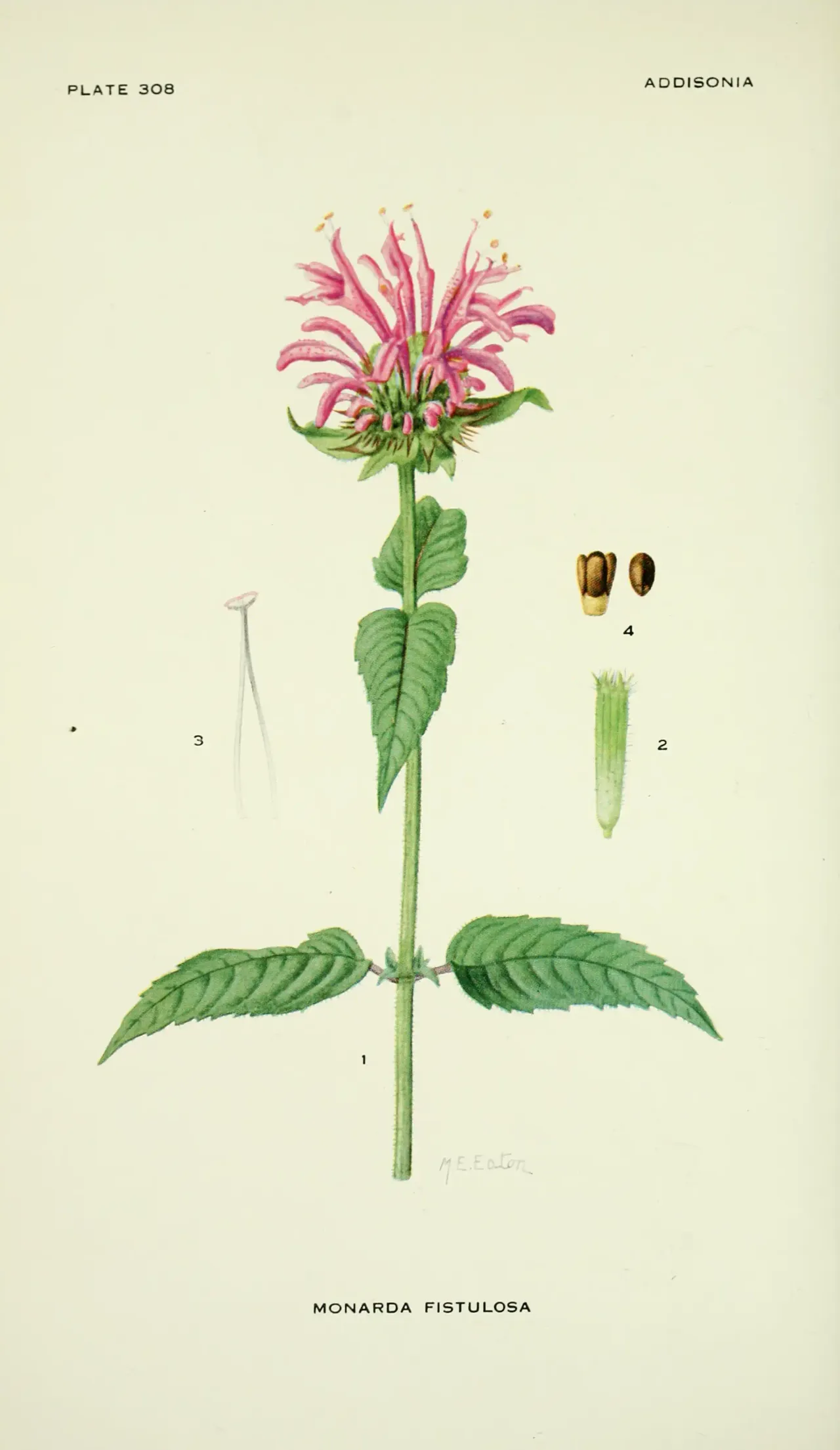 1 of 3
Native to most of the USA and Canada
Most of southern Canada and the United States east of the Rockies, except Maritime Provinces, and peninsular Florida, south to Veracruz in eastern Mexico.
- Light Full sun to part shade Sun tolerance
- Moisture Dry to moist Moisture preference
- Zones 3–9 Cold to heat range
- Bloom Jun–Aug Flowering time
- Height up to 5 ft to 1.5 m
- Life cycle Perennial Annual to perennial
In the garden
A wetland wildflower for full sun to part shade and dry to moist soil. Its white flowers peak in July. At up to 5 ft, it needs room in rain gardens, pond edges, and damp low spots. Hardy in USDA zones 3–9.
Growing conditions
Light
Full sun Partial shade Full shade
Moisture
Dry Moist Wet
Hardiness zones
Find your zone:
When it blooms
The Wild bergamot's white flowers bloom June to August, peaking in July. This midsummer display draws bees and butterflies.
Wild bergamot blooms white, pink & purpleFoliage
Pollinators & wildlife
- Bees Common Eastern Bumble Bee
also Western Honey Bee, Eastern Carpenter Bee, Brown-belted Bumble Bee +101 more
Two-spotted Bumble Bee, American Bumble Bee, Yellow-faced Bumble Bee, Ligated Furrow Bee, Tricolored Bumble Bee, Bicolored Striped Sweat Bee, Pure Green Sweat bee, Bombus fervidus, Red-belted Bumble Bee, Hunt's Bumble Bee, Two-spotted Longhorn Bee, Perplexing Bumble Bee, Fuzzy-Horned Bumble Bee, European Woolcarder Bee, Two-form Bumble Bee, Black-and-gold Bumble Bee, Half-black Bumble Bee, Orange-legged Furrow Bee, Yellow-fronted Bumble Bee, Lemon Cuckoo Bumble Bee, Northern Amber Bumble Bee, Brown-winged Striped Sweat Bee, Nevada Bumble Bee, Yellow-banded Bumble Bee, Sculptured Resin Bee, Golden Sweat Bee, Great Basin Bumble Bee, Rusty-patched Bumble Bee, Confusing Furrow Bee, Spurred Ceratina, Indiscriminate Cuckoo Bumble Bee, Hawthorn Mining Bee, Dark-veined Longhorn Bee, broad-handed leafcutter bee, Southern Plains Bumble Bee, Orange-tipped Wood-digger, Eastern Thistle Longhorn Bee, White-shouldered Bumble Bee, Western Bumble Bee, Texas Leafcutter Bee, Common Longhorn Bee, Silky Striped Sweat Bee, Unarmed Leafcutter Bee, Cryptic Bumble Bee, Morrison's Bumble Bee, Black-and-gray Leafcutter Bee, Bumblebee-like Digger Bee, Louisiana Painted-Dark bee, Bristle Sweat Bee, Golden-tailed Leafcutter Bee, Silver-tailed Petalcutter, Frigid Leafcutter Bee, Red-footed Cuckoo Leafcutter, Brown-winged Long-horned Bee, Squash Longhorn-Cuckoo, Viereck's Sweat Bee, Beebalm Shortface, Cherry Mining Bee, Worthy Longhorn, Anthophora walshii, Agile Longhorn Bee, Small-handed Leaf-cutter Bee, Annulate Masked Bee, Ceratina dupla, Cresson's Sweat Bee, Colletes nudus, Carinate Armored-Resin bee, Experienced Sweat Bee, Anomalous Metallic Sweat Bee, Triepeolus cressonii, Anthophora montana, Xenoglossa strenua, Pseudopanurgus labrosus, Melissodes hymenoxidis, Triepeolus concavus, Colletes paniscus, Ceanothus Sweat Bee, Augochlorella persimilis, Leavitt's Armored-Resin bee, Lasioglossum manitouellum, Anthophora occidentalis, Anthidiellum boreale, Bellflower Resin Bee, Melissodes communis communis, Melissodes bimaculatus bimaculatus, Morning Glory Turret Bee, Peponapis pruinosa, Nimble Ceratina, Giant Sweat Bee, Lunate Longhorn-cuckoo Bee, Xylocopa virginica virginica, Svastra atripes, Andrena sp., Anthidium florentinum, Abrupt Digger Bee, Bombus vagans vagans, Bombus sp., Svastra obliqua, Hoplitis pilosifrons, Triepeolus nevadensis, Svastra compta - Butterflies Monarch
also Eastern Tiger Swallowtail, Red Admiral, Black Swallowtail +109 more
Red-spotted Admiral, Pearl Crescent, Common Buckeye, Fiery Skipper, Silver-spotted Skipper, Painted Lady, Pipevine Swallowtail, Gray Hairstreak, Mourning Cloak, American Lady, Orange Sulphur, Eastern Tailed-Blue, Great Spangled Fritillary, Variegated Fritillary, Spicebush Swallowtail, Question Mark, Hackberry Emperor, Viceroy, Zabulon Skipper, Clouded Sulphur, Eastern Black Swallowtail, Peck's Skipper, American Snout, Eastern Comma, Checkered White, Western Tiger Swallowtail, Horace's Duskywing, Common Ringlet, Common Wood-Nymph, Clouded Skipper, Dun Skipper, Canadian Tiger Swallowtail, Woodland Skipper, Least Skipper, Long-tailed Skipper, Wild Indigo Duskywing, Two-tailed Swallowtail, Tawny-edged Skipper, American Red Admiral, Banded Hairstreak, Little Glassywing, Atlantis Fritillary, Common Sootywing, Aphrodite Fritillary, Broad-winged Skipper, Weidemeyer's Admiral, Coral Hairstreak, Taxiles Skipper, Midsummer Tiger Swallowtail, Hoary Edge, Gorgone Checkerspot, Behr's Hairstreak, Dion Skipper, Mulberry Wing, Arogos Skipper, Mottled Duskywing, Afranius Duskywing, Uncas Skipper, Prairie Arogos Skipper, Anatrytone logan lagus, Sirius Ruddy Copper, Speyeria atlantis, Mastor oslari, Speyeria atlantis sorocko, Speyeria atlantis hesperis, Parnassius smintheus smintheus, Lethe anthedon, Russet Skipperling, Pahaska Skipper, Crossline Skipper, Green Skipper, Byssus Skipper, Epargyreus clarus clarus, Regal Fritillary, Diana Fritillary, Panoquina panoquin, Atrytone delaware, Papilio cresphontes, Abaeis nicippe, Danaus plexippus plexippus, Papilio glaucus glaucus, Wallengrenia egeremet, Cercyonis oetus, Harkenclenus titus, Leonard's Skipper, Ottoe Skipper, Polites origenes, Polites mystic, Strymon saepium, Black Dash, Protographium marcellus, Columbine Duskywing, Ochlodes snowi, Mitoura gryneus, Euptychia cymela, Limenitis arthemis arthemis, Limenitis astyanax, Speyeria aphrodite, Poanes taxiles, Asterocampa clyton, Speyeria coronis, Speyeria callippe, Speyeria edwardsii, Speyeria idalia, Silvery Checkerspot, Cynthia cardui, Thorybes daunus, Speyeria cybele, Anosia plexippus - Moths White-lined Sphinx
also Large Yellow Underwing, Snowberry Clearwing, Virginia Ctenucha Moth +37 more
Yellow-collared Scape Moth, Large Maple Spanworm Moth, Hummingbird Clearwing, Bristly Cutworm Moth, Eight-spotted Forester Moth, Confused Eusarca Moth, Garden Webworm Moth, Delicate Cycnia Moth, Master's Dart, Nessus Sphinx, Carrot Seed Moth, Bedstraw Hawkmoth, Celery Looper Moth, Arcigera Flower Moth, Squash Vine Borer, Subgothic and Tricose Darts, Orange Mint Moth, Unspotted Looper Moth, Raspberry Pyrausta Moth, Rocky Mountain Clearwing, Saw-wing, Black-patched Glaphyria Moth, Brown Flower Moth, American White-spotted Sable, Pink-spotted Dart, Eastern American Ear Moths, Diachrysia aereoides, Hollow-spotted Blepharomastix Moth, Pyrausta acrionalis, Rachiplusia ou, Titan Sphinx, Giant Leopard Moth, Common Looper Moth, Asteroid Moth, Lycaena rubidus sirius, Peridroma saucia, Clover Looper Moth - Also visited by
- Beetles:
Asian Lady Beetle, Seven-spotted Lady Beetle +20 more
Spotted Cucumber Beetle, Goldenrod Soldier Beetle, Common Green June Beetle, Margined Leatherwing Beetle, Spotted Pink Lady Beetle, Oriental Beetle, Banded Longhorn Beetle, Common Red Soldier Beetle, Strangalepta Flower Longhorn Beetle, Bee-mimic Beetle, Slender Flower Longhorn Beetle, Black Diabrotica, Chestnut Longhorn Beetle, Ten-spotted Spurleg, Honeylocust Agrilus, Mordellistena comata, Red-shouldered Pine Borer, Brachyleptura vagans, Ursine Spurleg, Chlorophorus glaucus - Flower flies:
Margined Calligrapher, Eastern Calligrapher +16 more
Long-tailed Aphideater, American Snout Fly, Wavy Mucksucker, Spotted Bee Fly, Exoprosopa fasciata, Volucella bombylans, Adorned Bee Fly, Dusky-banded Leafwalker, Violet Leafwalker, Eurasian Smoothwing, Palpada meigenii, Epistrophe emarginata, Hemipenthes sinuosus, Anthrax doleschalli, Epistrophella emarginata, grasshopper bee fly - Wasps:
Bald-faced Hornet, Four-toothed Mason Wasp +16 more
Common Aerial Yellowjacket, Euodynerus foraminatus, Perennial Mason Wasp, Blackjacket, European tube wasp, Euodynerus megaera, Parancistrocerus fulvipes, Parasitic Aerial Yellowjacket, Parancistrocerus leionotus, Pseudomasaris vespoides, Tapered Mason Wasp, Parancistrocerus pedestris, Parancistrocerus histrio, Parancistrocerus pensylvanicus, German Yellowjacket, Spinola's Mason Wasp - Hummingbirds: Ruby-throated Hummingbird, Broad-tailed Hummingbird
- Birds: American Goldfinch
- Beetles:
Butterflies that use this plant
Documented host and nectar records. Each links to a planting guide for that butterfly.
- American ladynectar
- American snoutnectar
- Aphrodite fritillarynectar
- Banded hairstreaknectar
- Black swallowtailnectar
- Canadian tiger swallowtailnectar
- Checkered whitenectar
- Clouded sulphurnectar
- Common buckeyenectar
- Common ringletnectar
- Common wood-nymphnectar
- Coral hairstreaknectar
- Dainty sulphurnectar
- Eastern commanectar
- Eastern tailed-bluenectar
- Eastern tiger swallowtailnectar
- Edwards' hairstreaknectar
- Fiery skippernectar
- Giant swallowtailnectar
- Gorgone checkerspotnectar
- Gray hairstreaknectar
- Great spangled fritillarynectar
- Hedgerow hairstreaknectar
- Juniper hairstreaknectar
- Monarch butterflynectar
- Mourning cloaknectar
- Orange sulphurnectar
- Painted ladynectar
- Pearl crescentnectar
- Pipevine swallowtailnectar
- Question marknectar
- Red admiralnectar
- Red-spotted purplenectar
- Silver-spotted skippernectar
- Silvery checkerspotnectar
- Sleepy orangenectar
- Spicebush swallowtailnectar
- Variegated fritillarynectar
- Viceroynectar
- Western tiger swallowtailnectar
- Zebra swallowtailnectar
Full plant details
Where it grows
- Habitat
- WetlandThe wild plant community it grows in.
- Native range
- Most of the USA and CanadaUnited States (45): AL, AR, AZ, CO, CT, DC, DE, GA, IA, ID, IL, IN, KS, KY, LA, MA, MD, ME, MI, MN, MO, MS, MT, NC, ND, NE, NH, NJ, NM, NY, OH, OK, OR, PA, RI, SC, SD, TN, TX, UT, VA, VT, WI, WV, WY. Canada (8): AB, BC, MB, NL, NT, ON, QC, SK. Where it grows wild on its own, by state and province.
- Native distribution
- Most of southern Canada and the United States east of the Rockies, except Maritime Provinces, and peninsular Florida, south to Veracruz in eastern Mexico.The same native range, usually more exact than the state list, and often noting where it has spread beyond it.
Growing conditions
- Light
- Full sun to part shadeHow much sun it takes, from full sun to full shade.
- Moisture
- Dry to moistThe soil dampness it prefers, from dry to wet.
- Hardiness zones
- USDA 3–9 · Canadian 2–8The cold-to-heat climate range it survives.
- Soil
- Thrives in a wide range of soils, from acid to lime to rich to poor to sand to clay. Less tolerant of flooding, but can take it in the winterThe soils it grows in naturally.
- Soil texture
- Light to heavy (sandy to clay)The soil grade it prefers, from sand to clay.
- Soil pH
- 6.0–8.0The acidity to alkalinity it tolerates (7 is neutral).
- Soil quality
- MediumHow rich a soil it needs. Many natives prefer lean soil and flop in rich beds.
- Water use
- MediumHow thirsty it is, a rough guide to how often to water.
- Drought tolerance
- MediumRelative to plants of the same type and region, inferred from where it grows, not a days-without-water figure.
- Salinity tolerance
- NoneHow well it copes with salty soil, near roads or the coast.
- Lime (CaCO₃) tolerance
- MediumHow well it copes with chalky, lime-rich soil.
Growth & form
- Height
- up to 5 ft (to 1.5 m)Typical mature height.
- Spread
- ~2 ft (0.5 m)How wide one plant gets, a guide to spacing.
- Life cycle
- PerennialWhether it lives a single season (annual), two (biennial), or returns for years (perennial).
- Growth rate
- ModerateA relative ranking versus other plants of the same type (USDA), not an absolute rate.
- Shape
- ErectIts overall silhouette.
- Root depth
- 4+ in (10+ cm)How far the roots reach, a guide to drought resilience and transplanting.
Flowers, foliage & fruit
- Type
- WildflowerWhat kind of plant it is.
- Bloom
- Jun–AugWhen it flowers.
- Flower color
- White, Pink, PurpleThe bloom color, or colors.
- Fruit/Seeds
- Nutlets; ripens Apr–OctThe seed or fruit it sets after flowering.
- Toxicity
- None knownWhether any part is poisonous to people or pets.
Propagation & seed
- Cold stratification
- Not requiredWhether seed needs a cold, moist spell before it will germinate.
- Propagation
- Container, seedHow to start new plants.
- Seed
- ~1 million seeds per poundNotes on the seed and how to sow it.
- Seed spread rate
- SlowHow readily it self-sows. Slow or none means well-behaved, not a spreader.
- Seedling vigor
- MediumHow strongly young seedlings establish.
- Vegetative spread
- SlowWhether it creeps outward or stays put in a clump.