wetland shrub
Buttonbush
Cephalanthus occidentalis
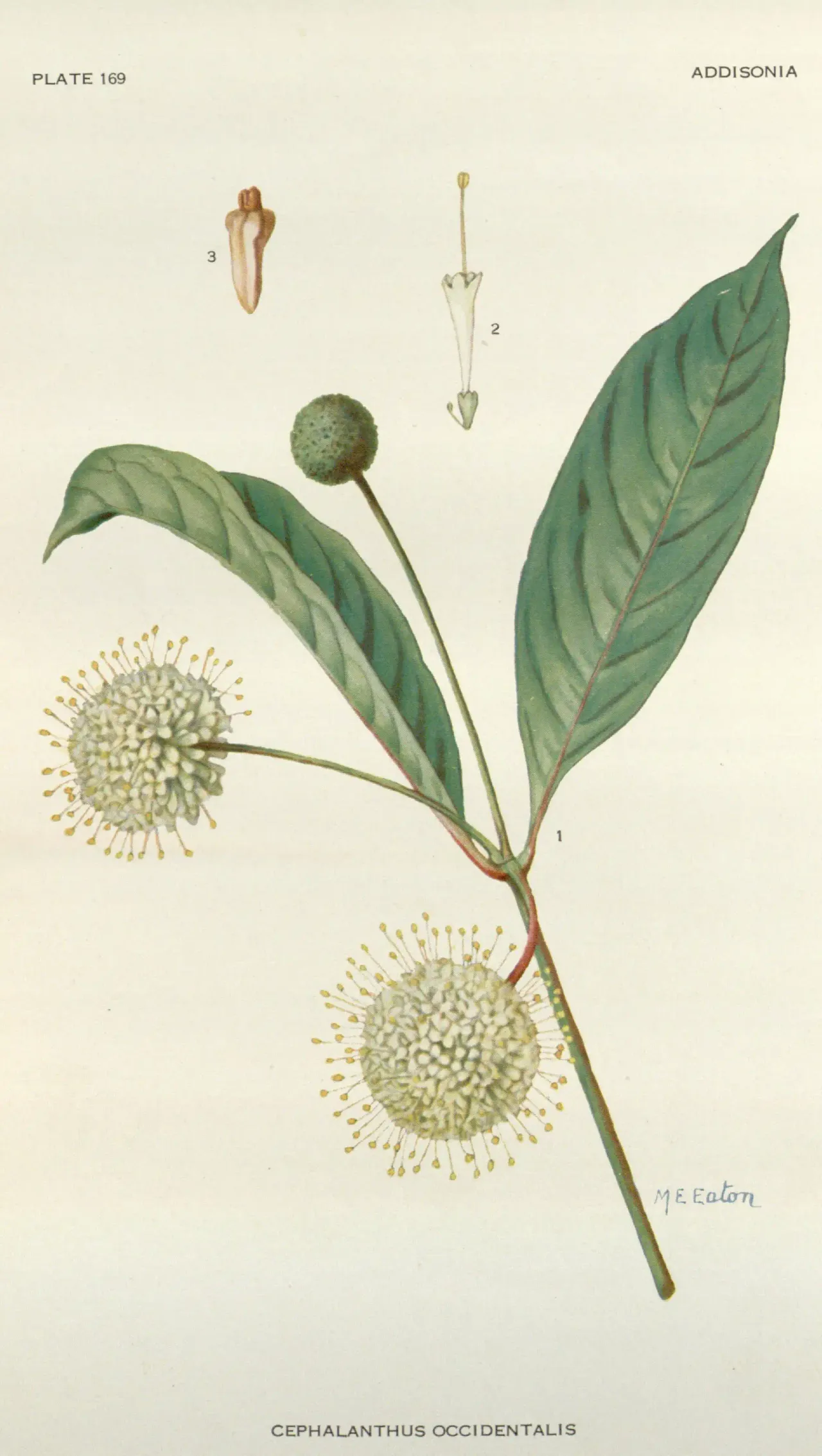 1 of 2
Native to much of the USA and southern Canada
New Brunswick and Quebec to upper Mississippi River Valley, eastern Nebraska and eastern Kansas, south to Florida and Texas
- Light Part shade to shade Sun tolerance
- Moisture Moist to wet Moisture preference
- Zones 4–10 Cold to heat range
- Bloom Jun–Aug Flowering time
- Height up to 12 ft to 3.7 m
- Life cycle Perennial Annual to perennial
In the garden
A wetland shrub for part to full shade and consistently moist to wet soil. Its white and pink flowers peak in July. At up to 12 ft, it needs room in rain gardens, pond edges, and damp low spots. Hardy in USDA zones 4–10.
Growing conditions
Light
Full sun Partial shade Full shade
Moisture
Dry Moist Wet
Hardiness zones
Find your zone:
When it blooms
The Buttonbush's white and pink flowers bloom June to August, peaking in July. This midsummer display draws butterflies and bees.
Buttonbush blooms white & pinkFoliage
Pollinators & wildlife
- Butterflies Monarch
also Eastern Tiger Swallowtail, Gulf Fritillary, Red Admiral +97 more
Black Swallowtail, Pearl Crescent, Common Buckeye, Fiery Skipper, Silver-spotted Skipper, Painted Lady, Pipevine Swallowtail, Gray Hairstreak, American Lady, Orange Sulphur, Great Spangled Fritillary, Variegated Fritillary, Queen, Spicebush Swallowtail, Hackberry Emperor, Viceroy, Zabulon Skipper, Clouded Sulphur, Cloudless Sulphur, Eastern Black Swallowtail, Eastern Comma, Checkered White, Western Tiger Swallowtail, Horace's Duskywing, Common Wood-Nymph, Clouded Skipper, Dun Skipper, Canadian Tiger Swallowtail, Least Skipper, Wild Indigo Duskywing, Northern Cloudywing, Funereal Duskywing, California Pipevine Swallowtail, Tawny-edged Skipper, American Red Admiral, Palamedes Swallowtail, Banded Hairstreak, Milbert's Tortoiseshell, Southern Dogface, Great Southern White, Little Glassywing, Great Purple Hairstreak, Whirlabout, Atlantis Fritillary, Broad-winged Skipper, Southern Skipperling, Bronze Copper, Orange Skipperling, Midsummer Tiger Swallowtail, Striated Queen, Dion Skipper, Mulberry Wing, Florida Viceroy, Nysa Roadside-Skipper, Berry's Skipper, Scylla Firetip, Bell's Roadside-Skipper, Rare Skipper, Asbolis capucinus, Wallengrenia otho, Palmetto Skipper, Limenitis archippus archippus, Papilio troilus troilus, Epargyreus clarus clarus, Regal Fritillary, Euphyes pilatka, Battus philenor philenor, Zebra Longwing, Lacey's Scrub-Hairstreak, Atrytone delaware, Panoquina ocola, Papilio cresphontes, Papilio rumiko, Abaeis nicippe, Cyaniris neglecta, Danaus plexippus plexippus, Wallengrenia egeremet, Siproeta stelenes, Ruddy Daggerwing, White Peacock, Large Orange Sulphur, Protographium marcellus, Mitoura gryneus, Limenitis astyanax, Clossiana toddi ammiralis, Brazilian Skipper, Silvery Checkerspot, Cynthia cardui, Elkalyce comyntas, Polites coras, Thorybes daunus, Speyeria cybele, Euphydryas phaeton, Elymnias mimalon, Anosia plexippus, Byssus Skipper, Panoquina panoquin - Bees Common Eastern Bumble Bee
also Western Honey Bee, Eastern Carpenter Bee, Brown-belted Bumble Bee +72 more
Two-spotted Bumble Bee, American Bumble Bee, Yellow-faced Bumble Bee, Ligated Furrow Bee, Tricolored Bumble Bee, Black-tailed Bumble Bee, Bicolored Striped Sweat Bee, Pure Green Sweat bee, Bombus fervidus, Two-spotted Longhorn Bee, Perplexing Bumble Bee, Black-and-gold Bumble Bee, Half-black Bumble Bee, Orange-legged Furrow Bee, Southern Carpenter Bee, Agapostemon texanus, California Bumble Bee, Lemon Cuckoo Bumble Bee, Brown-winged Striped Sweat Bee, Yellow-banded Bumble Bee, Carpenter-mimic Leafcutter Bee, Flat-tailed Leafcutter Bee, Sculptured Resin Bee, Rusty-patched Bumble Bee, Confusing Furrow Bee, Spurred Ceratina, Oblique Longhorn Bee, Southern Plains Bumble Bee, Crotch's Bumble Bee, Orange-tipped Wood-digger, Dark-winged Sweat Bee, Rufous-backed Cellophane Bee, Texas Leafcutter Bee, Common Longhorn Bee, Silky Striped Sweat Bee, Bumblebee-like Digger Bee, Louisiana Painted-Dark bee, Bristle Sweat Bee, Megachile inimica, Petulant Leafcutter Bee, Texas Nomad Bee, Worthy Longhorn, Sumac Cellophane-Cuckoo, Megachile brevis, Ceratina dupla, Hylaeus affinis, Hairy masked Bee, Experienced Sweat Bee, Very Smooth Sweat Bee, Graenicher's Masked Bee, Weems's Sweat Bee, Goatsbeard Miner Bee, Variable Cuckoo Bumble Bee, Obscure Sweat Bee, Box-headed Furrow Bee, Early Mining Bee, Xenoglossa strenua, Coelioxys alternata, Eastern Cuckoo Sweat Bee, Pickerelweed Longhorn Bee, Ornate Masked Bee, Ptilothrix bombiformis, California Digger-cuckoo Bee, Peponapis pruinosa, Giant Sweat Bee, Xylocopa virginica virginica, Megachile pyrrhothorax, Lunate Longhorn-cuckoo Bee, Melissodes tepaneca, Svastra obliqua, Agapostemon viridulus, Triepeolus concavus - Flower flies Eastern Calligrapher
also Common Drone Fly, Transverse-banded Flower Fly, Oblique Streaktail +24 more
Long-tailed Aphideater, Thick-legged Hover Fly, Black-shouldered Drone Fly, Virginia Giant Hover Fly, Yellow-shouldered Drone Fly, Dusky-winged Hover Fly, Oblique-banded Pond Fly, Orange-legged Drone Fly, Carolinian Elegant, Bare-eyed Bee-mimic Fly, Wavy Mucksucker, Bald-faced Hornet Fly, Volucella bombylans, Eastern Flower Fly, Shiny Bog Fly, Blue-polished Drone Fly, Yellow-legged Bog Fly, Sphaerophoria cylindricus, Poplar Pithead, Broad-banded Hornet Fly, Ocyptamus costatus, Iridescent Bromeliad Fly, Volucella vesiculosa, Single-banded Plushback - Also visited by
- Moths:
Banded Tussock Moth, Snowberry Clearwing +25 more
Virginia Ctenucha Moth, Yellow-collared Scape Moth, Hummingbird Clearwing, Grape Leaffolder and Leafroller Moths, Curved-toothed Geometer Moth, Eight-spotted Forester Moth, Ipsilon Dart Moth, Garden Webworm Moth, Green Cutworm Moth, Smeared Dagger, Black-and-yellow Lichen Moth, Dogwood Borer Moth, Lilac Borer Moth, Ornate Bella Moth, Zebra Conchylodes Moth, Black-winged Dahana Moth, Haploa confusa, Pyrausta acrionalis, Scarlet-bodied Wasp Moth, Bicolored Pyrausta Moth and Allies, Peridroma saucia, Spotted Oleander Moth, Mythimna unipuncta, Utetheisa bella, Cecropia Moth - Beetles:
Goldenrod Soldier Beetle, Common Green June Beetle +14 more
Margined Leatherwing Beetle, Spotted Pink Lady Beetle, Oriental Beetle, Banded Longhorn Beetle, Common Red Soldier Beetle, Larger Elm Leaf Beetle, Strangalepta Flower Longhorn Beetle, Yellow-horned Flower Longhorn Beetle, Chestnut Longhorn Beetle, Eight-spotted Tumbling Flower Beetle, Pubescent Tumbling Flower Beetle, Typocerus badius, Tumbling Ragdoll, Euderces picipes - Wasps:
Fraternal Potter Wasp, Common Aerial Yellowjacket +2 more
Euodynerus foraminatus, Blackjacket - Hummingbirds: Ruby-throated Hummingbird, Black-chinned Hummingbird
- Moths:
Butterflies that use this plant
Documented host and nectar records. Each links to a planting guide for that butterfly.
- American ladynectar
- Banded hairstreaknectar
- Black swallowtailnectar
- Canadian tiger swallowtailnectar
- Checkered whitenectar
- Clouded sulphurnectar
- Cloudless sulphurnectar
- Common buckeyenectar
- Common wood-nymphnectar
- Eastern commanectar
- Eastern tiger swallowtailnectar
- Fiery skippernectar
- Giant swallowtailnectar
- Gray hairstreaknectar
- Great spangled fritillarynectar
- Gulf fritillarynectar
- Juniper hairstreaknectar
- Milbert's tortoiseshellnectar
- Monarch butterflynectar
- Orange sulphurnectar
- Painted ladynectar
- Palamedes swallowtailnectar
- Pearl crescentnectar
- Pipevine swallowtailnectar
- Queennectar
- Red admiralnectar
- Silver-bordered fritillarynectar
- Silver-spotted skippernectar
- Silvery checkerspotnectar
- Sleepy orangenectar
- Spicebush swallowtailnectar
- Summer azurenectar
- Variegated fritillarynectar
- Viceroynectar
- Western tiger swallowtailnectar
- Zebra swallowtailnectar
Full plant details
Where it grows
- Habitat
- WetlandThe wild plant community it grows in.
- Native range
- Much of the USA and southern CanadaUnited States (36): AL, AR, CT, DC, DE, FL, GA, IA, IL, IN, KS, KY, LA, MA, MD, ME, MI, MN, MO, MS, NC, NE, NH, NJ, NY, OH, OK, PA, RI, SC, TN, TX, VA, VT, WI, WV. Canada (5): NB, NS, ON, PE, QC. Where it grows wild on its own, by state and province.
- Native distribution
- New Brunswick and Quebec to upper Mississippi River Valley, eastern Nebraska and eastern Kansas, south to Florida and TexasThe same native range, usually more exact than the state list, and often noting where it has spread beyond it.
Growing conditions
- Light
- Part shade to shadeHow much sun it takes, from full sun to full shade.
- Moisture
- Moist to wetThe soil dampness it prefers, from dry to wet.
- Hardiness zones
- USDA 4–10 · Canadian 4–8The cold-to-heat climate range it survives.
- Soil
- Limestone-based, Sandy, Sandy Loam, Medium Loam, Clay Loam, ClayThe soils it grows in naturally.
- Soil texture
- Light to heavy (sandy to clay)The soil grade it prefers, from sand to clay.
- Soil pH
- 4.7–8.6The acidity to alkalinity it tolerates (7 is neutral).
- Soil quality
- LowHow rich a soil it needs. Many natives prefer lean soil and flop in rich beds.
- Water use
- HighHow thirsty it is, a rough guide to how often to water.
- Salinity tolerance
- LowHow well it copes with salty soil, near roads or the coast.
- Lime (CaCO₃) tolerance
- MediumHow well it copes with chalky, lime-rich soil.
Growth & form
- Height
- up to 12 ft (to 3.7 m)Typical mature height.
- Life cycle
- PerennialWhether it lives a single season (annual), two (biennial), or returns for years (perennial).
- Growth rate
- ModerateA relative ranking versus other plants of the same type (USDA), not an absolute rate.
- Shape
- ErectIts overall silhouette.
- Root depth
- 14+ in (36+ cm)How far the roots reach, a guide to drought resilience and transplanting.
Flowers, foliage & fruit
- Type
- ShrubWhat kind of plant it is.
- Bloom
- Jun–AugWhen it flowers.
- Flower color
- White, PinkThe bloom color, or colors.
- Fruit/Seeds
- ripens Jul–NovThe seed or fruit it sets after flowering.
- Toxicity
- Poisonous if eatenWhether any part is poisonous to people or pets.
Propagation & seed
- Cold stratification
- Not requiredWhether seed needs a cold, moist spell before it will germinate.
- Propagation
- Bare root, container, cuttings, seedHow to start new plants.
- Seed
- ~0.1 million seeds per poundNotes on the seed and how to sow it.
- Seed spread rate
- ModerateHow readily it self-sows. Slow or none means well-behaved, not a spreader.
- Seedling vigor
- HighHow strongly young seedlings establish.
- Vegetative spread
- NoneWhether it creeps outward or stays put in a clump.